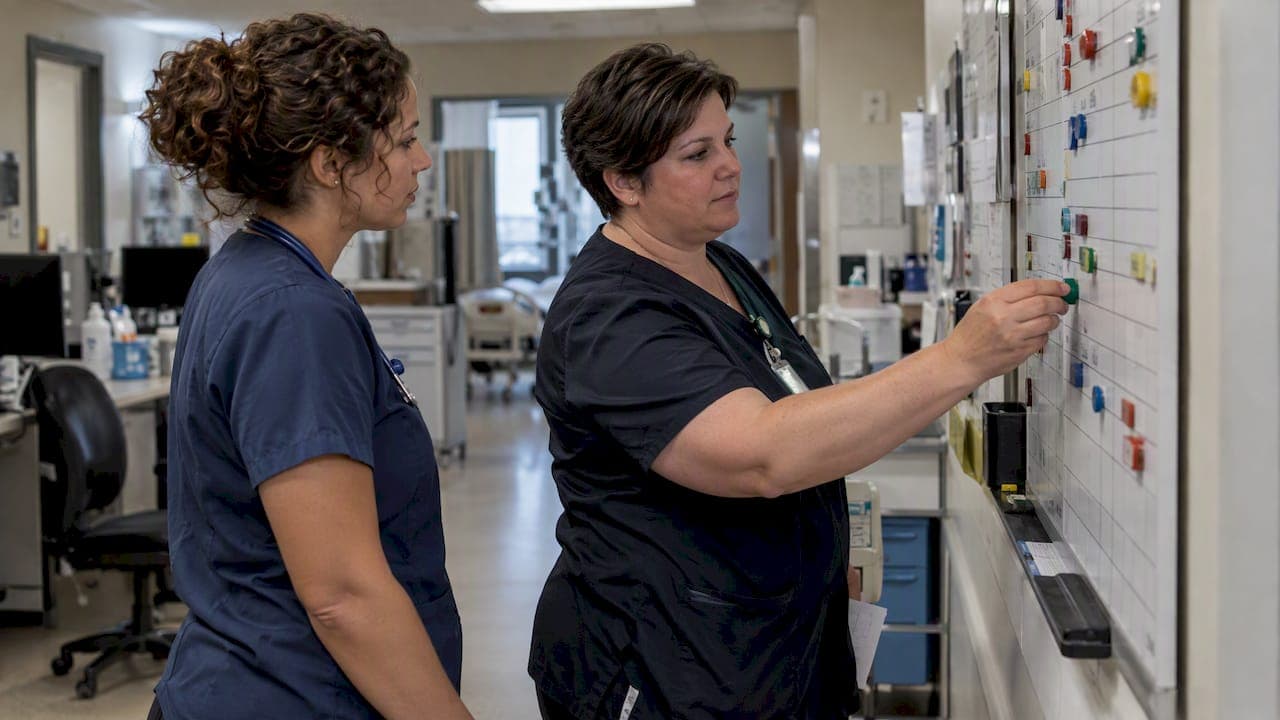
Stand up a centralized, metric-driven float pool with clear governance and competency documentation, then run a baseline staffing gap and cost-per-shift check this week. That single move tells you where internal coverage can replace agency spend and where it cannot. Safety comes first: competency checks and a structured orientation plan are not optional extras, they are the foundation the rest of the program sits on.
TL;DR:
- Analyze 90 days of unit staffing data and compare internal and agency costs per filled hour before deciding which units belong in the pool.
- Centralize scheduling across facilities for broader coverage; teams serving one site launch faster, while hybrid requisitions route shifts to pool staff, PRN nurses, then agencies.
- Verify competencies at hire and annually, confirm CPR status, and document orientation for each unit; never assign nurses beyond validated skills to fill a shift.
- Review fill rate, time to fill, cost per filled hour, and turnover weekly; predictive scheduling teams reported staffing variability below 5%, down from over 30%.
Table of Contents
- Why float pools matter now: benefits and patient-safety caveats
- Float pool models and governance: pick the right model for scale
- Five-step implementation checklist to build or improve a dependable float pool
- Operational playbook: scheduling, credentialing, orientation, and real-time shift flow
- Measuring success: KPIs and dashboards that prove the program is working
- Publisher perspective: how we support float pool operations with technology
- Strategies for recruitment and retention specific to float pool staff
- Legal and labor compliance considerations in float pool management
- Communication protocols between float pool staff and department managers
- Cost analysis and budgeting for establishing and maintaining a float pool
- How to pilot NurseFlex for your float pool needs
- Leader takeaways from mature centralized float teams
- FAQ
- Sources
Why float pools matter now: benefits and patient-safety caveats
A well-run float pool absorbs surge demand without the lead time or markup of outside agencies, and it keeps clinical knowledge inside your own walls. Persistent labor demand makes this more than a cost exercise: healthcare and social assistance postings reached 2.1 million job openings in a single month, a gap that internal flexibility helps close faster than recruiting alone.
Floating carries real tradeoffs. Equipment unfamiliarity and the extra orientation work placed on unit staff both raise patient-safety risks when a float nurse arrives without specialty preparation.
- Use float pools for predictable, recurring gaps across med-surg and similar general units.
- Reserve agencies for rare specialty needs, sudden volume spikes, or coverage beyond your pool's certified skill set.
- Give unit charge nurses a short, standardized way to flag a float nurse who needs extra support that shift.
Float pool models and governance: pick the right model for scale
The model you choose depends on how many units you need to cover and how specialized that coverage has to be. An internal float pool built from cross-trained staff launches quickly and works well for a single facility, though specialty depth stays limited to whatever skills your current staff already hold.
A centralized system-level float team scales better once you are coordinating across multiple facilities. It brings standardized scheduling and more predictable fill rates, and system-level operations have reported sustained improvements when scheduling and analytics are unified under one team.
- Internal pool: fast to start, best for single-site coverage, narrower specialty range.
- Centralized system float team: higher setup cost, broader reach, more consistent fill rates across sites.
- Hybrid model: one requisition feeds the internal pool first, then PRN staff, then agencies, closing the visibility gaps that otherwise drive unplanned agency orders.
Choosing between building an internal pool and leaning on outside temporary staffing solutions usually comes down to how often gaps repeat versus how rarely they happen.
Five-step implementation checklist to build or improve a dependable float pool
A float pool succeeds or fails on the sequence you follow to build it. Skipping the math or the credentialing step early tends to surface as chaos later.
- Do the math. Pull unit-level staffing data for the past 90 days, calculate cost per shift for internal coverage versus agency rates, and identify which units have the most recurring gaps.
- Define scope and governance. Decide who owns the pool, which units it serves, and how scheduling tiers work, so there is no ambiguity about who approves a float assignment.
- Build competency and credentialing standards. Model your documentation on Joint Commission competency guidance, which expects skills checklists and assessments at hire and annually thereafter.
- Create an orientation curriculum. Set explicit time budgets per unit (EHR access, equipment walkthroughs, emergency protocols) so a float nurse is ready, not improvising, on day one.
- Set launch rules and checkpoints. Review fill rates and feedback at 30, 90, and 180 days, adjusting scheduling tiers or training as the data shows.
Pro Tip: Run your cost-per-shift comparison before you finalize scope, since the numbers often reveal which units justify a float pool and which are better served by occasional agency support.
Reviewing survey-readiness and staffing standards guidance during step three keeps your documentation audit-ready instead of reactive.
Operational playbook: scheduling, credentialing, orientation, and real-time shift flow
Day-to-day execution depends on removing ambiguity from every open shift. A single-requisition workflow puts each shift in front of internal float staff, PRN staff, and agencies at the same time, so nothing sits unfilled while one channel is checked before another.
Credentialing should follow one standard regardless of whether the clinician is employed or contracted, tracked centrally with alerts before a certification lapses. Orientation should be a checklist, not a conversation:
- EHR access confirmed before the first shift, not during it.
- Equipment locations and unit-specific workflows walked through in person.
- Emergency protocols reviewed, including who to call and where supplies are kept.
- Unit contact assigned for the float nurse's first two shifts.
Standardized system-level float teams have reported sustained high fill rates, reflecting the benefits of consistent scheduling and credentialing processes compared to ad hoc arrangements.
Tiered fill windows, float pool first, then PRN, then agencies, keep the decision rule documented instead of left to whoever is on shift that day. That one change tends to eliminate the "emergency agency call" that governance was supposed to prevent.
Measuring success: KPIs and dashboards that prove the program is working
A float pool without metrics is just a scheduling experiment. Track the numbers that show whether internal coverage is actually replacing agency spend and whether your float staff are staying.
- Internal fill rate: the share of open shifts covered by your own pool before PRN or agency staff step in.
- Time-to-fill: how long a shift stays open from posting to confirmed coverage.
- Fully loaded cost per filled hour: wages, differentials, and overhead combined, compared against agency rates.
- Weekly staffing variability: how much the gap between demand and coverage swings week to week.
- Float staff turnover: whether your pool retains the people you trained.
Centralized teams that pair standardized scheduling with predictive staffing analytics have reported variability dropping from over 30% to under 5%, alongside lower reliance on contract labor. Review the operational dashboard weekly with the float pool manager, and bring the same metrics to a monthly leadership review so trends get caught before they become budget problems.
Publisher perspective: how we support float pool operations with technology
We built our platform around the same visibility problem float pools struggle with. Real-time matching and a streamlined application process on NurseFlex Jobs cut the time between an open shift and a confirmed clinician, and a single view of credentials and availability removes the blind spots that usually push managers toward an unplanned agency order.
Strategies for recruitment and retention specific to float pool staff
Float pool nurses face a different set of pressures than unit-based staff: a new environment every shift, less built-in camaraderie, and the expectation that they adapt fast. Recruiting for the role means being upfront about that reality rather than selling it as a generic staffing job.
Pay differentials matter, but so does predictability. Nurses who join a float pool often want more control over scheduling, not less, so offering self-scheduling within defined tiers tends to attract stronger applicants than rigid shift assignment.
Retention depends heavily on how well orientation and unit support actually work. A float nurse who is handed a badge and sent to a unit with no orientation checklist will not stay long, no matter the pay rate. Pairing new float staff with a consistent unit contact for their first several shifts, rather than a different person each time, builds the kind of familiarity that keeps people in the role.
Recognition matters too. Float staff rarely get the team cohesion that unit-based nurses build over months, so deliberate inclusion in staff meetings, recognition programs, and feedback loops closes that gap. Continuity-focused staffing models that avoid constant rotation, an approach some home care retention strategies also lean on, tend to produce steadier tenure than a purely transactional pool.
Cross-training investment doubles as a retention tool: nurses who gain new skills through the pool often see it as career development rather than just extra shifts, which keeps turnover lower than a model that treats floating as a stopgap assignment.

Legal and labor compliance considerations in float pool management
Float pool staffing touches several compliance areas that deserve attention before launch, not after an incident. Competency documentation should mirror Joint Commission expectations: skills checklists, competency assessments, and current CPR status verified at hire and reassessed annually, with the same standard applied whether the clinician is employed directly or brought in through a staffing arrangement.
Labor classification matters as well. Float pool nurses who are employees have different wage, overtime, and benefits obligations than contracted or agency staff, and blending the two without clear documentation creates exposure. Scheduling policies should specify differentials, minimum shift guarantees if any apply, and how float assignments interact with union agreements where they exist.
Scope-of-practice boundaries need the same rigor as competency tracking. A float nurse assigned outside their validated skill set is a compliance problem as much as a safety one, which is why governance should tie unit eligibility directly to documented competencies rather than general nursing licensure alone.
Keep records centralized and auditable. Surveyors expect to see proof of competency assessment, orientation completion, and ongoing training for anyone who floats, and scattered documentation across departments is one of the more common findings in a staffing review.

Communication protocols between float pool staff and department managers
Clear communication is what turns a float assignment from a disruption into a routine. Before the shift starts, the float nurse should receive the unit's census, acuity level, and any patients needing special attention, ideally through the same system used for permanent staff handoffs.
On arrival, a brief check-in with the charge nurse should cover where supplies and equipment are kept, who to call for rapid response, and any unit-specific workflow quirks that are not in the general orientation packet. This does not need to be long, five minutes before the shift starts prevents most of the confusion that happens an hour in.
During the shift, float nurses should know exactly who their point of contact is for clinical questions, separate from the general chain of command, so they are not left guessing when something unfamiliar comes up. After the shift, a short feedback loop, even a two-question form, lets both the float nurse and the unit manager flag what worked and what did not, which is how orientation checklists improve over time instead of staying static.
Consistency across units matters here too. A float nurse who gets a thorough handoff on one unit and almost none on another will treat the inconsistency as a sign the program is not fully supported, which shows up later in retention numbers.
Cost analysis and budgeting for establishing and maintaining a float pool
Building a float pool has upfront costs that are easy to underestimate: recruiting or reassigning staff, building orientation materials, setting up credentialing tracking, and the time managers spend coordinating the launch. None of that is wasted if the pool reduces agency reliance, but it does mean the first few months should be budgeted as an investment period rather than judged purely on immediate savings.
Ongoing costs break into a few categories: base pay and float differentials, training and competency recertification, any technology used for scheduling and credential tracking, and the administrative time spent managing the pool day to day. Comparing fully loaded cost per filled hour against agency rates for the same shifts is the clearest way to show whether the pool is paying for itself, and that comparison should happen at the unit level, not just as a single hospital-wide number.
Budgeting also means planning for turnover. Replacing a float nurse costs less than replacing a specialty unit nurse, but it still carries recruiting and training expense, so a retention-focused budget line tends to pay for itself over a year or two. Leaders who track this against agency spend side by side usually find the float pool's advantage grows the longer the program runs, since training costs are front-loaded while agency markups repeat every time they are used.
How to pilot NurseFlex for your float pool needs
We make it simple to test whether faster matching actually closes your coverage gaps before committing to a full rollout. Post a requisition through our employer page and run a small pilot alongside your existing float pool to compare fill speed and credential visibility side by side.

- Real-time matching surfaces available clinicians the moment a shift opens.
- A streamlined application process cuts onboarding friction for both float staff and specialty hires.
- Specialty categories, including case management, utilization review, and insurance nursing roles, are available when your pool needs coverage beyond general float capacity.
Ready to see it in action? Post your first requisition and compare the results against your current fill times.
Leader takeaways from mature centralized float teams
Expect 12 to 24 months before scheduling, cross-training, and credentialing fully standardize across a centralized float team. The common failure points are predictable: siloed credentialing between departments, ad-hoc agency orders that bypass the requisition tiers, and governance nobody can clearly explain. Fix all three with one habit: standardize the process, measure it weekly, and never compromise on competency documentation to fill a shift faster.
— Flexible
This article is general information, not a substitute for advice from a qualified doctor. Consult a qualified healthcare professional about your own circumstances before acting on anything here.
FAQ
What is a float pool nurse?
A float pool nurse is a staff member who works across multiple units or departments within a facility or health system rather than being assigned to one unit permanently. They are trained and credentialed to cover staffing gaps where demand is highest on a given shift.
Can you be a new grad float pool nurse?
Most float pool roles expect at least a year of clinical experience before a nurse floats independently, since the role requires adapting quickly across different units without the extended orientation a single unit provides. Some systems offer structured float pool residencies for new graduates, but these include extra mentorship and a longer ramp-up period than standard float assignments.
Is pool the same as PRN?
Pool and PRN staff are usually different categories: PRN (per diem) nurses work on an as-needed basis with no guaranteed hours, while float pool staff are often core employees assigned specifically to cover multiple units as part of their regular role. Some organizations use the terms more loosely, so it is worth confirming how your specific health system defines each category.
What does "pulled" or "float" nurse mean?
Being "pulled" or "floated" means a nurse scheduled for one unit is reassigned, often mid-shift or at the start of a shift, to cover a staffing gap on a different unit. This differs from a dedicated float pool role, where covering multiple units is the nurse's standing assignment rather than an occasional reassignment.
Sources
- Floating to intensive care units: nurses' messages for instant action to promote patient safety | PSNet
- Competency (v2023A) — Joint Commission
- 2.1 million job openings in health care and social assistance in September 2022 | BLS