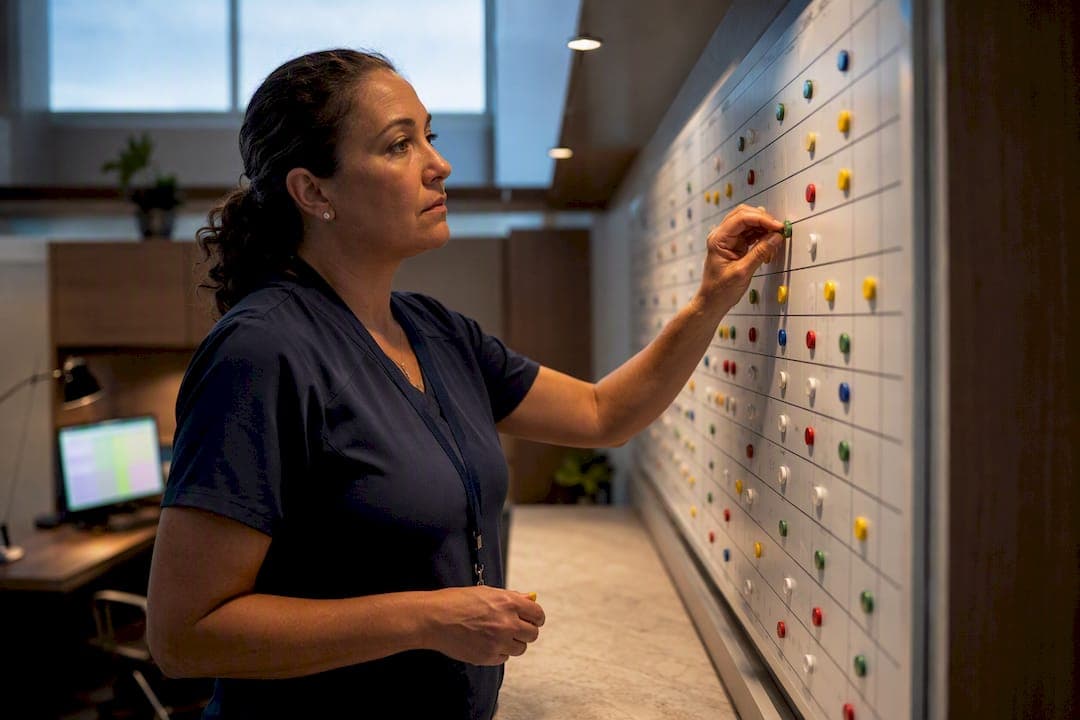
The fastest way to improve shift fill rate is to combine three levers at once: post shifts with enough lead time, contact your favorite PRN clinicians directly before broadcasting wide, and escalate pay the moment urgency demands it. None of this requires a strategic overhaul. It's an operational fix you can start applying to tomorrow's schedule.
TL;DR:
- Posting shifts 24 to 72 hours early, especially with recurring templates, significantly improves the chances of filling last-minute and weekend shifts.
- Building a trusted favorites or PRN pool and inviting them directly reduces reliance on broad broadcasts, increasing fill consistency and speed.
- Automating pay escalations for urgent shifts and setting clear triggers prevents delays and reduces the need for manual rate negotiations during staffing crunches.
- Speeding up candidate onboarding, credential verification, and payment approval encourages repeat hires and boosts rebooking rates.
- Regularly tracking metrics like overall fill rate, time-to-fill, escalation percentage, and favorite pickup rate helps identify and address staffing issues proactively.
Table of Contents
- Quick Wins to Improve Shift Fill Rate This Week
- What Is Shift Fill Rate and How Do You Calculate It?
- Why Posting Early Increases Your Shift Fill Rate
- How Do You Build a Reliable PRN and Favorites Pool?
- How Fast Should You Move on Broadcast and Outreach?
- When and How Should You Escalate Pay for Hard-to-Fill Shifts?
- What Reduces Friction for Returning Caregivers?
- Which Metrics Should You Check Every Week?
- How NurseFlex Jobs Supports These Fill Rate Tactics
- A Practical Rollout Order for These Tactics
- Ready to Put These Tactics on Autopilot?
- Sources
Quick Wins to Improve Shift Fill Rate This Week
Before digging into the mechanics behind each tactic, start with the moves that produce results in days, not months.
- Post shifts as early as your census allows, and use recurring templates so accuracy doesn't slip.
- Build a favorites/PRN pool and invite them directly before opening a shift to the general pool.
- Turn on push notifications and set auto-broadcast rules so unclaimed shifts escalate automatically.
- Escalate pay immediately for high-urgency slots, weekend coverage, or specialty roles.
- Cut onboarding time and speed up payment approval so returning caregivers keep coming back.
Each of these gets its own breakdown below, including the thresholds and SLAs that make them work.
What Is Shift Fill Rate and How Do You Calculate It?
Shift fill rate is the percentage of posted shifts that get successfully staffed within your required window. The formula is simple: divide filled shifts by total posted shifts, then multiply by 100. A facility that fills most of its posted shifts is running a high fill rate.
Edge cases matter more than the formula itself. A shift that gets canceled by the facility before anyone claims it shouldn't count against you the same way an unfilled shift does. An edited shift (time change, added credential requirement) resets the clock on fill probability, so track edits separately from cold postings.
Three related metrics round out the picture:
- Time-to-fill: how long a shift sits open before someone claims it.
- Percent escalated fills: how many shifts needed a pay bump to close.
- Favorite pickup rate: what share of fills come from your PRN pool versus the open market.
Pro Tip: *Track fill rate by shift type and day of the week, not just as a monthly average.
Industry benchmarks vary by setting, but the trend line matters more than any single number. A fill rate that's improving month over month, even from a low base, signals your operational changes are working.
Why Posting Early Increases Your Shift Fill Rate
Posting a shift 24 to 72 hours ahead of need gives more clinicians the chance to see it, plan around it, and claim it before someone else does. MyShyft's best-practices guidance points to earlier postings as one of the most reliable ways to widen the applicant pool and lift base fill rates, especially for weekend and holiday coverage that people need to plan around.
Three rules make lead time actually work:
- Set a standing lead time by shift type. Routine weekday shifts might need 48 hours; weekend and holiday shifts often need a full week.
- Use recurring templates for predictable coverage. A template posted once and repeated weekly saves your team from rebuilding the same shift from scratch, which is where posting errors creep in.
- Pull and correct inaccurate postings immediately. A shift with the wrong unit, wrong credential requirement, or wrong pay rate doesn't just fail to fill. It damages trust with clinicians who click through and find a mismatch.
Pro Tip: If a shift hasn't been claimed within half its posting window, that's your signal to escalate pay or broaden the invite list, not wait it out.
How Do You Build a Reliable PRN and Favorites Pool?
A dependable PRN pool is the single biggest lever for consistent fill rates, because it replaces cold outreach with warm relationships. ShiftKey's guidance on filling last-minute shifts confirms that direct invites to favorites close shifts faster than broadcasting to an open pool when time is short.
Building that pool takes deliberate steps:
- Flag clinicians who've completed multiple shifts at the same unit as "favorites" and route them direct invites first.
- Set a target onboarding service level of 48 to 72 hours from application to credential approval; delays here quietly bleed your pool.
- Keep credential files current with automated expiration reminders, so a favorite doesn't get blocked from claiming a shift over a lapsed certification.
- Recognize repeat pickups with small rebooking incentives, whether that's priority access to premium shifts or simple public recognition.
- Communicate on a regular cadence, not just when you need coverage. A pool that only hears from you during a staffing crunch stops responding to crunches.
Understanding how availability settings feed into matching helps you see why favorites who keep their availability current get first crack at the shifts they want.
How Fast Should You Move on Broadcast and Outreach?
Speed converts open shifts into filled ones. Platforms that support instant invites and one-tap claiming can see a majority of eligible shifts filled within minutes, and ShiftKey's data on last-minute fills backs the pattern: direct invites paired with broadcast fallback consistently outperform broadcast alone.
Set these rules and stick to them:
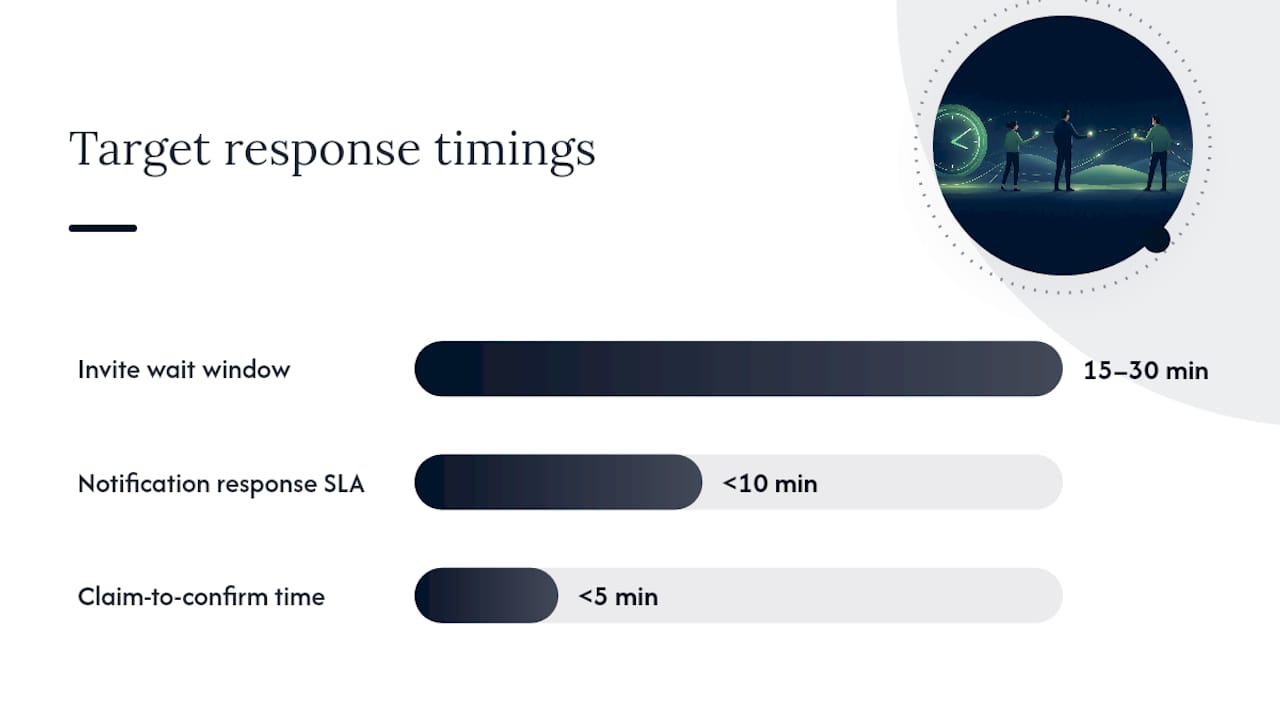
- Use direct invites to your top three to five favorites first; broadcast to the wider pool only after a defined wait window (15 to 30 minutes for urgent shifts).
- Aim for a notification-to-response SLA of under 10 minutes for anything marked high-urgency.
- Auto-escalate unclaimed shifts to a wider radius or a pay bump after a set time threshold instead of waiting for a manual check.
- Simplify the check-in step. Every extra tap between "claimed" and "confirmed" is a chance for a clinician to abandon the process.
Pro Tip: If your average claim-to-confirm time is longer than five minutes, the bottleneck is almost always your check-in flow, not clinician interest.
When and How Should You Escalate Pay for Hard-to-Fill Shifts?
Escalated pay isn't a fallback. It's a lever you apply on a rule, not a hunch. Decide your escalation triggers in advance so you're not negotiating rates in real time during a staffing scramble.
- Escalate automatically when a shift crosses a set percentage of its posting window unclaimed (for example, 50%).
- Weight escalation by specialty. A hard-to-source ICU or OR shift justifies a faster, larger bump than a general medical floor shift.
- Pin premium shifts at the top of the app feed so they get visibility disproportionate to a standard listing.
- Consider shift-splitting for partial coverage gaps. Shiftboard's research on flexible scheduling shows that advance signup lists and split shifts expand your available backfill pool when no one can cover a full shift.
Time of day matters too. Overnight and weekend shifts often need escalation triggers set lower than daytime shifts simply because the applicant pool is thinner.
What Reduces Friction for Returning Caregivers?
Administrative friction erodes rebooking faster than a slightly lower base rate ever will. Patchwork Health's findings on NHS bank staffing show that onboarding delays correlate directly with long-term inactivity among new bank staff.
- Set a 48 to 72 hour onboarding approval target and hold your team to it.
- Automate credential expiration reminders instead of relying on clinicians to track their own paperwork.
- Write clear check-in and orientation notes for every unit so a first-time clinician isn't guessing where to park or who to report to.
- Shorten payment approval windows; faster pay turnaround is one of the strongest predictors of a clinician picking up a second shift.
Speeding up the healthcare job application process pays off well beyond the first placement.
Which Metrics Should You Check Every Week?
A short weekly routine catches fill-rate problems before they become a pattern.
- Overall fill rate by unit and shift type, compared to the prior week.
- Time-to-fill, flagged if any shift type trends past your target SLA.
- Percent escalated fills, which tells you whether your base pay is falling behind market rate.
- Favorite pickup rate, since a drop here usually means your PRN pool is shrinking or disengaging.
How NurseFlex Jobs Supports These Fill Rate Tactics
NurseFlex Jobs was built around the same principles this guide lays out, because they're the ones that actually move fill rates.
- Real-time matching surfaces open shifts to qualified clinicians the moment they're posted, cutting the lag between listing and claim.
- A favorites-style matching engine routes shifts based on skills, availability, and prior placement history, so facilities reach dependable clinicians first.
- Streamlined onboarding gets registered clinicians credentialed and shift-ready fast, addressing the exact friction point Patchwork Health's data flags as a rebooking killer.
For more on how real-time job matching reduces time-to-fill, the mechanics work the same way whether you're filling a single shift or building a standing PRN bench.
A Practical Rollout Order for These Tactics
Don't try to implement all of this at once. Start with lead time. Extending your posting windows by even 24 hours produces measurable gains within two to three weeks without touching your budget or your tech stack.
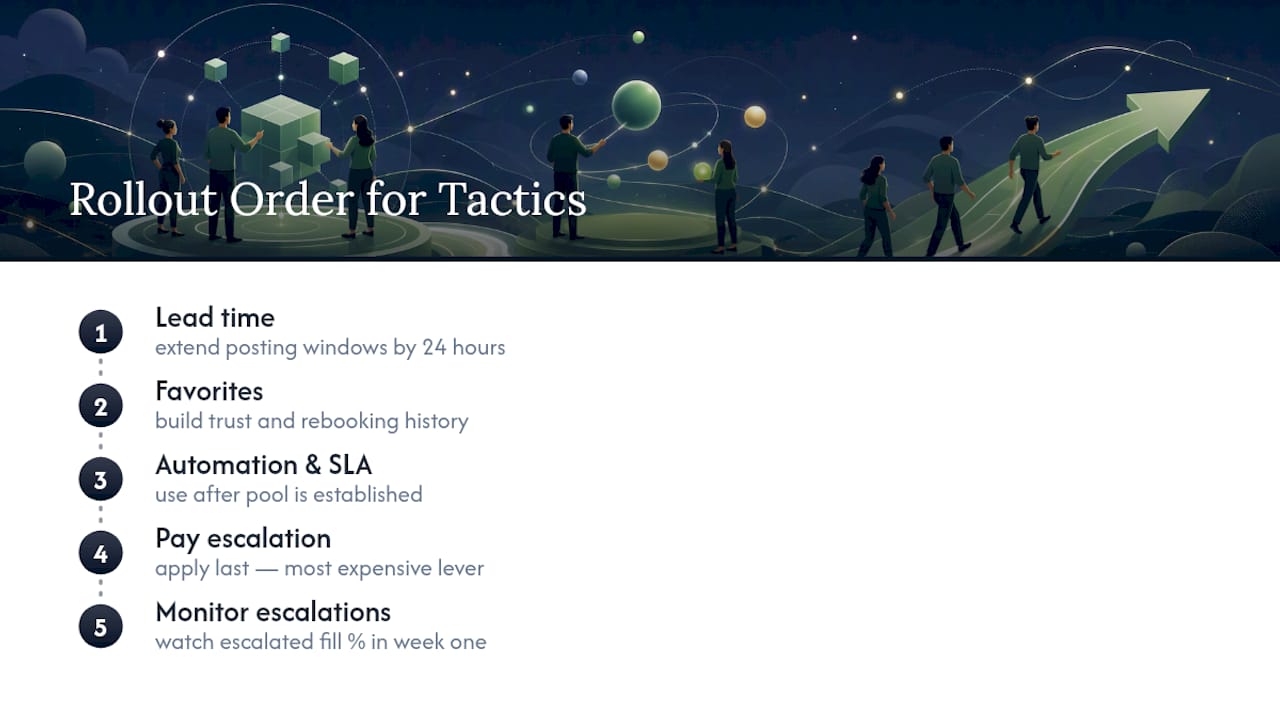
Layer in favorites next, since that pool takes time to build trust and rebooking history. Automation and SLA discipline come third, because they matter more once you have a pool worth notifying quickly. Save pay escalation for last. It's the most expensive lever, and it works best when the cheaper three are already doing their job.
Watch your escalated fill percentage in week one. If it's dropping without a pay increase, your other levers are working.
— Flexible
Ready to Put These Tactics on Autopilot?
Running this playbook manually across spreadsheets and phone calls eats hours every week that a coordinator doesn't have to spare. NurseFlex Jobs gives facilities a direct alternative to that manual grind: real-time matching that surfaces qualified, available clinicians the moment a shift posts, instead of waiting on callback trees and broadcast texts.

The platform's rapid onboarding also solves the friction problem this guide keeps circling back to, getting credentialed clinicians shift-ready fast enough that your favorites pool actually behaves like one. If you're a facility staffing manager looking to close the gap between posting and fill, visit the employer page to see how the matching engine works, or explore current nursing job listings to gauge clinician demand in your area before your next open shift goes live.