
Shift bidding lets nurses claim open shifts by submitting a bid, and in the growing number of facilities running reverse-auction models, that bid can shrink the extra-pay premium instead of protecting it. If your hospital just switched from a posted bonus system to a bidding platform, the practical move today is simple: calculate your personal pay floor before you touch the app, and get the caps, floors, and override rules in writing from HR.
Here's what that means in real terms:
- Definition: Shift bidding is a system where open shifts get posted and staff compete for them, sometimes through simple sign-up, sometimes through a live auction where the premium pay changes based on demand.
- The controversy: Reverse-auction versions can let the extra-shift premium decay as the shift date approaches, meaning the nurse willing to accept the least money gets the assignment.
- Your first move: Know your floor rate before you open the app, not while you're staring at a shrinking number in real time.
The rest of this guide walks through the models you're likely to encounter, the mechanics behind the auction-style systems, and the specific tactics that keep a bidding process from working against you.
Key Takeaways
Shift bidding shifts risk toward nurses when premiums decay without transparency, and the safest response is setting a documented pay floor before the auction begins.
| Point | Details |
|---|---|
| Know your model | Fixed-premium, reverse-auction, seniority-weighted, and posted-bonus bidding all pay out differently. |
| Set your floor first | Calculate base rate times 1.5 plus an inconvenience premium before opening the bidding app. |
| Managers keep override power | The lowest bid doesn't guarantee the shift; skill mix and acuity often decide the final award. |
| Get policy in writing | Request caps, floors, decay triggers, and override criteria from HR by email before bidding. |
| Consider matching over bidding | NurseFlex Jobs connects nurses to flexible shifts through real-time matching instead of competitive auctions. |
Table of Contents
- What Is Shift Bidding in Nursing? The Main Models Explained
- How Reverse Auctions and Premium Decay Actually Work
- Does Shift Bidding Actually Save Money, or Just Shift the Risk?
- How to Protect Your Pay When Bidding for Shifts
- What Fair Shift Bidding Design Looks Like for Managers
- Where NurseFlex Fits Into the Shift-Bidding Conversation
- Our Take: Fairness in Scheduling Shouldn't Be Optional
- A Predictable Alternative to Bidding for Your Next Shift
- Frequently Asked Questions
- Sources
What Is Shift Bidding in Nursing? The Main Models Explained
Nursing shift bidding covers several distinct systems, and the model your facility uses determines whether bidding works in your favor or against it. Confusing one model for another is the fastest way to misread your own paycheck.
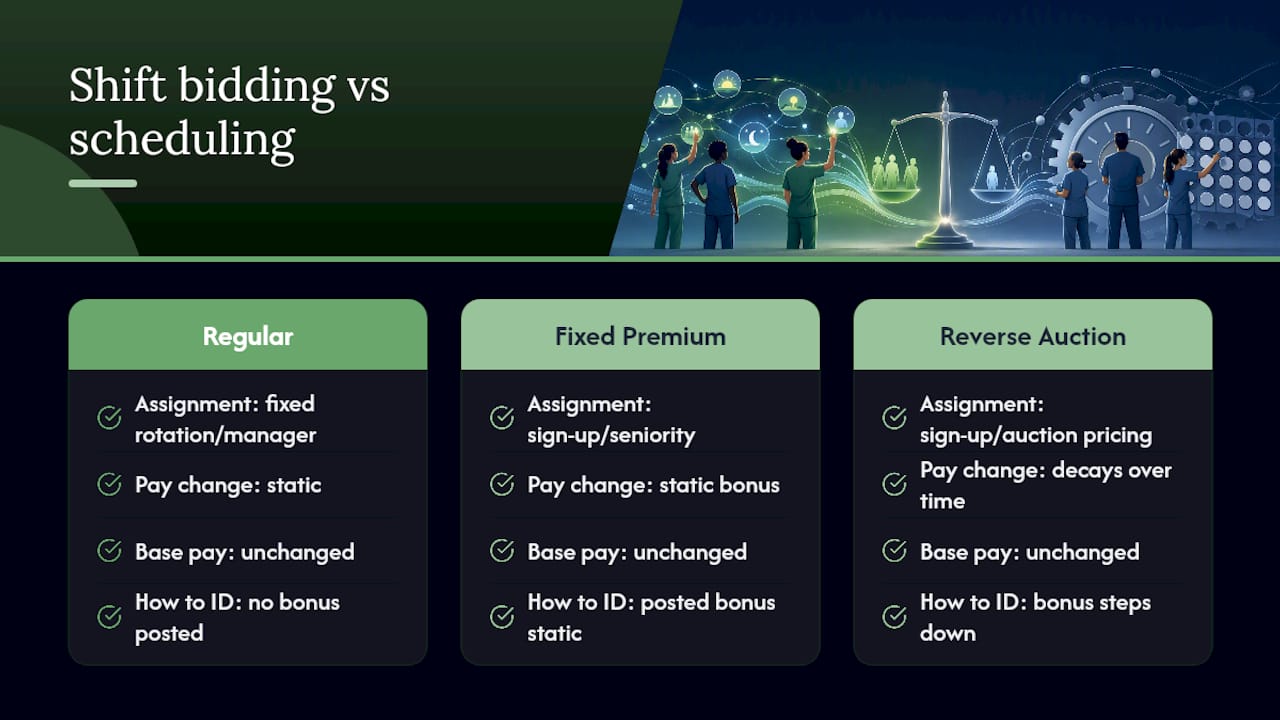
- Fixed-premium bidding. The facility posts a shift with a set bonus attached (say, an extra $15 an hour), and any qualified nurse who signs up first, or who has seniority priority, gets it. The pay never moves.
- Reverse-auction bidding. The shift posts with a starting premium, and interested nurses submit bids. As the shift date closes in, unfilled shifts often see the premium decrease rather than increase, since the facility is betting someone will eventually accept a lower rate rather than leave the shift open.
- Seniority-weighted bidding. Multiple nurses bid the same shift, but tenure or unit experience breaks the tie, regardless of who bid lowest.
- Posted-bonus bidding. Similar to fixed-premium, but the bonus scales with how urgently the facility needs coverage, and it's disclosed upfront rather than negotiated in real time.
In practice, most hospital systems run these through third-party scheduling software or an in-house portal with eligibility filters that screen for certifications, unit competency, and hours already worked that week. Some systems open bidding windows days in advance; others open and close within hours for last-minute call-outs.
The reverse-auction model is the one generating public attention. Recent news coverage of UNC Health's shift-change rollout documented staff pushback after a premium-decay style system replaced simpler posted-bonus scheduling, with the health system publicly stating base pay wouldn't be cut even as the auction dynamics drew criticism. That distinction between base pay and shift premiums matters enormously for anyone trying to understand what's actually changing in a paycheck.
How Reverse Auctions and Premium Decay Actually Work
A reverse auction runs on a simple logic: unfilled shifts are a cost the facility wants to minimize, so the system is built to find the lowest price at which someone will say yes. Understanding the mechanics turns a confusing app screen into something you can actually negotiate around.
Here's the typical sequence:
- The facility posts an open shift with a starting premium, often the highest amount it's willing to pay.
- If no one bids within a set window, the premium can step down at scheduled intervals, sometimes hourly, sometimes daily, depending on how close the shift date is.
- Nurses see the current premium and can accept it or wait to see if it drops further, though waiting risks another nurse grabbing it first.
- Once a bid comes in, the system may auto-award the shift, or it may route it to a manager for approval.
That last step is where the manager override lives. Facilities almost always retain the authority to override a low bid and assign the shift based on skill mix, unit familiarity, or patient acuity instead of purely the lowest number. Reporting on the UNC Health rollout confirms managers keep this discretion in practice, which means the lowest bidder doesn't automatically win. The override exists partly for safety and partly to prevent a race to the bottom, but it also means the "auction" isn't purely mechanical. A manager relationship can matter as much as your bid number.
Before you bid on a shift under this kind of system, request answers to these specific questions in writing:
- What is the premium cap (the highest it can go) and the floor (the lowest it can drop to)?
- What triggers a decay step, and how often does the premium adjust?
- What criteria does a manager use to override a bid, and who makes that call?
- Does declining a low-premium shift affect your performance review or your standing for future shifts?
- Can the facility change your core scheduled shifts based on bidding activity, or is bidding limited to voluntary extra shifts?
Pro Tip: Ask HR to send these answers by email rather than verbally. A written policy answer is something you can point back to later if the system doesn't behave the way you were told it would.
Does Shift Bidding Actually Save Money, or Just Shift the Risk?
Employers and nurses are looking at the same data and drawing very different conclusions, and both sides have real evidence behind them.
On the employer side, the numbers are genuinely compelling. A facility case study tracked in a University of New Hampshire thesis projected annual savings exceeding $3.2 million after implementing bidding technology to reduce agency staffing reliance, driven by fewer outside contract hours and lower staffing-hour costs overall. Separate reporting on web-based open-shift bidding programs found reduced overtime use, lower agency hours, and measurable fill-rate improvements within the first few months of deployment. Industry analysis published in ScienceDirect backs this up in principle, though it adds an important qualifier: the return on investment depends heavily on how the program is governed, not just whether bidding exists.
That qualifier is the crux of the nurse-side concern. Documented risks include:
- Underbidding pressure, where nurses compete against each other for shifts and premiums trend downward instead of up.
- Schedule unpredictability, since a shift you'd normally count on may now depend on winning a bid rather than being assigned.
- Morale and retention strain, particularly when staff feel the system rewards whoever needs money most urgently rather than whoever has seniority or specialized skill.
- Erosion of informal pay floors, since a single nurse willing to underbid can collapse a rate the rest of the unit had informally agreed to hold.
The design choices facilities make change these outcomes substantially. Programs that combine bidding technology with clear governance, transparent caps, published floors, and seniority protections tend to land closer to the employer's projected savings without the staff backlash. Programs that leave the premium floor open ended, with no transparency into how or why it decays, are the ones generating news coverage and internal grievances.
How to Protect Your Pay When Bidding for Shifts
The single most useful thing you can do is decide your number before the app is open in front of you. Waiting until a shift is live and the premium is ticking down is exactly when nurses accept less than they meant to.
- Calculate your floor in advance. A practical starting formula from practitioner guidance on shift-auction systems is your base hourly rate times 1.5, plus an inconvenience premium for the specific hassle of that shift (a weekend, a holiday, a unit you don't normally work). If your base rate is $42 an hour, your overtime-equivalent floor lands around $63, and a $10 inconvenience premium for a holiday overnight brings your real floor to roughly $73. Anything below that, you decline, no matter how the countdown looks.
- Get five things in writing before you bid: the premium cap and floor, what triggers a decay step, the override criteria a manager uses, whether declining low bids affects your evaluations, and whether bidding activity can alter your core scheduled shifts.
- Talk to your coworkers about the floor. A shared, informal price floor only holds if people actually stick to it. One nurse willing to underbid can undercut the whole unit's leverage, so treat the floor as a group agreement, not a personal secret.
- Document everything. Save screenshots of posted premiums, decay timing, and any verbal promises from a manager that don't match written policy.
- Know your escalation path. If a written policy is violated, or if you suspect coordinated wage suppression through the bidding tool, your options include a union representative if you're covered by a contract, labor counsel, or your state labor board.
Pro Tip: Decide your floor "in daylight," away from a live countdown, exactly as Innovative Nurse's playbook recommends. A number you set calmly on a Tuesday afternoon is far more reliable than one you set while watching a premium drop in real time on a Saturday night.
What Fair Shift Bidding Design Looks Like for Managers
Nurse managers and schedulers who want a bidding system to actually work, rather than trigger the kind of backlash UNC Health faced, need to build in safeguards before launch, not after complaints start.
The core design principles are transparency, written limits, and an audit trail. Every bidding program should publish its premium caps and floors, spell out exactly what triggers a manager override, and log every award decision so patterns can be reviewed later. Operational guidance on shift-bidding software recommends posting windows of one to four weeks in advance for routine coverage, with response deadlines of 48 to 72 hours, plus skill-mix screening built into the eligibility filters so unqualified bids never reach the award stage.
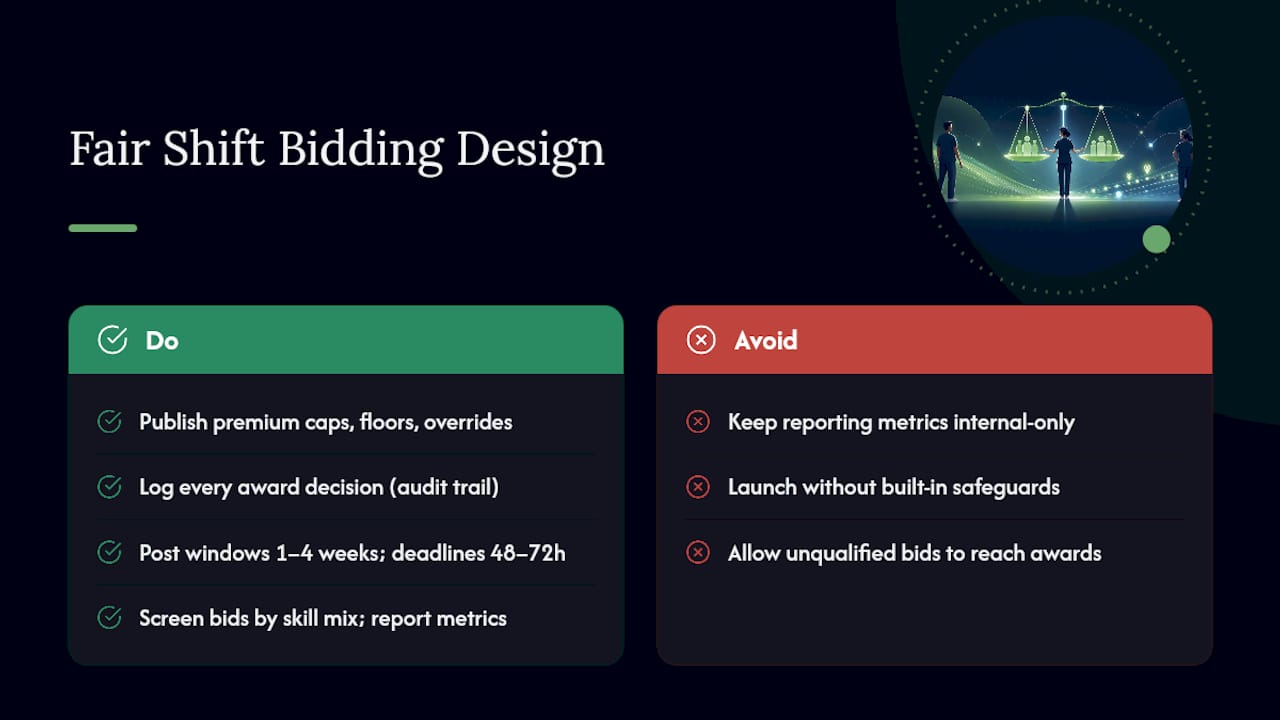
Governance doesn't stop at launch. Facilities getting real ROI from bidding technology track fill rates, agency-hour reductions, overtime trends, and staff satisfaction on a recurring basis, and they report those numbers back to staff rather than treating them as internal-only metrics. Without that reporting loop, a manager has no way to prove the system is cutting agency costs without quietly pushing down staff pay, and staff have no reason to trust that it isn't. If you're rebuilding a scheduling process from scratch, tactics for filling temporary vacancies quickly offer a useful comparison point for coverage gaps that don't require an auction model at all.
Where NurseFlex Fits Into the Shift-Bidding Conversation
Not every scheduling problem needs an auction to solve it. Flexiblenursingcareers built NurseFlex Jobs around real-time matching instead of competitive bidding, connecting nurses and other healthcare professionals with flexible opportunities based on their actual skills, availability, and preferences.
- The platform matches candidates to open roles directly, without the lengthy application cycles that traditional staffing processes require.
- Registered nurses can start working quickly once a match is confirmed, rather than waiting through multi-step hiring pipelines.
- Job selection spans settings and schedules, so nurses pursuing work-life balance or career growth aren't limited to whatever happens to be posted in a bidding window.
- NurseFlex reports meaningfully reduced hiring times and higher job satisfaction among users compared with conventional staffing routes, though independent verification of those specific figures isn't publicly available.
The difference between bidding for a shift and being matched to one is control. A matching system asks what you need and finds it. An auction asks what you'll accept and waits to see how low that number goes.
Matching and bidding solve the same staffing gap through opposite logic, one built around fit, the other around price competition.
Our Take: Fairness in Scheduling Shouldn't Be Optional
The financial stakes in shift bidding are real, and so is the frustration nurses feel watching a premium shrink in real time on a shift they were counting on. That's not an overreaction. It's a rational response to a system that, without transparency, can quietly redistribute risk from the employer's budget onto the nurse's paycheck.
Flexiblenursingcareers believes scheduling technology should work for the person filling the shift, not just the balance sheet behind it. That means transparent terms, predictable pay, and alternatives to auction-style pressure wherever they're available.
A Predictable Alternative to Bidding for Your Next Shift
If the auction model has you second-guessing every open shift, NurseFlex Jobs offers a different starting point: real-time matching based on your skills, availability, and pay expectations, with no countdown clock deciding what you're worth.

Instead of competing against other nurses for a shrinking premium, you set your preferences once and get matched to roles that fit them, whether that's a local hospital shift, a telehealth opportunity, or PRN work across a different setting entirely. The platform cuts the application timeline down substantially compared to traditional staffing processes, so you're not stuck refreshing a bidding app while premiums decay underneath you. If you're a nurse manager or scheduler tired of defending an auction system to your own staff, NurseFlex's employer page walks through how facilities fill gaps without reverse-auction pressure at all.
Ready to see what's open right now? Browse current nursing jobs and set your availability preferences directly, no bid required.
Frequently Asked Questions
Is shift bidding the same as regular shift scheduling? No. Traditional nursing shift scheduling assigns shifts through a fixed rotation or manager-built calendar, while bidding lets staff compete for open shifts through sign-up, seniority, or auction-style pricing.
Can a facility lower my base pay through shift bidding? Reverse-auction models affect extra-shift premiums, not contracted base pay. Employers involved in recent controversies, including UNC Health, have publicly stated base salaries remain unchanged even as bidding premiums fluctuate.
How do I know if my facility uses a reverse auction or a fixed-premium system? Check whether the posted pay for an open shift ever decreases the longer it stays unfilled. A static bonus that never changes is a fixed-premium model; a bonus that steps down over time signals a reverse auction.
What should I ask HR before I start bidding for shifts? Request the premium cap and floor, the decay trigger schedule, the criteria managers use for overrides, and whether declining low bids affects performance reviews, all in writing.
Does declining a low-bid shift hurt my standing at work? It depends entirely on facility policy, which is exactly why getting that answer in writing before you bid matters. Some facilities have no penalty; others informally track responsiveness, so clarity upfront protects you either way.
Sources
- Bidding Against Yourself: What Shift-Auction Systems Actually Do to Nurse Pay (and How to Play Them Without Losing) – Innovative Nurse
- Shift bidding technology: case study (UNH thesis)
- Shift bidding technology: A substantial return on investment (ScienceDirect)