
The fastest way to speed up your healthcare job application process comes down to six actions you can take in the next 48 hours: assemble a ready application kit, sign up for a matching platform, enable autofill with ATS-optimized documents, pre-order credential verifications, open four calendar windows for interviews, and send templated follow-ups the same day you apply.
Here is your immediate checklist:
- Assemble your application kit (resume, license numbers, scanned certs, standard role bullets). Saves time on each application.
- Sign up for a matching platform like NurseFlex Jobs. Removes the search step entirely.
- Enable browser autofill and run applications through a standardized kit. Cuts a long form to just a few minutes.
- Pre-order state license verifications and background checks. Prevents multi-week credentialing delays.
- Block multiple interview windows on your calendar during the week. Lets you say yes same-day.
- Send a follow-up email within 24 hours of applying. Moves your file to the top of the recruiter's queue.
Each of these steps works independently. Together, they can compress a hiring process that typically spans weeks into days.
Table of Contents
- What should you prepare before you apply?
- How do you produce ATS-ready applications quickly?
- How do matching platforms get you hired faster?
- How do you move interviews and offers forward faster?
- How do you prevent credentialing and background-check delays?
- What are realistic time-to-hire ranges in U.S. healthcare?
- How does NurseFlex Jobs speed up your hiring timeline?
- Key Takeaways
- What hiring teams say actually speeds their decisions
- NurseFlex Jobs: your faster path to a healthcare role
- Further reading and authoritative links
What should you prepare before you apply?
The biggest source of delay in healthcare hiring is not the interview. It is missing paperwork. Recruiters at hospitals and health systems routinely put candidates on hold while waiting for a license number, an immunization record, or a reference contact. You can prevent every one of those holds before you submit your first application.
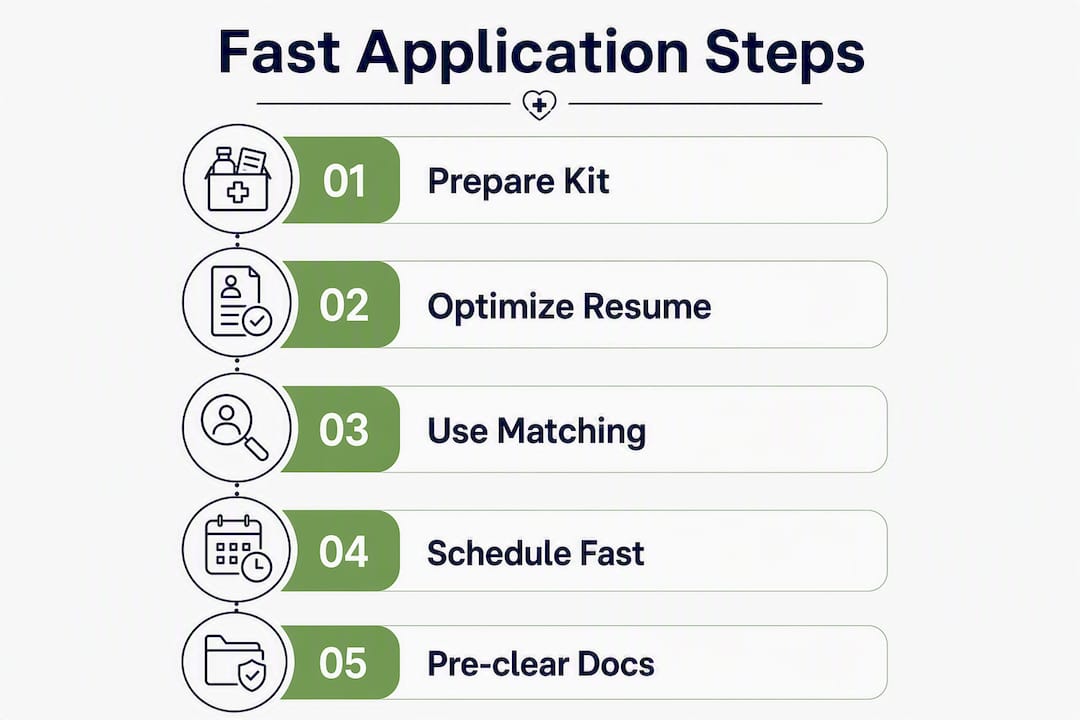
Start by assembling a single application kit: one master resume, a credential list with license numbers and expiration dates, scanned PDFs of all active certifications, and three to five standard role-specific bullet points you can drop into any application. Store everything in one folder, cloud-synced so you can access it from any device.
The documents below cover the full range of what US hospitals and health systems commonly require:
| Document | Where to get it quickly | Typical turnaround | Who commonly requires it |
|---|---|---|---|
| Active state RN/LPN/NP license | State nursing board online portal | Instant (PDF download) | All clinical employers |
| DEA registration (if applicable) | DEA Diversion Control Division online | Expedited processing possible in a few days | Prescribing roles |
| BLS/ACLS certification card | AHA or Red Cross provider course | Same day (digital card) | Most hospital roles |
| Immunization records (MMR, TB, COVID) | Primary care provider or employee health portal | Few days turnaround typical | Hospitals, long-term care |
| Government-issued photo ID | On hand | Immediate | All employers |
| SSN / work authorization | On hand | Immediate | All employers |
| Professional references (contacts) | Email or call former supervisors | Confirmation may take a few days | Most employers |
| Malpractice/registration numbers | Issuing insurer or state board | 1–3 business days | Advanced practice, physicians |
| Background check (self-initiated) | Employer-preferred vendor or national service | Express reports available for faster turnaround | Most clinical employers |
Pro Tip: Pre-order your state license verification PDF directly from your state nursing board's online portal before you apply anywhere. Many boards offer same-day digital verification. Pair that with an express background check from whichever vendor your target employer uses (ask the recruiter on first contact). These two items alone account for the majority of credentialing holds.
Once your kit is assembled, completing your healthcare profile with all fields populated means you can apply to a new role in minutes rather than starting from scratch each time.
How do you produce ATS-ready applications quickly?
Most healthcare ATS rejections happen before a human ever reads the resume. The fix is not a perfect document. It is a fast, repeatable tailoring workflow you can run in under two minutes per job.

Follow this three-step process: extract two to four keywords from the job description (look for terms like "EHR," "HIPAA compliance," "acute care," "patient advocacy," "charge nurse," or the specific unit name), swap one to three bullets in your master resume to mirror those terms, then run a quick ATS check using a tool like Jobscan or the built-in scoring in a healthcare-specific application assistant. That last step takes about 30 seconds and tells you whether your keyword overlap is strong enough to pass the filter.
For formatting, keep it clean: standard section headings (Summary, Licensure, Experience, Education, Certifications), consistent month/year date formats, no tables or text boxes inside the resume file, and a single-column layout. ATS parsers in hospital systems frequently misread multi-column formats.
Tools and approaches that speed this up:
- Browser autofill + application kit: Once your kit is built, autofill populates repetitive fields across ATS forms. Autofill can cut a 20-minute application to seconds after your standardized data is saved.
- AI-assisted tailoring: AI tools can generate ATS-optimized resume bullets and cover letter drafts in as little as 30 seconds, giving you a strong starting point for each role without manual rewriting.
- ATS keyword scanners: Services like Jobscan or Pronto provide ATS score breakdowns and suggested edits specific to healthcare roles, so you know exactly what to change.
- Saved workflow: Open five to ten job tabs at once, run autofill on each, do a quick keyword swap, and submit in a single session. High-throughput applicants use this batch approach to process multiple applications per hour.
Quick-change phrases for common hospital roles:
- RN (Med-Surg): "Managed care for 5–6 patients per shift in a 32-bed acute care unit, coordinating with interdisciplinary teams and documenting in Epic EHR."
- ER Tech: "Assisted with triage, IV placement, and patient transport in a Level II trauma center averaging 120 daily visits."
- Clinical Coordinator: "Oversaw scheduling, credentialing compliance, and HIPAA-aligned documentation for a 15-provider outpatient clinic."
Pro Tip: After any AI-generated draft, spend 30–60 seconds on a manual check of three things only: your license number is correct, all employment dates are accurate month and year, and any work-authorization checkbox matches your actual status. These are the fields that cause costly rejections if wrong, and AI tools occasionally pull stale data from your profile.
How do matching platforms get you hired faster?
The standard search-and-apply model costs you time at every step: find a listing, read it, decide if it fits, tailor your documents, apply, wait. A matching platform removes the first three steps entirely. You set your preferences once, and relevant roles come to you.
Matching platforms filter opportunities by credentials, availability, shift preferences, location, and pay expectations, then notify you when a role fits your profile. The more accurate your profile data, the faster and more relevant your matches. Vague availability ("flexible") produces slower, lower-quality matches than specific windows ("Monday–Friday, 7 AM–3 PM, open to nights").
Signup checklist to maximize match speed (20–30 minutes total):
- Upload your complete application kit documents (license, certs, ID).
- Set specific availability windows, not open-ended ranges.
- Enter your preferred pay rate, shift type, and unit specialty.
- Add a two-line profile pitch (see the NurseFlex Jobs section below for the exact format).
- Enable push notifications and email alerts.
- Accept the first outreach within the same business day.
What fast placement looks like on a matching platform: A candidate with a complete profile, verified credentials, and specific availability set can move from signup to a recruiter screen in 24–48 hours on a well-matched platform. The key variable is not the platform's speed. It is how complete and accurate your profile is on day one. Candidates who upload documents at signup and respond to first outreach the same day consistently reach the interview stage faster than those who treat the profile as a work-in-progress.
After signup, keep your calendar open for at least four interview slots in the first week. Matching platforms surface roles in real time, and a recruiter who cannot reach you in 24 hours will move to the next candidate. Understanding how real-time matching works helps you set up your profile in a way that maximizes those early matches.
How do you move interviews and offers forward faster?
Speed in the interview stage is almost entirely within your control. Recruiters make faster decisions when candidates are easy to schedule, quick to respond, and clear about their availability and start date.

When a recruiter reaches out, reply the same day with three to four specific windows rather than asking them to suggest times. "I'm available Tuesday 10 AM–12 PM, Wednesday 2–4 PM, or Thursday anytime after 9 AM" closes the scheduling loop in one exchange instead of three.
Ready-to-use email templates:
After applying (send within 24 hours):
Subject: Application Follow-Up — [Your Name], [Role Title] Hi [Recruiter Name], I submitted my application for [Role] today and wanted to confirm receipt and express my interest. I'm available for a phone screen this week: [Day] [Time], [Day] [Time], or [Day] [Time]. Please let me know what works. Thank you, [Your Name] | [License # and State] | [Phone]
After an interview (send within two hours):
Subject: Thank You — [Your Name], [Role Title] Interview Hi [Name], Thank you for your time today. I'm very interested in the [Role] position and confident I can contribute quickly given my [specific skill or experience]. I'm ready to move forward and can provide references immediately. Please let me know the next step. [Your Name]
Counteroffer or offer negotiation:
Subject: Re: Offer — [Your Name], [Role Title] Hi [Name], Thank you for the offer. I'm excited about this opportunity. Based on my [X years of experience / specialty certification], I'd like to discuss [specific ask]. I'm flexible and want to reach an agreement quickly. Can we connect briefly today or tomorrow? [Your Name]
Behaviors that recruiters say speed decisions: confirming reference contacts before they are requested, stating a clear start date in your first conversation, and giving concise clinical examples (one sentence, one outcome) rather than lengthy narratives.
Pro Tip: If you have a competing offer or a firm start-date need, say so professionally and early: "I have another offer with a decision deadline of [date] and want to give you the opportunity to move forward first." Most recruiters will accelerate internal approvals when they know a candidate has a real deadline. This is not pressure. It is information.
How do you prevent credentialing and background-check delays?
Credentialing is where healthcare hiring slows down most. A candidate who clears the interview in two days can still wait three to six weeks for a start date because of a license verification hold or a missing immunization record. Pre-clearing these items before you apply is the single highest-leverage action you can take.
The most common bottlenecks are state board license verifications, primary source verifications (where the hospital contacts the issuing body directly), and hospital privileging for advanced practice roles. Each of these has a candidate-side action that shortens the wait.
| Item to pre-clear | Candidate action | Typical timeline if pre-ordered |
|---|---|---|
| State nursing license verification | Download verification PDF from state board portal | Same day to 2 business days |
| Background check | Order express report from employer-preferred vendor | 1–3 business days |
| Immunization records | Request from primary care provider or employee health | 1–5 business days |
| BLS/ACLS certification | Ensure digital card is current and downloadable | Immediate if current |
| DEA registration (if applicable) | Confirm active status at DEA online portal | Immediate (check) |
| Employment verification | Prepare W-2s or pay stubs for last two employers | Immediate if on hand |
| Primary source verification (PSV) | Upload credential PDFs to CAQH or employer portal | 1–2 days (upload); PSV itself varies |
Primary source verifications and state board checks are the most frequent choke points in hospital credentialing. Proactively requesting verification PDFs from issuing bodies and keeping expiration dates current prevents the administrative holds that add weeks to a start date.
For immunization records, your primary care provider's patient portal (MyChart, FollowMyHealth, or similar) often has downloadable records. If not, your county health department can provide a copy. For state license verification, every state nursing board has an online verification page. The NCSBN's Nursys database covers most states and provides instant verification.
Ask the recruiter on first contact which background-check vendor they use. Ordering the same report yourself in advance is not always accepted, but knowing the vendor means you can complete their authorization form the moment it arrives rather than waiting to identify the service.
What are realistic time-to-hire ranges in U.S. healthcare?
Healthcare hiring takes longer than most industries, and the gap between a fast process and a slow one is wide. Knowing where the time goes lets you push at the right moments.
| Stage | Fast-track timeline | Typical timeline | Where delays occur |
|---|---|---|---|
| Application to recruiter screen | 1–2 days | 3–7 days | Incomplete applications, ATS filtering |
| Recruiter screen to hiring manager interview | 1–3 days | 5 days | Scheduling, internal approvals |
| Interview to reference check | Same day–1 day | 3–7 days | Candidate not providing contacts promptly |
| Reference check to offer | 1–2 days | 3–10 days | Slow reference responses |
| Offer to credentialing clearance | 3–7 days (pre-cleared) | 2–6 weeks | License verification, background check, PSV |
| Credentialing to start date | 1–3 days | 1–2 weeks | Hospital onboarding scheduling |
| Total (fast-track) | 7 days | 6–12 weeks |
The Association for Advancing Physician and Provider Recruitment (AAPPR) tracks time-to-fill benchmarks across healthcare roles. Its research consistently shows that credentialing and privileging account for the largest share of total hiring time, particularly for advanced practice and physician roles.
Healthcare roles take longer to fill than most other sectors. The BLS Occupational Outlook Handbook documents strong and sustained demand across nursing and allied health, which means open roles are plentiful but hospital onboarding pipelines remain slow by design. The fastest candidates are typically those who are most prepared.
The three candidate actions that most reliably compress the timeline: pre-cleared credentials (cuts credentialing from weeks to days), same-day interview scheduling (cuts the screen-to-interview gap by half), and references who are pre-briefed and responsive (cuts the reference-to-offer gap to 24 hours). See the healthcare hiring process overview at SurfSearch for a detailed breakdown of each stage from the hospital's perspective.
How does NurseFlex Jobs speed up your hiring timeline?
NurseFlex Jobs reduces time-to-hire by combining real-time matching, a streamlined candidate profile, and employer-ready credential packages. Instead of applying to individual postings and waiting for a response, you set your preferences once and get matched directly to roles that fit your credentials, availability, and pay expectations.
The platform works in four steps: create your profile, verify your credentials, set your availability and shift preferences, and accept matches as they arrive. Employers on the platform are actively hiring, which means matches move to recruiter screens quickly rather than sitting in an applicant queue.
Candidate checklist to maximize match speed:
- Upload your full application kit at signup (license, BLS/ACLS, immunization records, ID).
- Set specific availability windows, not open-ended ranges.
- Enter your specialty, preferred unit type, and pay expectations accurately.
- Write a two-line profile pitch (see below).
- Enable push notifications and check the platform daily for the first week.
- Respond to first outreach the same business day.
Pro Tip: Your profile pitch is the first thing a recruiter reads. Write it in two lines: your role and years of experience, then your top two clinical skills and your availability. Example: "RN with 6 years in acute care med-surg, experienced in Epic EHR and rapid patient turnover. Available for day or night shifts starting [date]." This format consistently produces faster outreach than a generic summary.
For travel nursing roles, which often fill within days rather than weeks, a complete profile on NurseFlex Jobs is especially valuable. Travel contracts move fast, and a pre-verified candidate profile means you can accept a match and move to contract review the same day.
Key Takeaways
Pre-clearing credentials, using a matching platform, and sending same-day follow-ups are the three actions that most reliably compress a US healthcare hiring timeline from weeks to days.
| Point | Details |
|---|---|
| Build your application kit first | Assemble license numbers, certs, and role bullets once; reuse across every application. |
| Pre-clear credentials before applying | Order state license verification and background checks in advance to prevent multi-week holds. |
| Use matching platforms, not just job boards | Platforms like NurseFlex Jobs remove the search step and surface pre-matched roles directly. |
| Control interview scheduling proactively | Offer several specific windows in your first reply to cut scheduling back-and-forth. |
| NurseFlex Jobs fast-track route | Create a complete profile, verify credentials, and respond to first outreach the same day for the fastest path to a match. |
What hiring teams say actually speeds their decisions
From a recruiter's perspective, the candidates who move through the process fastest share a few consistent behaviors. They respond the same day. They provide reference contacts without being asked twice. They state a clear start date in the first conversation. And when they describe their clinical experience, they keep it to one sentence with one measurable outcome.
Verified credentials at the point of application make a real difference. When a candidate uploads a current license verification PDF and a background check alongside their resume, the credentialing team can begin work immediately rather than waiting for the recruiter to request documents. That single step can significantly shorten the process.
Availability matters more than most candidates realize. A recruiter who cannot schedule a phone screen within 48 hours will often move to the next candidate, not because the first candidate was less qualified, but because the hiring manager has a unit to staff. Keeping several open windows on your calendar during an active search is a small commitment that pays off in faster decisions.
The candidates who wait to be contacted, who send documents only when asked, and who need several days to confirm a time slot consistently take longer to place. Not because the system is slow. Because the system responds to the signals you send.
NurseFlex Jobs: your faster path to a healthcare role
Searching job boards and waiting for callbacks is the slow route. NurseFlex Jobs connects you directly with hospitals and health systems that are actively hiring, using real-time matching based on your credentials, availability, and preferences. No lengthy application queues. No cold outreach to recruiters who may not respond.

The process is straightforward: create your free candidate profile, upload your credentials, set your availability and shift preferences, and start receiving matches. Employers on the platform are pre-screened and ready to hire, which means your first match can move to a recruiter screen within 24–48 hours of signup. Registration is free for candidates.
If you are ready to skip the search and get matched to nursing jobs that fit your schedule and specialty, create your profile on NurseFlex Jobs today and have your application kit ready to upload.
Further reading and authoritative links
These sources give you the implementation detail and context to act on the tactics in this article.
- Complete Your Healthcare Profile for Faster Hires — Step-by-step guidance on building a complete candidate profile with all the fields and documents that surface you to recruiters faster.
- Instant Job Match Healthcare Platform Guide — Explains how real-time matching platforms work and how to set up your profile for maximum match velocity.
- Get Hired for a Healthcare Job Fast — An updated checklist and timeline for candidates who want a prioritized, step-by-step action plan.
- Why Healthcare Platforms Beat Job Boards for Nurses — The candidate-facing case for using niche platforms over general job boards, with specific examples of where boards fall short.
- AAPPR Benchmarking Research — The Association for Advancing Physician and Provider Recruitment publishes time-to-fill benchmarks across healthcare roles. Useful for understanding where your process stands relative to industry norms.
- BLS Healthcare Occupational Outlook — Bureau of Labor Statistics data on demand, growth projections, and employment conditions across nursing and allied health roles.
- The Role of Technology in Hospital Hiring — Covers how ATS systems and hospital hiring technology affect candidate throughput and what you can do to work with them rather than against them.
- Healthcare Job Alert Systems Explained — How to set up job alerts and notification strategies so you respond to new opportunities before the application window fills.