
Healthcare job alert systems are automated notification tools that send you real-time or scheduled updates when new job postings match your criteria across healthcare platforms, career pages, and job boards. The industry term for this category is "job alert automation," and it covers everything from free email digests on Indeed and LinkedIn to paid direct-monitoring services that check employer career pages every five minutes. Speed is the defining variable. In competitive healthcare markets, the difference between a free daily digest and a paid real-time monitor can determine whether you apply in the first wave or miss the window entirely. This guide has healthcare job alert systems explained from setup to strategy.
How healthcare job alert systems work
Healthcare job alert systems operate through two distinct pipelines: aggregation and direct monitoring. Understanding the difference is the first step to using them well.
Aggregation-based systems collect job postings from multiple sources, index them, and then batch notifications to users. Platforms like LinkedIn and Indeed use this model. The process involves crawling employer career pages, parsing job data, and queuing alerts for delivery. That multi-step process creates real delays. LinkedIn alerts default to daily delivery and batch emails, causing delays of 18–48 hours after the original career page post. For a high-demand ICU travel nurse role that closes in 24 hours, that delay is disqualifying.

Direct monitoring tools take a different approach. Instead of waiting for an aggregator to crawl a page, tools like Visualping check employer career pages directly and frequently. Paid monitoring plans start at $10/month for 15-minute checks and $25/month for 5-minute checks, enabling near real-time alerts. That is a fundamentally different speed tier.
Most major healthcare employers use applicant tracking systems (ATS) like Greenhouse, Lever, Workday, or iCIMS. How alerts reach you depends on which ATS the employer uses. RSS feed job alerts appear immediately for companies using Greenhouse or Lever, but only those platforms support RSS natively. For employers on Workday or iCIMS, direct URL monitoring tools are the only reliable option for fast alerts.
- Aggregation pipeline: Crawl, parse, index, batch, deliver. Adds 18–48 hours.
- Direct monitoring: Check live career page, detect change, notify. Adds 5–15 minutes.
- RSS feeds: Instant for Greenhouse and Lever ATS users only.
- Email digests: Free but slowest. Best for passive scanning, not competitive roles.
Pro Tip: Set up RSS feeds for any employer using Greenhouse or Lever before you even apply. You will get alerts before aggregators even crawl the page.
Free vs. paid healthcare job alert options: what is the speed trade-off?
The cost of a job alert system is directly tied to how fast it notifies you. Free tools are sufficient for broad market awareness. Paid tools are necessary for competitive, high-demand healthcare roles.
Free alerts from LinkedIn, Indeed, and aggregator sites deliver daily or weekly digests. They cover a wide range of roles and require no setup beyond a profile and saved search. The trade-off is that aggregation pipeline delays result in slower alerts, disadvantaging early applicants in fast-moving healthcare markets. If you are searching for a general administrative healthcare role with a two-week posting window, free tools work fine.
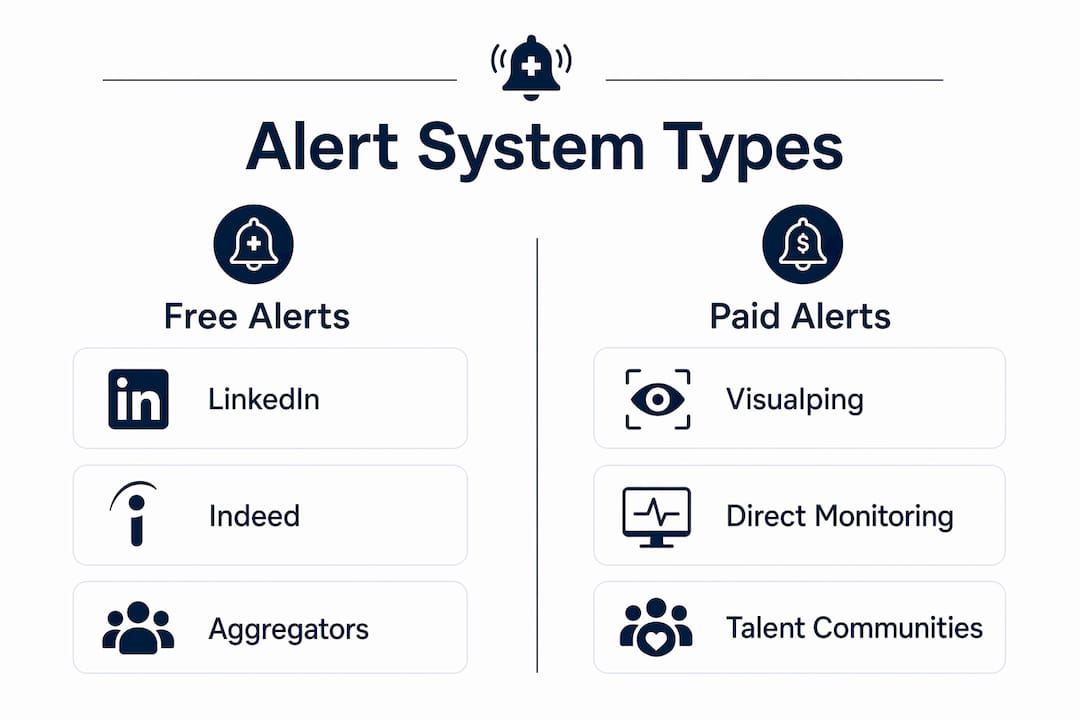
Paid tools like Visualping change the equation for competitive positions. The $10/month plan checks career pages every 15 minutes. The $25/month plan checks every 5 minutes. Visual monitoring tools work across all ATS platforms by detecting live changes on career pages rather than relying on API feeds. That means they work even for employers on Workday or iCIMS, where RSS is not available.
| Tool | Cost | Alert Speed | Best For |
|---|---|---|---|
| LinkedIn Job Alerts | Free | 18–48 hours | Broad market scanning |
| Indeed Alerts | Free | Daily digest | General healthcare roles |
| Visualping (Basic) | $10/month | 15 minutes | Targeted employer monitoring |
| Visualping (Pro) | $25/month | 5 minutes | Highly competitive roles |
| RSS via Greenhouse/Lever | Free | Near instant | Employers on those ATS platforms |
Pro Tip: Use free aggregator alerts for passive scanning and reserve a paid monitoring tool for your top three to five target employers. That combination covers both breadth and speed without overspending.
How to set job alerts in healthcare for maximum relevance
The most common mistake healthcare professionals make with job alerts is setting one broad alert and forgetting it. Precise configuration is what separates useful notifications from inbox noise.
Platforms like Indeed allow users to filter by job title, location, salary thresholds, experience level, and healthcare-specific roles. You can stack multiple alerts to manage diverse searches. For example, one alert for remote nationwide telehealth nursing roles with a salary filter above $75,000, and a separate alert for local clinical RN positions within 25 miles. Each alert stays focused. Neither floods your inbox with irrelevant postings.
Here are the core filters to configure on any platform:
- Job title: Use exact titles like "Registered Nurse ICU" rather than broad terms like "nurse." Broad terms return too many irrelevant results.
- Location: Set separate alerts for remote and local roles. Combining them muddies relevance.
- Salary threshold: Filter out roles below your minimum. This saves time and prevents lowball applications.
- Experience level: Mid-level and senior healthcare roles fill faster. Filtering by experience level keeps alerts targeted.
- Healthcare sector: Specify acute care, home health, behavioral health, or other subsectors to avoid generic healthcare postings.
Review and prune your alerts every 30 days. Job markets shift, and an alert that was relevant in January may be pulling irrelevant results by March. Integrating alerts with a job search workflow tool like Notion or a simple spreadsheet tracker keeps your pipeline organized without relying on memory.
Should you use employer talent communities alongside alert systems?
Talent Communities are direct employer notification systems that place you on a priority candidate list before a role is even posted publicly. They are the fastest alert source available, and most healthcare professionals ignore them entirely.
Talent Communities act as Tier 1 alerts, offering fast but less filterable notifications compared to third-party aggregators for broad market scanning. When a hospital system like Baptist Health or HCA Healthcare opens a new ICU position, Talent Community members often receive direct outreach before the role appears on LinkedIn or Indeed. The limitation is that these alerts are employer-controlled. You cannot filter by salary or experience level the way you can on Indeed.
The right approach is a tiered alert strategy:
- Tier 1: Talent Communities. Sign up directly on the careers pages of your top five to ten target employers. These deliver the fastest alerts with the least competition.
- Tier 2: Direct monitoring tools. Use Visualping or a similar tool to monitor the career pages of employers not in your Talent Community list.
- Tier 3: Aggregator alerts. Use LinkedIn and Indeed for broad market awareness and to catch roles from employers you have not specifically targeted.
Combining employer Talent Communities with direct career page monitoring and aggregators gives you both speed and coverage. Passive job hunting, where you check boards manually a few times a week, cannot compete with this kind of alert-driven pipeline.
Does alert speed actually affect your chances of getting hired?
Alert speed is not a minor optimization. For competitive healthcare roles, it is the primary variable that determines whether you get an interview.
Competitive healthcare roles close within hours to days in high-demand sectors like travel nursing, emergency medicine, and behavioral health. A 48-hour aggregation delay means you are applying after dozens of candidates who received faster alerts. The first applicants reviewed often have a structural advantage, particularly when hiring managers are under pressure to fill critical staffing gaps quickly.
Automation enables efficient focus on applications and credentialing rather than manual job hunting. That shift matters because the time you save not checking job boards manually is time you can spend refining your resume and keeping your licenses current.
When an alert arrives, follow this response sequence:
- Open the posting immediately. Skim for fit on title, location, and salary before investing more time.
- Check your resume. Confirm your most recent role and certifications are current. A stale resume is the most common reason for a missed opportunity.
- Tailor one paragraph. Adjust your summary or cover letter opening to reflect the specific role. Generic applications perform worse in ATS screening.
- Submit within two hours. For high-demand roles, same-day submission is the standard. Rapid application response is a documented advantage in fast-moving healthcare hiring.
- Log the application. Record the role, employer, date, and alert source. This data helps you identify which alert tier is producing your best leads.
Pro Tip: Keep a master resume template with your certifications, licensure numbers, and clinical skills pre-filled. When an alert arrives, you spend two minutes tailoring rather than twenty minutes rebuilding.
Key takeaways
A tiered alert strategy combining Talent Communities, direct monitoring tools, and aggregator alerts gives healthcare professionals the fastest and broadest job notification coverage available.
| Point | Details |
|---|---|
| Aggregation delays cost you time | LinkedIn and Indeed alerts arrive 18–48 hours late, putting you behind faster applicants. |
| Paid tools close the speed gap | Visualping at $10–$25/month checks career pages every 5–15 minutes for near real-time alerts. |
| Talent Communities are Tier 1 | Signing up directly with target employers delivers alerts before roles go public on aggregators. |
| Precise filters reduce inbox noise | Stack multiple targeted alerts by title, location, salary, and sector instead of one broad search. |
| Fast response is the final step | Submitting within two hours of a high-demand alert significantly improves your interview odds. |
What i have learned after watching thousands of healthcare job searches
Most healthcare professionals set up one LinkedIn alert, check it when they remember, and wonder why they keep missing good roles. The alert is not the problem. The strategy around it is.
The single biggest shift I have seen is when professionals move from passive scanning to an automated, tiered pipeline. Free aggregator alerts have their place, but treating them as your primary source for competitive roles is a structural disadvantage. The real-time job matching advantage is not theoretical. It shows up in application timestamps, interview rates, and offer timelines.
The second mistake I see constantly is ignoring Talent Communities. Healthcare systems like HCA Healthcare, Kaiser Permanente, and Mayo Clinic all run them. Joining takes five minutes. The payoff is direct employer outreach before a role is even indexed by LinkedIn. That is a meaningful edge in a competitive market.
My honest recommendation: spend $10 a month on a direct monitoring tool for your top three target employers, join every Talent Community on your target list, and set precise aggregator alerts for broad scanning. That combination costs less than a single missed shift and covers every speed tier in the market.
Job alerts do not guarantee interviews. They are timely triggers for immediate action. The professionals who act within hours of a relevant alert, with a polished resume ready, consistently outperform those who treat alerts as a passive information feed.
— Flexible
Find your next healthcare role faster with Flexiblenursingcareers
Flexiblenursingcareers connects nurses and healthcare professionals with flexible, skills-matched roles through a technology-driven platform built for speed. You set your availability, skills, and preferences. The platform matches you to relevant openings and notifies you directly, cutting out the manual search entirely.

Unlike general job boards, Flexiblenursingcareers is built specifically for healthcare staffing. The platform's automated job placement approach means you spend less time searching and more time working. Registered users report faster hiring timelines and better role fit compared to traditional recruitment platforms. Sign up at NurseFlex Jobs and start receiving tailored healthcare job notifications today.
FAQ
What are healthcare job alert systems?
Healthcare job alert systems are automated tools that notify you when new job postings match your saved criteria on platforms like LinkedIn, Indeed, or direct employer career pages. They range from free email digests to paid real-time monitoring services.
How do i set job alerts in healthcare?
Sign in to a platform like Indeed or LinkedIn, run a job search with your preferred filters, and save the search as an alert. For faster notifications, use a direct monitoring tool like Visualping to track specific employer career pages.
Why are my job alerts arriving late?
Aggregation pipeline delays cause most late alerts. LinkedIn and Indeed crawl, parse, and batch jobs before sending notifications, creating 18–48 hour delays after the original posting goes live on an employer's career page.
Are paid job alert tools worth it for healthcare roles?
Paid tools are worth it for competitive, high-demand roles. A $10/month plan on Visualping checks career pages every 15 minutes, giving you a significant speed advantage over free daily digest alerts.
What is a talent community in healthcare hiring?
A Talent Community is a direct employer notification list that alerts registered candidates when new roles open, often before the position is posted publicly on aggregator platforms. Talent Communities offer the fastest alerts but provide fewer filtering options than third-party job boards.