
Block scheduling lets nurses reserve or get assigned a set sequence of shifts, commonly spanning a month, so they know weeks in advance which days they're working and which they're not. Staff nurses, travel nurses, and PRN nurses all use it. The main payoff is control: fewer last-minute schedule changes and an easier time planning life around work.
TL;DR:
- Nurses should confirm their schedule includes at least 30 minutes overlap for handoff if shifts are back-to-back, especially with 12-hour shifts.
- Well-designed block schedules cap consecutive shifts to reduce fatigue and include guaranteed hours and cancellation policies to protect nurse income.
- Block scheduling suits stable units with predictable census, such as long-term care or perioperative teams, but is less effective in variable outpatient settings.
- The success of a block schedule depends on clear communication, early nurse involvement, and tracking key performance indicators like fill rate and turnover.
- State regulations on overtime and consecutive hours must be checked, as long shift blocks can conflict with labor laws if not properly managed.
Table of Contents
- What Is Block Scheduling in Nursing?
- Nursing Block Schedule Examples You Can Copy
- The Benefits and Drawbacks of Block Scheduling
- Which Nurses and Units Benefit Most From Blocks?
- How Facilities Roll Out Block Scheduling
- How to Request and Manage Your Own Block
- Does Block Scheduling Help or Hurt Patient Care Continuity?
- What Block Scheduling Does to Team Communication
- Legal and Regulatory Considerations for Block Schedules
- How to Measure Whether Block Scheduling Is Actually Working
- Publisher Perspective: How Matching Platforms Support Block Use
- Sources
What Is Block Scheduling in Nursing?
Block scheduling assigns nurses a fixed run of shifts, typically over two to four weeks, instead of posting a new schedule every week or two. Facilities often build blocks around a monthly cycle, letting nurses claim or get assigned to a defined shift pattern well in advance, which is why some guides also call it block booking.
Common block lengths include:
- Two-week blocks for units that want frequent flexibility to adjust staffing
- Four-week (monthly) blocks for maximum predictability
- Weekend-only blocks for units chronically short on Saturday/Sunday coverage
Assignment styles vary by facility. Some use fixed blocks where a nurse works the same days every cycle. Others rotate blocks among a group so no one is stuck permanently on nights or weekends. Many staffing platforms use invite based blocks, where a nurse accepts or declines an offered sequence before it expires.
This differs sharply from traditional rotating schedules, where shift patterns change week to week, and from pure PRN coverage, where shifts are filled one at a time with no guaranteed sequence. Note that "block" also shows up in nursing education to describe concentrated academic terms, a different concept entirely from shift scheduling.
Nursing Block Schedule Examples You Can Copy
These templates give you a starting point to bring to your manager or use when evaluating a travel assignment.
- Two-week day/night swap. Week one: four 12-hour day shifts. Week two: four 12-hour night shifts, illustrating a swap of shift types. This spreads exposure across both shift types while keeping total hours consistent.
- Four-week, 10-on/4-off block. Ten consecutive 12-hour shifts split across two work stretches, followed by four days off. Popular with travel nurses who want longer stretches of true time off between runs.
- Weekend block. Two 12-hour shifts every Saturday and Sunday, often paid at a premium rate, ideal for nurses juggling a second job or school during the week.
- Low-commitment block. Two shifts a week, fixed days, for nurses easing back from leave or balancing family care.
Pro Tip: Before agreeing to any block with back-to-back 12-hour shifts, check the handoff overlap time built into the schedule. A 15-minute overlap is not enough for a true bedside report on a busy med/surg floor. Ask for at least 30 minutes.
Whatever the length, confirm the block respects safe staffing limits on consecutive shifts to reduce risks associated with shift work sleep disorder. Ten straight 12-hour shifts without a break point is a fatigue risk, not just a scheduling convenience.
The Benefits and Drawbacks of Block Scheduling
The upside is real, and so are the trade-offs.
Benefits:
- Predictable days off make childcare, school schedules, and second jobs easier to plan around
- Fewer last-minute calls asking you to pick up an open shift
- Steadier income for per diem and travel nurses who can see hours coming weeks ahead
Drawbacks:
- Long blocks of consecutive shifts raise fatigue risk, especially with back-to-back nights
- Cancellation exposure: a facility that cuts a shift on a low-census day can leave a block nurse short on expected hours
- Less flexibility to swap or adjust once a block is locked in
Peer-reviewed research on shift design consistently ties poor scheduling patterns and limited rest opportunities to burnout and sleep disruption among nursing staff. A well-built block schedule protects against this by capping consecutive shifts and building in real recovery time. A poorly built one does the opposite, raising fatigue risk even while it looks predictable on paper.
Which Nurses and Units Benefit Most From Blocks?
Block scheduling fits some roles naturally and fights against others.
Good fits:
- Travel nurses who want to plan personal time between contracts
- Med/surg and long-term care units with steady, predictable census
- Perioperative teams running consistent block time in the OR schedule
Poor fits:
- Units with highly variable daily census, where staffing needs swing too much to lock in weeks ahead
- Outpatient procedural schedules tied to appointment volume rather than fixed coverage needs
Unit culture matters as much as the schedule design. A manager who treats block requests as negotiable, and staff who communicate early about swaps, make block scheduling work far better than a facility that just posts a rigid grid and expects compliance.
How Facilities Roll Out Block Scheduling
A facility playbook approach to block scheduling starts small and measures before scaling.
- Identify the recurring gap. Look at weekends, nights, or holidays where call-offs and open shifts happen most often.
- Pilot on one unit. Don't roll out facility-wide on day one. Test the block design where the pain is worst.
- Define the commitments. Set block length, guaranteed minimum hours, a cancellation-notice window (commonly 72 hours), and a cap on consecutive shifts.
- Choose your scheduling tool. Whether it's a manual sign-up sheet or a staffing platform, set clear sign-up windows and invite rules so nurses know exactly when and how to claim a block.
- Track KPIs from day one. Fill rate, cancellation rate, overtime hours, and staff satisfaction scores tell you whether the pilot is working.
- Iterate. Adjust block length, guaranteed hours, or cancellation terms based on what the pilot data and staff feedback actually show.
Two design choices matter more than most managers expect:
- A minimum guaranteed hours clause protects nurses from unpredictable income loss when census dips
- A clear cancellation window keeps the facility from quietly hollowing out the predictability the block promised
Facilities that treat blocks as a genuine staffing design problem, not just an invite list, see far better acceptance than those that skip straight to posting shifts. That distinction shows up again and again in facility guidance.
How to Request and Manage Your Own Block
Getting a block usually starts with timing. Ask during the sign-up window your facility or agency posts, and come with clear availability rather than a vague request. Vague requests get skipped over for specific ones.
Before you accept any block, run through this checklist:
- Guaranteed minimum hours, in writing
- Minimum cancellation notice (72 hours is a reasonable ask)
- Rules for swapping a shift within the block if something comes up
- How overtime or premium pay applies if the block runs long
Once you're in the block, protect your own health. Prioritize sleep hygiene around night stretches, avoid volunteering for extra shifts on top of an already long block, and never skip a proper handoff report just because you're tired at the end of shift four. Managing your availability proactively, rather than reactively, keeps you in control of the schedule instead of the other way around.
Pro Tip: If you're a travel nurse comparing contracts, ask recruiters directly whether the facility's schedule is block-based or ad hoc. It changes how much you can plan around the assignment before you sign.
Does Block Scheduling Help or Hurt Patient Care Continuity?
Continuity tends to improve under well-designed block scheduling, and the reason is simple: the same nurse sees the same patients across consecutive shifts more often than under a schedule that shuffles staff every day. A patient recovering from surgery who sees the same nurse for four straight days benefits from someone who already knows their baseline, their pain tolerance, and the subtle changes that don't always make it into the chart.
That continuity has a flip side. If a block nurse is fatigued by shift three or four of a long stretch, the same familiarity that helps care can mask declining attention to detail. A tired nurse who "knows" a patient may miss a new symptom precisely because they've stopped looking as closely.
Handoff quality is where block scheduling either pays off or falls apart. A block schedule with generous overlap time between shifts supports thorough bedside reporting, medication reconciliation, and a real conversation about what changed overnight. A block schedule that squeezes overlap to save labor costs undercuts the very continuity it's supposed to deliver.
The safest approach treats block length and handoff time as linked design decisions, not separate line items. A facility that commits to 10-day blocks but refuses to budget adequate overlap time is optimizing for the schedule, not the patient. Getting both right is what actually protects safety, and it's worth pushing back on any rollout that shortchanges one to make the other look better on paper.
What Block Scheduling Does to Team Communication
Nurses working consistent blocks together tend to build stronger working relationships than staff who rarely see the same coworkers twice in a month. A charge nurse who runs the same team for a two-week stretch learns who needs backup on a tough assignment and who works best solo, and that kind of situational awareness takes time to build.
Block scheduling also creates a more stable communication rhythm for care teams. Physicians, charge nurses, and ancillary staff who see the same nursing team repeatedly develop shorthand that speeds up rounds and reduces the friction of re-explaining context every shift. Newer nurses on a stable block often report faster comfort asking questions of the same senior colleagues, rather than starting from scratch with a new face every shift.
The risk shows up when blocks isolate teams too tightly. A unit that never mixes its block groups can develop silos, where one team's practices drift from another's and nobody notices until a handoff between groups exposes the gap. Rotating block assignments periodically, even within a stable overall block system, keeps information moving across the whole unit instead of pooling inside small, insulated groups.

Communication tools matter here too. A block schedule posted on a shared platform where swap requests and coverage gaps are visible to the whole team beats one buried in a manager's private spreadsheet. Transparency about who's on which block, and why, cuts down on the resentment that builds when nurses suspect favoritism in who gets the "good" blocks.
Legal and Regulatory Considerations for Block Schedules
Block scheduling itself isn't a regulated practice, but the elements built into a block often intersect with labor law and state nurse staffing rules. Overtime calculation is the most common trip point. A block that stacks four 12-hour shifts in a row can push a nurse over 40 hours in a work week even without extra shifts, and federal overtime rules under the Fair Labor Standards Act still apply regardless of how the schedule is labeled.
Mandatory overtime and consecutive-shift limits are handled differently state by state. Several states restrict mandatory overtime for nurses or cap consecutive hours worked, so a block design that relies on back-to-back long shifts needs to be checked against the specific rules in the state where the facility operates. What's allowed for a block in one state may violate a staffing law in another.
Contract terms matter just as much for travel and per diem nurses. A block offered through an agency or staffing platform should spell out guaranteed hours, cancellation notice, and what happens if the facility cuts a shift mid-block. Verbal promises about a "guaranteed" block mean little if the written contract doesn't back them up, and nurses accepting travel assignments should read the cancellation clause as closely as the pay rate.
Facilities rolling out block scheduling also need to document their commitment rules clearly enough to survive a labor dispute or state board inquiry. A published policy on block length, minimum hours, and cancellation notice protects both the facility and the nurse if a disagreement ever ends up in front of HR or a regulator.
How to Measure Whether Block Scheduling Is Actually Working
The same KPIs used to justify a pilot should keep running long after rollout, not just during the trial phase. Fill rate tells you whether nurses actually want the blocks you're offering; a block that sits open for weeks signals a design problem, not a staffing shortage. Cancellation rate tells you the opposite side of that story: how often the facility itself pulls shifts nurses were counting on.
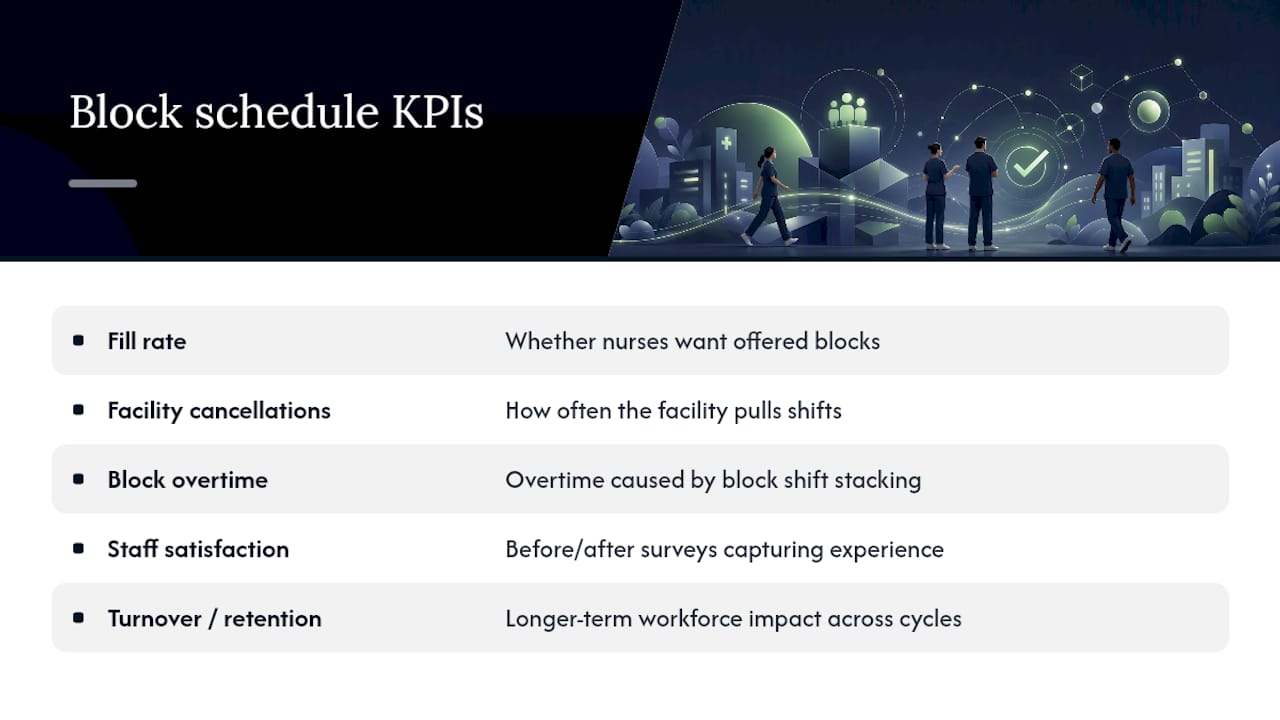
Overtime hours tied to block schedules deserve their own line of tracking, separate from overall unit overtime. If block nurses are consistently tipping into overtime because of how shifts stack within the block, that's a scheduling design flaw, not an individual nurse working too much.
Staff satisfaction surveys, run before and after a block rollout, catch what the numbers alone miss. A block that looks efficient on a spreadsheet but leaves nurses exhausted and resentful will eventually show up in turnover, even if the fill rate looks great for the first two quarters.
Turnover and retention data, tracked over two to three scheduling cycles rather than one, separate a genuinely successful block program from one that just looks good short-term. Facilities that skip this longer view often declare victory after a smooth pilot month, then get surprised when burnout-driven attrition shows up two quarters later. Comparing block-scheduled units against non-block units in the same facility, when that comparison is available, gives the clearest read on whether the block design itself is driving the improvement.
Publisher Perspective: How Matching Platforms Support Block Use
Real-time availability matching has changed how fast a block gets filled compared to a printed sign-up sheet passed around a break room. Platforms that limit consecutive-shift invites and set short expiration windows on offers cut down on the no-show and last-minute scramble that plague manually managed blocks, a pattern documented in staffing platform feature guides.
That said, marketplace-matched blocks and locally negotiated ones solve different problems. A travel nurse chasing income stability across contracts benefits from a platform's speed and reach. A staff nurse negotiating a permanent block with their own unit manager is better served by a direct conversation, since that relationship outlasts any single scheduling cycle. Know which situation you're in before you pick your tool.
— Flexible
Sources
For deeper detail on rollout mechanics, start with the facility playbook on block scheduling and Intelycare's facility guide and FAQ. For fatigue and shift design research, the PubMed literature on nurse scheduling outcomes is worth a read before finalizing any pilot design.
If you're ready to see what block-friendly openings look like in practice, browse current nursing jobs or travel nursing jobs built around flexible, real-time scheduling.