
Nurses today report the same core problems in unit after unit: unsafe staffing ratios, burnout and moral distress, workplace violence, exhausting shift schedules, EHR overload, stalled career advancement, communication breakdowns, harassment, and shrinking work-life balance. Each one has a peer-reviewed evidence base behind it, and each one responds to specific action, both from the nurse living it and the manager who can change the conditions around it.
Here is the short list before we go deep on each:
- Inadequate staffing and high patient-to-nurse ratios
- Burnout, stress, and moral distress
- Workplace violence and safety threats
- Long shifts, fatigue, and physical strain
- Administrative and EHR documentation burden
- Limited career development and recognition
- Communication breakdowns and interprofessional conflict
- Harassment and discrimination
- Work-life balance pressure
The fastest way to make progress on any of these is pairing a nurse-level habit you can start this week with an organizational fix you can advocate for at your next unit meeting. That pairing structures everything below.
Key Takeaways
Nursing's core workplace challenges, staffing, burnout, violence, fatigue, documentation burden, and limited advancement, share common roots in staffing models and organizational design, and each responds to specific nurse-level and manager-level action.
| Point | Details |
|---|---|
| Staffing drives most other problems | Advocate for unit-based staffing committees and document missed care patterns with time stamps. |
| Burnout is systemic, not personal | Use peer debriefs and EAP resources now; push managers for workload redistribution after high-acuity stretches. |
| Report every safety incident | Even verbal threats and near-misses build the data pattern that changes policy. |
| Fatigue and injury risk climb with shift length | Use lifting equipment consistently and log fatigue-related near misses. |
| Escalate structurally, not informally | SBAR scripts and written development proposals get faster, clearer responses than verbal requests. |
Table of Contents
- Common Workplace Challenges Nurses Face: Staffing and Patient Ratios
- Stress, Burnout, and Moral Distress in Nursing
- Workplace Violence and Safety Concerns for Nurses
- Long Hours, Shift Work, and Physical Fatigue
- Administrative and EHR Documentation Burden
- Career Development, Pay, and Professional Recognition
- Communication Failures and Interprofessional Conflict
- What Nurse Managers Can Do to Fix Multiple Problems at Once
- What the Research Says About Staffing, Burnout, and Patient Safety
- Harassment and Discrimination Nurses Encounter at Work
- Healthcare Policy Shifts and Economic Pressure on Nursing Jobs
- Counseling, Peer Support, and Other Resources Nurses Can Use
- Frequently Asked Questions
- Sources
Common Workplace Challenges Nurses Face: Staffing and Patient Ratios
Inadequate staffing is the root cause behind much of what makes nursing exhausting. When ratios climb, nurses cannot complete every task on every patient, and something gets skipped. That "something" is usually documentation, ambulation, or patient education, the exact tasks that prevent readmissions and falls.
Turnover, retirements, and faculty shortages that limit new-nurse pipelines all feed the shortage, and surge periods (flu season, local disasters, understaffed night shifts) make it worse overnight, according to a StatPearls review of nursing shortage drivers.
For nurses, high ratios mean more mandatory overtime, more moral distress, and less time per patient. For patients, the research link is direct: understaffed units see higher mortality and longer lengths of stay.
What helps right now:
- Triage tasks by clinical risk, not by what's easiest to finish first.
- Use structured escalation language ("I have four critical patients and no support; I need a charge nurse now") instead of general complaints.
- Track missed care incidents in writing, with time stamps, so patterns become visible.
Managers can counter this with staffing committees that include bedside nurses, float pools sized to actual surge history, and unit-based staffing decisions instead of hospital-wide averages.
Pro Tip: Keep a private log of missed care tasks and why they were missed. Bring the pattern, not just a complaint, to your next staffing meeting. Aggregated data moves committees; anecdotes get filed away.
Nursing shortages tied to staffing gaps remain one of the most consistent findings in workforce research, and the post-COVID nursing crisis analysis found unsustainable workloads sitting at the center of the current retention problem.
Stress, Burnout, and Moral Distress in Nursing
Burnout and moral distress in nursing are not new, and they are not rare. Decades of research tie them directly to staffing levels, leadership behavior, and the broader work environment, not to individual resilience, according to a longform review of nursing work stress.
The causes stack: chronic overload, repeated exposure to trauma and death, and ethical conflict when you know the right care but lack the resources to give it. Over time this produces emotional exhaustion and depersonalization, the two hallmark symptoms clinicians describe.
A recent cross-sectional study found workload, staff shortages, shift work, role conflict, and weak supervisory support were the strongest predictors of occupational stress among nurses, per Frontiers research on occupational stress.
What actually helps:
- Short peer debriefs after difficult cases, even five minutes matters.
- Micro-rest practices during shifts, not just at the end of them.
- Using your Employee Assistance Program before a crisis point, not after.
Managers reduce this with regular one-on-one check-ins, redistributing workload after high-acuity stretches, and building psychological safety so nurses can speak up without career risk. The CDC's stress and coping resources for healthcare workers offer practical, evidence-based starting points.
Pro Tip: When asking for workload relief, frame it as a specific, measurable request: "Our unit needs one additional nurse on Tuesday and Thursday nights" lands better than "we're overwhelmed."
Workplace Violence and Safety Concerns for Nurses
Verbal abuse and physical violence are common realities in nursing, not rare exceptions. The Bureau of Labor Statistics reports that healthcare and social service workers face workplace violence at rates far above the private industry average.

Patients in confusion or crisis, agitated visitors, and occasionally coworkers are the typical sources, with emergency departments, psychiatric units, and geriatric care carrying elevated risk.
Immediate steps that matter:
- Learn and rehearse two or three de-escalation phrases before you need them.
- Know your unit's exit routes and panic-button locations, not just where they're posted.
- Report every incident, including verbal threats, even when it feels routine.
Employers reduce risk through mandatory de-escalation training, genuine zero-tolerance enforcement (not just a poster in the break room), environmental controls like visibility and secure entry points, and adequate staffing in high-risk units. A scoping review of occupational hazards among American nurses confirms violence sits alongside musculoskeletal injury and needlesticks as a top workplace hazard.
Pro Tip: File a written incident report even for near-misses. Aggregated reports are what push administration toward policy change, isolated verbal complaints rarely do.
Long Hours, Shift Work, and Physical Fatigue
Twelve-hour shifts and physically demanding work drive up error rates and injury risk, and the evidence on this is consistent across settings. Musculoskeletal injuries and needlesticks remain among the most common occupational hazards nurses face, confirmed by the same scoping review on nurse health conditions cited above.
Rotating shifts disrupt sleep cycles in ways that accumulate over weeks, and mandatory overtime compounds the damage.
Practical tactics:
- Use safe patient handling equipment every time, not just when convenient.
- Take strategic micro-breaks rather than pushing through a full shift without one.
- Protect sleep hygiene aggressively on days before and after night shifts.
Organizations that manage schedules thoughtfully, minimize mandatory overtime, and invest in lifting and transfer equipment see fewer injuries and less turnover. Flexible scheduling models, including how platforms match nurse availability to shifts, give nurses more control over rotation patterns.
Pro Tip: Document fatigue-related near misses, medication errors nearly made, missed assessments, and note the shift length involved. That data is what eventually shifts scheduling policy.
Administrative and EHR Documentation Burden
Technology meant to save time often adds to workload instead, particularly when nurses have no input into how it's built. Studies on EHR burden and clinician time show documentation load frequently rises after EHR rollouts that skip nurse-centered design and training.
Duplicate documentation, clunky workflows, and policy creep (new fields added faster than old ones are removed) are the usual culprits.
What helps at the bedside:
- Build and use smart phrases for common documentation.
- Push for focused charting templates specific to your unit's patient population.
- Use structured upward feedback channels instead of informal griping.
Leaders fix this at the source: vendor governance that requires nurse input before rollout, and role-based documentation reallocation so nurses aren't charting tasks better handled elsewhere.
Pro Tip: Run a short, informal usability audit, time how long five common documentation tasks take, and bring that data to your informatics team. Concrete minutes lost per shift are far more persuasive than "the system is slow."
Career Development, Pay, and Professional Recognition
Limited advancement pathways and pay disparities push experienced nurses out the door, and it's one of the more fixable problems on this list. Causes include thin clinical ladder opportunities, faculty shortages limiting advanced training slots, and the time and cost of credentialing.
What you can do now:
- Document your achievements and outcomes in writing throughout the year, not just before review season.
- Pursue targeted micro-credentials that align with where you want your career to go.
- Seek mentorship actively rather than waiting for it to appear.
Organizations retain talent with clear clinical ladders, protected continuing-education time, and recognition programs that mean something beyond a certificate. Reviewing flexible healthcare role options can also reveal advancement paths outside the traditional bedside track.
Pro Tip: Write a one-page professional development proposal: the skill gap, the training that closes it, the cost, and the unit benefit. A concise ask gets approved faster than a vague request for "more support."
Communication Failures and Interprofessional Conflict
Communication breakdowns are implicated in a significant share of adverse events and most of the interpersonal conflict nurses report at work. Handoffs, interdisciplinary rounds, and unclear escalation pathways are the usual failure points.
Structured tools close that gap. Nurses using SBAR (Situation, Background, Assessment, Recommendation) scripts report clearer, faster escalations, especially with physicians who are used to that exact format.
- Keep handoffs to the SBAR structure every time, resist the urge to narrate.
- Use direct escalation language when a concern isn't being heard the first time.
- Push for regular interdisciplinary huddles if your unit doesn't already run them.
Managers reduce conflict with role clarity (who owns what decision) and conflict resolution training that goes beyond a single onboarding session.
Pro Tip: Adapt a short SBAR script for your unit's most common escalation, print it, and tape it near the phone. Situation, Background, Assessment, Recommendation, in that order, every time.
What Nurse Managers Can Do to Fix Multiple Problems at Once
Five high-impact practices address staffing, scheduling, safety, documentation, and wellbeing simultaneously, and managers don't need to tackle every issue separately to make real progress.
- Involve nurses in staffing decisions. Bring bedside staff onto scheduling and staffing committees. Measure: overtime hours per pay period, missed care incident reports.
- Fix scheduling structurally, not reactively. Build float pools sized to real surge history instead of scrambling each time. Measure: mandatory overtime frequency, shift-swap request denials.
- Invest in safety infrastructure. Fund de-escalation training and secure environmental design in high-risk units. Measure: reported violence incidents, staff injury claims.
- Streamline documentation with nurse input. Require nurse representation before any EHR change goes live. Measure: minutes per shift spent charting, duplicate-entry complaints.
- Build psychological safety and career ladders. Create check-in structures and visible advancement paths. Measure: voluntary turnover rate, exit interview themes.
Pro Tip: Start with a small unit-level pilot rather than a hospital-wide rollout. A nurse-led PDSA cycle, Plan, Do, Study, Act, tests a scheduling or documentation change on one unit before scaling it, which limits risk and builds credibility for the next change.
What the Research Says About Staffing, Burnout, and Patient Safety
Staffing levels and work environment quality correlate directly with both patient safety outcomes and nurse wellbeing, and this connection shows up across multiple independent research streams.
- Missed nursing care is a frequent, often silent, outcome of understaffing and tracks with worse readmission rates and longer stays.
- Healthcare and social service workers face workplace violence at rates well above the private industry average, according to BLS data.
- Occupational hazards, including musculoskeletal injury and needlesticks, remain widespread among American nurses per the scoping review cited earlier.
- EHR burden rises when nurses are excluded from system design, per PMC research on documentation load.
For managers building a case to leadership, start with the StatPearls nursing shortage review, it directly links staffing to patient outcomes in language administrators respond to. Bedside nurses looking for practical coping frameworks should start with the CDC's stress and coping page.
Harassment and Discrimination Nurses Encounter at Work
Bias based on gender, race, and age remains a persistent workplace issue in nursing, and it compounds every other challenge on this list. Younger nurses report being dismissed in clinical discussions; nurses of color report being mistaken for support staff by patients and colleagues alike; older nurses report being pushed toward retirement before they're ready.
This isn't only patient-driven. Interprofessional hierarchies (physician-nurse dynamics in particular) still carry gendered assumptions in many settings, and workplace bullying between nursing staff, sometimes called "lateral violence," remains a documented problem in unit culture.
The practical response starts with documentation. Write down what was said, when, and who witnessed it. Verbal patterns are hard to prove after the fact; a dated record is not.
Report through formal channels even when you expect little to happen the first time. Patterns matter more than single incidents when HR or leadership eventually has to act. If your organization has an ombudsperson or diversity and inclusion office, use it, that's a different reporting path than your direct manager and sometimes a safer one.
Organizations serious about this train supervisors specifically on bias recognition, not generic sensitivity training, and build reporting systems that don't route every complaint through the person being complained about. Anonymous reporting channels, when genuinely anonymous, surface problems that direct reporting structures miss entirely.
Healthcare Policy Shifts and Economic Pressure on Nursing Jobs
Policy changes and reimbursement pressure ripple down to the unit floor faster than most nurses realize. When Medicare and Medicaid reimbursement models shift, or when a hospital system faces margin pressure, staffing budgets are almost always among the first line items adjusted.
That connection explains a pattern many nurses have lived through: a unit that felt adequately staffed one year suddenly cutting positions the next, not because patient acuity dropped, but because the finance department needed to hit a number.
Agency and travel nursing became a common workaround during periods of acute shortage, and while the pay premium is real, the research on workforce challenges found agency and travel nurses often report higher rates of job dissatisfaction and burnout when organizational support and social integration are weak. Flexibility without belonging has a cost.
Economic pressure also shapes hiring patterns in less obvious ways. Facilities may lean harder on part-time and PRN staff to manage benefit costs, which shifts scheduling unpredictability onto nurses without necessarily improving their pay. Understanding why nurses increasingly work multiple employers helps explain how economic pressure reshapes career decisions across the profession, not just at any single hospital.
Staying informed about how reimbursement and policy trends affect your specific facility, through union updates, staff meetings, or trade publications, gives you earlier warning before a staffing change lands on your schedule.
Counseling, Peer Support, and Other Resources Nurses Can Use
Support exists, but most nurses underuse it, often because they don't know it's there or assume it won't help. Employee Assistance Programs typically offer free, confidential counseling sessions, and using them isn't a sign that you've failed to cope, it's a resource built for exactly the stress nursing produces.
Peer support programs, where trained colleagues provide structured debriefs after difficult cases, have grown in hospitals specifically because informal hallway conversations weren't enough after traumatic events. If your unit doesn't have one, asking leadership to start one is a reasonable, specific request.
External resources matter too. The CDC's stress and coping guidance for healthcare workers offers concrete, field-tested strategies rather than generic wellness advice. Organizations like the Institute for Functional Nurses provide training and clinical resources aimed specifically at nurse wellbeing and professional development, worth exploring if your hospital's internal offerings feel thin.
For broader stress management approaches that extend beyond the clinical setting, resources like managing chronic stress can complement what your workplace already offers.
The gap usually isn't that support doesn't exist, it's that nurses don't ask because asking feels like admitting weakness in a culture that rewards toughing it out. That culture is the actual problem worth challenging.
What Nurses Report and What Leaders Should Hear
Frontline nurses consistently describe feeling unheard in decisions that directly affect their patient loads, and ethically squeezed when they know the right care but lack the time or staff to deliver it. That combination, powerlessness plus ethical conflict, is what actually drives people out of bedside nursing, more than pay alone.
Leaders should take three things from that: give nurses real votes in staffing decisions, not just a suggestion box; measure missed care as seriously as any other quality metric; and treat burnout reports as operational data, not personal weakness.
Pro Tip for nurses: Bring data, not just frustration, when you raise a concern. Pro Tip for leaders: When a nurse escalates a problem, respond within days, not months, silence reads as dismissal even when that isn't the intent.
Frequently Asked Questions
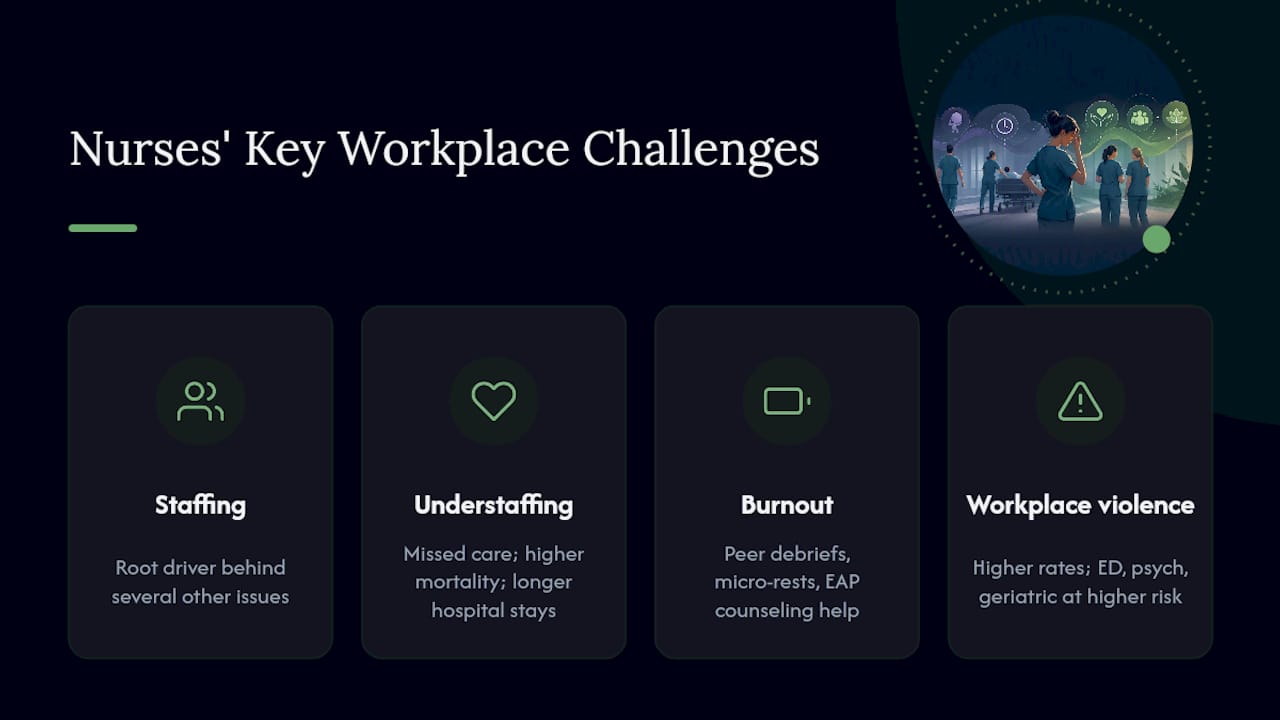
What are the most common workplace challenges nurses face? The most frequently reported issues are inadequate staffing, burnout and moral distress, workplace violence, long shifts and fatigue, EHR and documentation burden, limited career advancement, communication breakdowns, harassment, and work-life balance pressure. Staffing tends to be the root driver behind several of the others.
How does understaffing affect patient care? Understaffing correlates with missed nursing care, higher patient mortality, and longer hospital stays, according to research summarized in the StatPearls nursing shortage review. Nurses managing too many patients cannot complete every task safely, and documentation and patient education are usually what gets skipped first.
What can nurses do about burnout right now? Short peer debriefs after hard cases, deliberate micro-rests during shifts, and using Employee Assistance Program counseling before a crisis point all help. The CDC's stress and coping guidance offers additional field-tested strategies.
How prevalent is workplace violence against nurses? Healthcare and social service workers experience workplace violence at rates substantially higher than the private industry average, per BLS data. Emergency departments, psychiatric units, and geriatric care carry elevated risk.
Can flexible scheduling reduce these challenges? Flexible and part-time arrangements can reduce fatigue and improve work-life balance when paired with strong organizational support. Reviewing flexible healthcare role options can help you find schedules that fit your life without sacrificing the professional integration that prevents dissatisfaction.
This article is general information, not a substitute for advice from a qualified doctor. Consult a qualified healthcare professional about your own circumstances before acting on anything here.
Sources
Managers building a case for change should start with the StatPearls nursing shortage review and BLS workplace violence data, both translate directly into administrative language.
Bedside nurses looking for practical coping tools should start with the CDC stress and coping resources and the longform review on nursing burnout.
For deeper context on occupational hazards, read the scoping review on nurse health conditions and the post-COVID nursing crisis analysis. For practical next steps on flexible scheduling, see PRN nursing role examples and how availability-based job matching works.
If your current schedule is the biggest driver of your stress, flexible nursing job listings let you filter by availability and setting instead of taking whatever shift is offered. Nurses considering a shift toward lower-strain settings can also explore telehealth roles, which often reduce physical demands while keeping clinical skills active.
- Nursing crisis: Challenges and opportunities for our profession after COVID‐19 (PMC)
- Work-Related Health Conditions Among American Nurses (PMC)
- Workplace violence in healthcare (BLS)
- Nursing Shortage (StatPearls, NCBI Bookshelf)