
You can earn nursing certifications while working full time. The path requires three things: a quick eligibility check, a focused study plan, and the right employer support. Bodies like the American Nurses Credentialing Center (ANCC), the American Heart Association (AHA), and the American Association of Critical-Care Nurses (AACN) all publish clear eligibility rules. Prometric handles exam scheduling for many of these boards, and most exams can be booked around your existing shifts. The certification process follows three core steps: meet eligibility, prepare, and pass a board exam. You can start that process this week.
Your 30-second action checklist:
- Confirm your RN license is active and in good standing.
- Count your qualifying clinical hours in your target specialty.
- Pick your issuing body: ANCC, AANP, AACN, AHA, or BCEN.
- Open the board's eligibility handbook and check the application window.
- Register for the exam through Prometric (or the board's own portal).
- Block some daily study time into your schedule, aiming for manageable sessions fitting around your shifts.
- Ask HR about tuition reimbursement or certification pay differentials.
Pro Tip: Request a shift swap or use one PTO day per month as a dedicated study day. A single uninterrupted four-hour block can replace ten fragmented 25-minute sessions.
Key Takeaways
Earning nursing certifications while working is realistic when you verify eligibility first, build a structured study plan around your shifts, and use employer resources to reduce cost and scheduling friction.
| Point | Details |
|---|---|
| Verify eligibility before anything else | Check active license status, clinical hours, and education level against the board's official handbook. |
| Study in 25–45 minute daily blocks | Consistent short sessions around shifts outperform weekend marathon study for shift-based nurses. |
| Use employer support to cut costs | Request reimbursement, pay differentials, and free CE through HealthStream or Relias before spending out of pocket. |
| Plan renewal from day one | Log CEUs monthly and set a calendar reminder 18 months before your credential expires to avoid lapses. |
| Flexiblenursingcareers helps you find scheduling that fits | Flexible travel and telehealth roles create protected study windows and may include employer-funded training. |
Table of Contents
- What are nursing certifications and why do they matter?
- Which certifications do working nurses commonly pursue?
- How do you earn a nursing certification without quitting your job?
- What does it cost and how long does it take?
- How do you study for a certification exam on a shift schedule?
- What online programs work for nurses who are already employed?
- How do you display new credentials at work and on your resume?
- How do you keep certifications current while working?
- A 12-week study plan you can actually follow while working full time
- What the certification process actually feels like when you are working full time
- Flexible scheduling can make your certification study more achievable
- Sources
What are nursing certifications and why do they matter?
A nursing license proves you are legally qualified to practice. A nursing certification proves you are expert in a specific clinical area. The two are not interchangeable. Certification is voluntary, specialty-focused, and awarded by a credentialing body after you meet defined eligibility criteria and pass a standardized exam.
The primary issuing bodies you will encounter:
- ANCC (American Nurses Credentialing Center): the largest nursing certification organization in the United States, covering specialties from oncology to informatics to psychiatric-mental health.
- AANP (American Association of Nurse Practitioners): primary and specialty NP certification, including the FNP-C and ENP-C exams.
- AACN (American Association of Critical-Care Nurses): CCRN for acute and critical care, PCCN for progressive care.
- AHA (American Heart Association): BLS, ACLS, and PALS life-support credentials are commonly expected by hospitals.
- BCEN (Board of Certification for Emergency Nursing): CEN, CPEN, and CFRN credentials for emergency and flight nurses.
Why employers care: certified nurses often qualify for pay differentials, meet role-eligibility requirements for charge or specialty positions, and contribute to a unit's quality metrics. Many Magnet-designated hospitals track certification rates as a performance indicator. According to Purdue Global, earning a certification can open doors to career advancement, leadership roles, and higher pay, with many employers offering reimbursement or a certification differential.
There is also an immediate, less-discussed benefit. Certification study fills knowledge gaps and can improve your workplace performance before the credential is even awarded. Colleagues and clinical leaders often notice the shift in confidence and clinical reasoning during the study period.
Pro Tip: Before you pick a certification, check your unit's staffing matrix. Some hospitals list specific credentials as preferred or required for charge nurse eligibility. Knowing that in advance turns certification into a direct promotion lever.
Which certifications do working nurses commonly pursue?
The right credential depends on your current role, your unit's needs, and the return on your study investment. Here is a practical grouping by setting, with quick eligibility notes drawn from nurse.com's compilation of high-value certifications.
Life-support credentials (universally expected)
- BLS (Basic Life Support, AHA): required by virtually every hospital employer; renewed every two years; completed in a single half-day course.
- ACLS (Advanced Cardiovascular Life Support, AHA): required for ICU, ED, and telemetry nurses; one to two days; renewal every two years.
- PALS (Pediatric Advanced Life Support, AHA): required for pediatric and ED nurses; one to two days; renewal every two years.
Acute care and critical care
- CCRN (AACN): requires an active RN license plus 1,750 hours in direct care of acutely/critically ill patients within the past two years, with 875 of those hours in the most recent year preceding application.
- PCCN (AACN): same license requirement; 1,750 hours in progressive care settings.
Emergency nursing
- CEN (BCEN): active RN license; two years of emergency nursing experience recommended (no mandatory hour minimum, but strongly advised).
Perioperative and surgical
- CNOR (Competency and Credentialing Institute): active RN license; 2 years and 2,400 hours in perioperative nursing within the past five years.
Nursing education and leadership
- CNE (Certified Nurse Educator, NLN): MSN or higher; two years of teaching experience in nursing education.
- NE-BC (Nurse Executive, ANCC): BSN minimum; 24 months of executive-level nursing management experience.
Psychiatric-mental health
- PMH-BC (ANCC): active RN license; 2,000 hours in psychiatric-mental health nursing within the past three years.
Nurse practitioner pathways
- FNP-C (AANP) or FNP-BC (ANCC): requires a graduate-level FNP program plus supervised clinical hours; see the online programs section for how working nurses complete these.
Pro Tip: If you are within six months of meeting the clinical hour requirement for CCRN or CEN, apply now. Both AACN and BCEN allow you to test before your hours are fully logged if you meet the threshold by exam day.
| Certification | Issuing body | Minimum eligibility snapshot | Renewal cycle |
|---|---|---|---|
| BLS | AHA | Current healthcare provider status | Every 2 years |
| ACLS | AHA | Active healthcare provider; BLS current | Every 2 years |
| CCRN | AACN | Active RN; 1,750 ICU/acute hours (875 in past year) | Every 3 years |
| CEN | BCEN | Active RN; ED experience recommended | Every 4 years |
| CNOR | CCI | Active RN; 2 years/2,400 perioperative hours | Every 5 years |
| PMH-BC | ANCC | Active RN; 2,000 psych-MH hours in past 3 years | Every 5 years |
| FNP-BC | ANCC | Graduate FNP program + supervised clinical hours | Every 5 years |
How do you earn a nursing certification without quitting your job?
The process is sequential. Skipping steps wastes money and time, so follow this order.
Step 1: Verify eligibility
Pull the official eligibility handbook from the credentialing body's website. Confirm:
- Your RN or APRN license is active and unrestricted.
- You meet the clinical hour requirement for your target specialty.
- Your education level matches the minimum (BSN for some ANCC exams, MSN for NP certifications).
- The application window is open or opens within 90 days.
Contact the board directly if anything is unclear. ANCC, AACN, and BCEN all have candidate services teams.
Step 2: Choose your certification based on role and return
Match the credential to your current unit and your next career move. Check whether your employer lists it as a preferred qualification for any open or upcoming roles. Confirm whether a pay differential applies upon passing.
Step 3: Build your study plan
- Self-study: Use the official exam content outline (every board publishes one) as your study map. Work through it domain by domain.
- Review courses: AACN offers a CCRN review; BCEN partners with several prep vendors. Employer-sponsored training counts toward study hours.
- Practice tests: Run a baseline diagnostic first. Identify your two weakest domains and spend 60% of your study time there.
- Daily blocks: 25–45 minutes per day, six days per week, is more effective than marathon weekend sessions for shift workers.
Step 4: Schedule the exam
Register through the credentialing body's portal. For ANCC exams, Prometric handles test delivery at hundreds of locations nationwide, and remote proctoring is available for some credentials. Book your exam date before you start studying. A fixed deadline prevents indefinite delay.
On test day: bring two forms of ID, arrive 30 minutes early, and review the board's specific prohibited-items list. Prometric centers enforce strict security protocols.
Step 5: After passing
- Apply your post-nominal credentials immediately (see the formatting section below).
- Submit documentation to HR and formally request any applicable pay differential.
- Note your renewal date and set a calendar reminder for 12 months before expiration.
- Update your state license record if the board requires notification.
Pro Tip: Schedule your exam for a Tuesday, Wednesday, or Thursday. Test centers tend to be quieter mid-week, and you avoid the Monday-morning technical issues that occasionally affect Prometric scheduling systems.
Certification study produces measurable workplace value before the credential is awarded. Employers and clinical leaders notice knowledge gains and improved confidence during the study period, so starting the process has immediate returns even before you sit the exam.
What does it cost and how long does it take?
Timelines and fees vary widely by credential type. Here is a realistic budget and schedule overview.
Typical timelines:
- BLS, ACLS, and PALS courses generally take one to two days to complete.
- Specialty board exams (CCRN, CEN, CNOR, PMH-BC): 8–16 weeks of self-study after eligibility is confirmed
- Post-graduate certificate programs (FNP, AGACNP, CNE pathways): 12–24 months part-time
Fee ranges to budget:
- AHA life-support courses: $50–$150 per course through an authorized training center
- ANCC application and exam fees: typically $270–$395 depending on ANA membership status
- AACN CCRN exam fee: approximately $225–$325
- BCEN CEN exam fee: approximately $230–$330
- Review courses and prep materials: $100–$500 depending on format
- Post-graduate certificate programs: tuition varies by institution; many programs charge per credit hour
Where to recover costs:
- Ask HR about your employer's certification reimbursement policy before you apply. Many hospitals reimburse the exam fee upon passing, and some cover prep materials.
- Certification pay differentials can add meaningful income, but amounts vary by employer.
- Education expenses that qualify as work-related may be tax-deductible. Consult a tax professional for your specific situation.
According to Purdue Global, many employers actively encourage or reimburse certification, making the net out-of-pocket cost significantly lower than the sticker price suggests.
Pro Tip: Submit your reimbursement request the same week you pass. Some employer policies have a 30- or 60-day submission window, and missing it means paying out of pocket.
You can also track your clinical competencies and documentation using tools like MyLTC Apps' competency tracking software, which helps you organize the hour logs and skill verifications many credentialing bodies require.
How do you study for a certification exam on a shift schedule?
Shift-based schedules are not a barrier to certification. They require a different study architecture than a traditional student's calendar.
The core technique stack:
- Spaced repetition: Review material at increasing intervals (day 1, day 3, day 7, day 14). Apps like Anki make this automatic.
- Active recall: Close the book and write down everything you remember about a topic before re-reading. This is more effective than re-reading alone.
- Microlearning blocks: 25–45 minutes per session, one topic per session. Finish each block with three to five practice questions on that topic.
- Weekly practice test: One full-length timed practice exam per week starting at week four. Review every wrong answer before moving on.
Sample weekly templates:
Day shift (7 AM–7 PM):
- Study block: 5:00–5:45 AM before shift, or 8:30–9:15 PM after dinner
- Rest day: one full day off per week with no study material
- Practice test: Saturday morning, 90 minutes
Night shift (7 PM–7 AM):
- Study block: 1:00–1:45 PM after waking, before the pre-shift routine
- Rest day: the day immediately after a run of three or more night shifts
- Practice test: first day off after a run, afternoon
Rotating schedule:
- Anchor study to a fixed time relative to wake-up (two hours after waking), not a clock time
- Use a shared calendar to mark study days, rest days, and practice-test days four weeks in advance
Burnout prevention is non-negotiable. Cap study at six days per week. Build in one full recovery week every six weeks with no new material.
Pro Tip: Use a PTO day or a shift swap to create one four-hour intensive study block per month. Treat it like a shift: show up, put your phone away, and work through two full practice test sections with detailed review.
What online programs work for nurses who are already employed?
For nurses pursuing post-graduate certificates (FNP, AGACNP, CNE, informatics), the program structure matters as much as the curriculum. Post-graduate certificate programs designed for working nurses typically require an MSN or doctoral degree, list practicum requirements, and provide online coursework options built around employment schedules.
Didactic sessions are often recorded, so you can watch them between shifts. Practicum hours require real-time patient contact, but many programs allow you to complete those hours at your current workplace.
How workplace practicum placement works:
- The program coordinator contacts your employer to establish a clinical affiliation agreement.
- Your hours must be documented as student clinical time, not as compensated employment hours.
- A qualified preceptor (typically an NP, CNS, or physician) supervises your student hours.
- Some programs explicitly allow workplace placements when the role is appropriate and hours are non-compensated.
Accreditation to confirm before enrolling:
- CCNE (Commission on Collegiate Nursing Education) or ACEN (Accreditation Commission for Education in Nursing) accreditation is required for most employer tuition reimbursement programs and for ANCC/AANP exam eligibility.
If you already hold an MSN: request a gap analysis when you apply. Norwich University and similar programs conduct gap analyses to identify which courses you still need, often reducing required coursework and shortening time to completion.
Graduate certificate programs can often be completed in under two years part-time, with flexible term lengths and recorded sessions designed for shift workers. Franklin University's FNP post-graduate certificate uses online didactic coursework with on-site practicum experiences, a structure explicitly marketed to working nurses.
Pro Tip: Before you enroll, email the program director and ask two questions: "Can I complete my practicum hours at my current employer?" and "Do you have a gap analysis process for MSN holders?" The answers will tell you everything about how nurse-friendly the program actually is.
How do you display new credentials at work and on your resume?
Post-nominal order follows a standard convention: highest academic degree first, then licensure, then certifications, then honors.
Examples:
- Jane Smith, MSN, RN, CCRN
- James Lee, BSN, RN-BC, CEN
- Maria Torres, DNP, APRN, FNP-BC
Steps to take after passing:
- Update your name badge request with your unit manager or HR.
- Send a brief email to your supervisor and HR documenting the credential, the issuing body, and the effective date.
- Submit a formal pay differential request with your certificate attached.
- Update your LinkedIn profile: add the certification under "Licenses & Certifications" with the issuing organization and expiration date.
- Add the post-nominal to your resume, email signature, and any professional directory listings.
- If your state board of nursing requires notification of specialty certification, submit that update.
Pro Tip: Add your certification to your LinkedIn headline, not just the certifications section. Recruiters search by credential abbreviation (CCRN, CEN, FNP-BC), and a headline placement makes you findable without them having to open your full profile.
For specialty-specific job opportunities that recognize your new credential, the nursing specialties page at Flexiblenursingcareers lists in-demand roles by specialty and the certifications employers in each area typically look for.
How do you keep certifications current while working?
Most specialty certifications renew on a three to five-year cycle. Missing a renewal deadline means losing the credential and potentially having to retest from scratch.
Common renewal methods:
- Continuing education units (CEUs): the most common route; hours vary by credential (typically 45–75 CEUs per renewal cycle).
- Clinical practice hours: some boards require documented hours in the specialty during the renewal period.
- Professional contributions: teaching, precepting, publishing, or presenting at conferences often count toward renewal points.
- Re-examination: some nurses choose to retake the exam rather than accumulate CEUs; both routes are valid for most credentials.
Building a rolling renewal calendar:
- On the day you pass, record your expiration date in a calendar app with a reminder set for 18 months before expiration.
- Identify how many CEUs your credential requires and divide by the number of months in the cycle to get a monthly target.
- Check whether your employer offers free CE through platforms like Relias, HealthStream, or unit-based education programs.
- Log every qualifying activity immediately. Do not wait until the renewal year to reconstruct your hours.
Renewal tracking checklist:
- Credential name, issuing body, and expiration date recorded
- Required CEU total and current count tracked
- Employer CE resources identified and enrolled
- Professional contribution activities (precepting, teaching) documented with dates and hours
- Renewal application window noted (most boards open renewal 6–12 months before expiration)
Pro Tip: Treat CEUs like a monthly bill. Completing two to four CE hours per month means you will hit most renewal requirements without a last-minute scramble. Many hospital systems offer free CE through HealthStream or Relias that counts toward ANCC and AACN renewal.
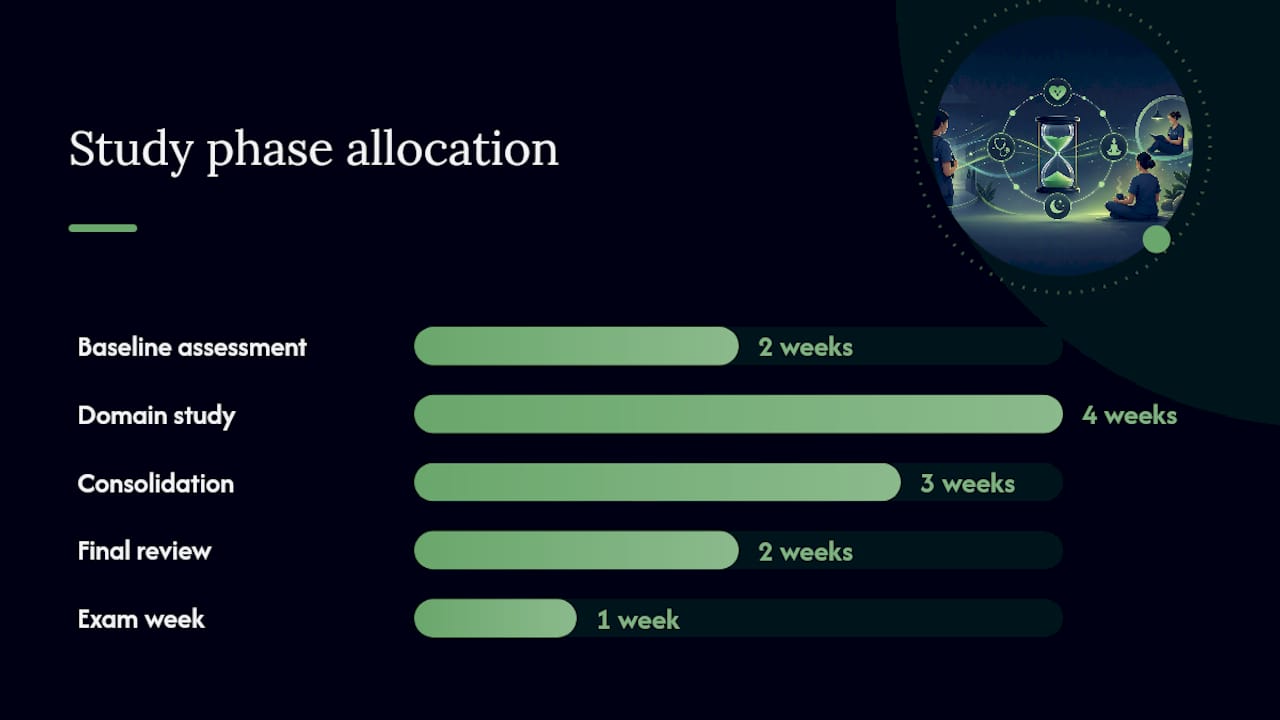
A 12-week study plan you can actually follow while working full time
This plan is built for a nurse working three 12-hour shifts per week. Adjust the day labels to match your rotation.
Phase structure:
| Week | Phase | Focus |
|---|---|---|
| 1–2 | Baseline assessment | Diagnostic practice test; identify two weakest domains; gather all study materials |
| 3–6 | Domain study | Work through exam content outline domain by domain; 25–45 min daily; several practice questions per session |
| 7–9 | Consolidation | Full-length practice tests weekly; review every wrong answer; targeted re-study of weak domains |
| — | Final review | High-yield summaries only; no new material; two full practice tests; confirm exam logistics |
| 12 | Exam week | Light review Monday–Tuesday; exam Wednesday or Thursday; rest Friday–Sunday |
Sample weekly schedule (rotating shift nurse):
Resources to use:
- Official exam content outline from your credentialing body (free download from ANCC, AACN, or BCEN)
- Board-specific practice question banks (AACN PassCCRN, BCEN practice exams)
- Employer-sponsored review courses or unit-based education sessions
- Spaced repetition app (Anki) for high-yield terminology and drug calculations
Nurses who already hold an MSN should request a gap analysis from their certificate program before building this plan. Reducing required coursework can shift your timeline from 24 months to 12 months or less.
Pro Tip: On practice test review days, do not just mark answers right or wrong. Write one sentence explaining why the correct answer is correct and why each distractor is wrong. This active processing step is where most of the learning actually happens.
Certification study starts paying off before exam day. Knowledge gains during the study period translate directly into stronger clinical reasoning at the bedside, which your charge nurse and manager will notice.
What the certification process actually feels like when you are working full time
The standard advice is to "make a study schedule and stick to it." That is true, but it misses the harder part: the weeks when you work five shifts in a row, your kid is sick, and your study plan falls apart completely.
Here is what actually works. Treat missed study days as neutral events, not failures. A two-day gap does not erase six weeks of preparation. The nurses who abandon their certification attempt usually do so after one bad week, not because the material was too hard.
The trade-offs are real. You will give up some TV time, some social plans, and some sleep. But the study period is finite. Twelve weeks of structured effort is a small window compared to the career years a credential opens.
What I would do differently:
- Start with a diagnostic test on day one, not week two. Knowing your weak domains from the start means you never waste study time on material you already know.
- Book the exam before you feel ready. A scheduled date creates accountability that no amount of motivation can replicate.
- Tell your charge nurse you are studying. Most will accommodate shift swaps or lighter assignments during your final two weeks.
- Use your employer's CE resources from day one. Free content through HealthStream or Relias reduces your out-of-pocket prep costs significantly.
- Do not study on every day off. Rest is part of the plan, not a deviation from it.
Flexible scheduling can make your certification study more achievable
Earning certifications while working is easier when your schedule actually gives you study windows. That is where the type of role you hold matters as much as your motivation.

Travel nursing roles and telehealth positions through Flexiblenursingcareers tend to offer predictable shift patterns, contract-based scheduling, and in some cases employer-funded training. A 13-week travel contract with a consistent three-day schedule gives you four protected days per week to study. Telehealth roles eliminate commute time entirely, which adds 60–90 minutes of usable study time on every shift day.
Flexiblenursingcareers matches nurses to flexible, real-time job opportunities based on your skills, availability, and schedule preferences. You can filter for roles that fit your study timeline rather than forcing your study plan around a rigid hospital schedule. Check current travel nursing openings or explore telehealth roles to find positions that give you the scheduling control certification study requires.

Sources
These are the primary sources to visit for exact eligibility rules, application windows, and exam logistics.
- Which Nursing Certificates Can Improve Your Credentials?
- Which Nursing Certificates Can Improve Your Credentials? (Walden University)
- Post-Graduate Certificate in Nursing | Norwich University - Online