
Balancing a nursing career with family obligations means intentionally designing your schedule and commitments to protect your energy, prioritize key family moments, and maintain career satisfaction. Work-life balance in nursing is not a fixed state. It is a dynamic, seasonal process that shifts as your family grows and your career evolves. 62% of nurses identify flexibility and lifestyle as primary drivers of their career choices in 2026. That number tells you something important: most nurses are already thinking about balance, not just clinical advancement. The strategies that work are grounded in energy management, boundary setting, and smart use of flexible career options.
How can nurses balance career and family obligations?
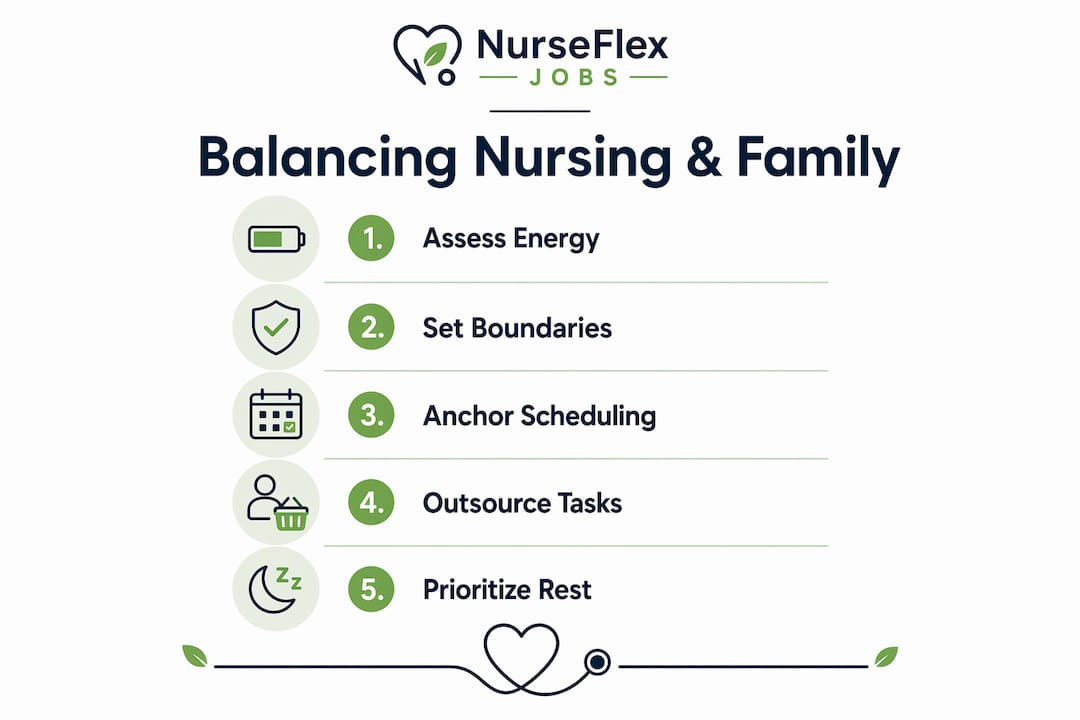
The first step is understanding your energy, not just your hours. More than 20% of RNs work 41–50 hours weekly, which creates real emotional exhaustion that spills directly into family life. Long shifts do not just take time. They take the mental and emotional reserves you need to be present at home.
Decompression rituals after shifts are one of the most effective boundary tools available to nurses. A 15-minute walk before entering the house, a short drive in silence, or a consistent post-shift routine signals to your brain that the clinical role is ending and the family role is beginning. This transition is not indulgent. It is protective.

Boundary setting also means communicating clearly with your household. Clear family discussions about your energy levels and workload help set realistic expectations after a demanding shift. Your family does not need a full debrief of your day. They need to know when you are available and when you need 20 minutes to reset.
Pro Tip: Use the anchor point method for scheduling. Identify your fixed, non-negotiable family commitments first, such as school pickups, medical appointments, or a partner's work schedule. Then build your nursing shifts and flexible tasks around those anchors. This approach prevents the most common scheduling conflict: booking work into time that was never actually free.
The anchor point scheduling method works because it forces you to treat family time as a constraint, not a casualty. Most nurses do the opposite. They fill their schedule with work first and hope family time survives. Anchor points reverse that logic.
Key boundary practices that protect family time:
- Set a firm "no phone" window during family meals or bedtime routines
- Communicate your post-shift decompression ritual to your household so they respect it
- Block recovery time on your calendar the same way you block a shift
- Avoid scheduling back-to-back high-demand shifts before major family events
What flexible nursing career pathways support better family balance?
Flexible career planning for nurses with families is less about ambition and more about keeping your options open. Dual credentials and multi-care environment qualifications allow nurses to pivot roles as family demands change without losing professional ground. A nurse certified in both acute care and community health, for example, can shift to a lower-intensity community role during a demanding family season and return to acute care when life allows.
The nursing workforce supports this kind of movement. 81% of nurses would choose the profession again, and many see real possibilities to adjust their roles to fit different life stages. That adaptability is a professional asset, not a compromise.
Flexible career options worth considering:
- Part-time roles: Reduced hours with maintained benefits in many hospital systems
- Casual or per-diem positions: Work when it fits your schedule, with no fixed commitment
- Telehealth and remote nursing: Eliminates commute time and allows home-based work
- School nursing or clinic roles: Align closely with school-age children's schedules
- Agency or float pool nursing: Choose shifts in advance based on family calendar
The nursing career advancement pathways available in 2026 are broader than most nurses realize. Many roles that once required full-time hospital commitments now exist in hybrid or part-time formats.
Thinking about your career in seasons is a practical framework. During early parenthood, a part-time or casual role preserves your license and skills while reducing hours. As children become more independent, you can add hours, pursue specialty certifications, or move into leadership. The career does not have to pause. It just needs to flex. Reviewing part-time nursing job options regularly keeps you aware of what is available when your circumstances shift.
Which household logistics can nurses organize to reduce daily stress?
Outsourcing labor-intensive household tasks is a career move, not a luxury. Delegating chores like grocery delivery, laundry pickup, or periodic cleaning preserves your energy for the moments that matter most: patient care and family connection. Nurses who treat domestic outsourcing as a budget line item rather than an indulgence report less resentment and more presence at home.
Family calendar systems reduce the mental load that nurses carry between shifts. A shared digital calendar with your partner or older children, reviewed weekly, prevents the double-booking and last-minute scrambles that erode family time. Weekly family meetings of 10–15 minutes to align schedules are more effective than reactive daily check-ins.
Practical logistics that reduce pressure:
- Use grocery delivery or curbside pickup on days before long shifts
- Assign age-appropriate household tasks to children to distribute responsibility
- Batch errands into one trip per week rather than multiple short trips
- Explore childcare co-ops with other nursing families for reciprocal coverage
- Ask your employer about childcare benefits or backup care programs
Pro Tip: Lower your housekeeping standards during high-demand work periods. A clean-enough home during a stretch of night shifts is not failure. It is triage. Decide in advance which tasks are non-negotiable and which ones can wait a week.
Reciprocal childcare arrangements with other nursing families are underused. Two families with complementary shift schedules can cover each other's childcare gaps without cost. This works especially well for nurses on rotating schedules who need coverage at non-standard hours when commercial daycare is unavailable.
How can nurses use time management techniques to protect what matters?
Batching is the most underrated time management tool for nurses. Grouping similar tasks together, such as all phone calls, all errands, or all documentation, reduces the mental switching cost that fragments your day. A nurse who batches administrative tasks into one focused hour recovers more usable time than one who handles them reactively throughout the day.
Advance planning is the second pillar. Reviewing the next two weeks of your schedule every Sunday takes about 20 minutes. It reveals conflicts before they become crises and lets you arrange coverage, childcare, or family support proactively.
A practical time management framework for nurses:
- Plan two weeks ahead. Review your shift schedule alongside the family calendar every week.
- Batch similar tasks. Group errands, calls, and administrative work into dedicated blocks.
- Protect one personal recovery activity. Exercise, sleep, or a hobby is not optional. Schedule it like a shift.
- Say no without guilt. Declining an extra shift or a social obligation during a high-demand period is a form of professional sustainability.
- Communicate energy levels to family. After a difficult shift, say "I need 30 minutes" rather than showing up depleted and disengaged.
Learning to say no is a skill that takes practice. Nurses are trained to respond to need, which makes declining requests feel wrong. But balance is sustainable only with intentional systems and a willingness to redefine roles over time. Saying no to one extra shift protects your capacity for the next ten.
Rest is not a reward for finishing everything. It is a prerequisite for doing everything well. Nurses who protect sleep and personal recovery time consistently outperform those who sacrifice rest for productivity.
Key Takeaways
Nurses who balance career and family obligations successfully treat flexibility as a system, not a hope, building their schedules around fixed family anchors and adjusting their career roles as life stages change.
| Point | Details |
|---|---|
| Anchor point scheduling | Fix family commitments first, then build nursing shifts around them to prevent conflicts. |
| Energy management over hours | Track emotional reserves, not just clock hours, to prevent burnout from spilling into family life. |
| Flexible career pathways | Part-time, casual, and dual-credential roles let you adjust workload as family demands shift. |
| Outsource household tasks | Delegating chores protects your energy for nursing and genuine family engagement. |
| Seasonal career thinking | Redefine success at each life stage rather than holding one fixed standard for career and home. |
What I have learned about balance after years in nursing careers
The biggest misconception about nursing career-family balance is that it is something you achieve once and then maintain. That is not how it works. Balance is a recalibration you do repeatedly, sometimes weekly, as shifts change, children grow, and your own needs evolve.
What I have seen consistently is that nurses who struggle most are the ones holding onto a fixed picture of what balance should look like. They measure themselves against a standard that made sense two years ago but no longer fits their life. The nurses who manage well are the ones who give themselves permission to redefine the standard.
Flexibility is not a consolation prize for nurses who could not get a full-time hospital position. It is a deliberate career architecture. The seasonal nature of balance means that a lighter clinical schedule during a demanding family period is not a step back. It is a smart allocation of your most limited resource, which is your energy.
Self-compassion is not soft advice. It is a clinical reality. Nurses who practice it return to work more effectively and stay in the profession longer. The goal is not a perfect week. It is a sustainable career over decades.
— Flexible
Flexiblenursingcareers connects you to roles that fit your life
You have built a career around showing up for others. Your schedule should show up for you too.

Flexiblenursingcareers matches nurses with flexible positions based on your skills, availability, and the hours that actually work for your family. Whether you need part-time shifts, per-diem options, or roles with predictable hours, the platform surfaces real opportunities without a lengthy application process. You can find flexible nursing jobs that fit around school pickups, partner schedules, and the life you are building outside of work. Sign in or create your account to see what is available in your area right now.
FAQ
How do nurses manage work-life balance effectively?
Nurses manage work-life balance by using anchor point scheduling, setting firm post-shift boundaries, and choosing career roles that align with their current family demands. Energy management matters as much as time management.
What nursing roles offer the most family-friendly schedules?
Part-time hospital roles, per-diem positions, telehealth nursing, and school nursing offer the most schedule flexibility for nurses with family commitments. These roles allow shift selection based on your family calendar.
How can I balance nursing and family without burning out?
Protect recovery time as non-negotiable, outsource household tasks during high-demand periods, and communicate your energy limits clearly to your family. Burnout prevention starts with treating rest as a professional requirement, not a reward.
Is it realistic to advance my nursing career while raising a family?
Yes. 81% of nurses would choose the profession again, and many successfully adjust their roles across different life stages. Building dual credentials keeps career options open without requiring a fixed full-time commitment.
How does the anchor point method help with nursing schedules?
The anchor point method places fixed family commitments, such as school hours and medical appointments, as immovable schedule anchors. Nursing shifts and flexible tasks are then arranged around those anchors, reducing conflicts before they happen.