
The most common new nurse job application mistakes are ATS-incompatible formatting, generic resumes, missing license details, vague clinical rotation entries, unprofessional contact info, wrong file types, no follow-up, narrow job targeting, weak references, and unquantified clinical work. Each one has a fast fix you can apply before your next submission.
Here is a quick-reference list of the top mistakes and their one-line corrections:
- ATS-incompatible formatting — Use a single-column PDF with standard fonts and no graphics.
- Generic resume and cover letter — Mirror the exact language from the job posting.
- Missing license or certification details — List state, full license title, license number, and expiration date.
- Vague clinical rotation entries — Format each rotation as a job entry with unit, facility, hours, and three action bullets.
- Unprofessional email or social media — Create a professional email and audit every public profile.
- Wrong file type or file name — Save as PDF and name it Firstname_Lastname_RN.pdf.
- No follow-up after applying or interviewing — Send a thank-you within 24 hours and a check-in after 7–10 days.
- Applying only to top-tier hospitals — Apply broadly in your final semester, including community hospitals and residency programs.
- Weak or unprepared references — Ask references in advance and brief them on the roles you are targeting.
- Unquantified clinical work — Add patient ratios, hours, or procedure counts wherever possible.
Stat to know: Many new-grad resumes are filtered by ATS before a human ever reads them. Formatting errors are the single fastest way to lose an application before it starts.
Key Takeaways
Avoiding the most common new nurse job application mistakes comes down to five actions: ATS-compatible formatting, complete license details, tailored keywords, professional contact info, and a follow-up plan.
| Point | Details |
|---|---|
| ATS formatting is the first filter | Use a single-column PDF with Arial, Calibri, or Times New Roman; no graphics or tables. |
| License details must be complete | List state, full license title, license number, and expiration date on every application. |
| Tailor every application | Mirror the job posting's exact language and include both acronym and full-name versions of credentials. |
| Apply early and broadly | Submit in your final semester and target community hospitals and residency programs, not just top-tier facilities. |
| Flexiblenursingcareers simplifies matching | Verified license storage and keyword-matched job alerts reduce the formatting errors that cost new grads interviews. |
Table of Contents
- 1. Resume formatting mistakes that get you filtered before a human sees you
- 2. Not tailoring your resume and cover letter to the job posting
- 3. How to list licenses, certifications, and clinical rotations so hiring teams notice them
- 4. Contact details and online presence errors that cost you interviews
- 5. Application-portal mistakes that create friction before anyone reads your resume
- 6. Applying too narrowly and too late in your job search
- 7. Failing to follow up after applying or interviewing
- 8. Practical toolkit: resume bullets, cover-letter snippet, and follow-up templates
- What hiring managers actually notice first on new-grad applications
- Flexiblenursingcareers gets your profile in front of the right employers faster
- Authoritative guides and templates to consult next
- Sources
1. Resume formatting mistakes that get you filtered before a human sees you
The single most important fix: submit a plain, single-column PDF using standard fonts. That one change alone prevents the most common automatic disqualification.
Hospital ATS systems routinely fail to parse resumes that contain graphics, tables, headers and footers, text boxes, or unusual fonts. The system reads your resume as garbled text or skips sections entirely. A hiring manager never sees a skills section buried inside a table cell.
| What to avoid | What to use instead |
|---|---|
| Graphics, logos, or icons | Plain text only |
| Tables for layout | Bullet points in a single column |
| Headers and footers with contact info | Contact info in the main body |
| Decorative or uncommon fonts | Arial, Calibri, or Times New Roman, 10–12 pt |
| .docx with tracked changes | Clean PDF |
| Columns or text boxes | Single-column layout |
Standard fonts, a one-column format, and saving as PDF are the baseline requirements for new-grad nursing applications, according to career guidance from the University of Texas at Tyler.
Pro Tip: Build one exhaustive "master resume" that includes every rotation, skill, EMR system, and metric. Then copy and trim it into a clean, ATS-friendly version for each specific posting. You never start from scratch, and you never miss a relevant detail.
2. Not tailoring your resume and cover letter to the job posting
A generic application is the fastest route to rejection. The fix: read the job posting carefully, pull out the exact words and phrases the employer uses, and mirror them in your resume and cover letter.
ATS systems score resumes against the job description. If the posting says "telemetry monitoring" and your resume says "cardiac monitoring," the system may not match them. Use both the acronym and the spelled-out version of every credential and skill (for example, "Electronic Health Records (EHR)" and "Epic EHR") so neither ATS nor a human reader misses it.
Here is how tailoring looks in practice for two different postings:
Med-surg posting bullet:
- Provided post-operative care for 5–6 patients per shift, including wound assessment, pain management, and patient education on discharge medications.
ED posting bullet:
- Assisted with triage and rapid assessment of 8–10 patients per shift in a Level II trauma center, prioritizing acuity using the Emergency Severity Index (ESI).
Same clinical experience, different framing. The keywords change; the facts stay honest.
Recruiters spot a generic cover letter quickly. Mentioning a specific unit program, a named preceptor experience, or a rotation at that facility's own system changes the read entirely.
Beyond keywords, avoid these cover-letter mistakes: opening with "I am applying for the position of…," repeating your resume bullet-for-bullet, and closing with a cliché like "I am a compassionate team player." A stronger two-to-three sentence opener: state the role, name one specific reason you want that unit, and connect it to a concrete rotation experience.
3. How to list licenses, certifications, and clinical rotations so hiring teams notice them
Incomplete license information and vague rotation entries are two of the most common nurse application errors that delay or kill a review. The fix: list every license with its state, full title, license number (or "NCLEX passed, pending licensure" if you are pre-license), and expiration date. Format every clinical rotation as a job entry.

Forgetting to include the RN license number, state, or expiration date is a documented mistake that slows the review process and can cause outright rejection at facilities with strict credentialing workflows.
For certifications, list both the full name and the acronym so ATS and human readers both catch it:
- American Heart Association (AHA) Basic Life Support (BLS), expires MM/YYYY
- Advanced Cardiovascular Life Support (ACLS), expires MM/YYYY
- Pediatric Advanced Life Support (PALS), expires MM/YYYY
Listing certifications prominently and formatting each clinical rotation as a job entry with hours and specific clinical activities is the standard recommended by multiple nursing resume guides for new grads.
A rotation entry should look like this:
Clinical Rotation — Medical-Surgical Unit St. Mary's Regional Medical Center, Anytown, TX | January 2025–April 2025 | 180 clinical hours
- Performed head-to-toe assessments and documented findings in Epic EHR for 4–5 patients per shift.
- Administered oral, IV, and subcutaneous medications under RN supervision, maintaining a zero medication error rate.
- Educated patients and families on post-surgical wound care and discharge instructions.
Competency-tracking systems used in long-term care and hospital settings display verified certifications and licenses in structured fields, which is exactly why clear credential formatting on your resume matters — it mirrors what hiring teams are trained to look for.
4. Contact details and online presence errors that cost you interviews
An unprofessional email address, a missing phone number, or a public social media post can sink an otherwise strong application. The fix: use a professional email, include a direct phone number, and audit every public profile before you apply.
Your contact section should include exactly these fields:
- Full name (as it appears on your license)
- Professional email (firstname.lastname@gmail.com or similar)
- Phone number (direct cell, with voicemail set up)
- City and state only (no full street address)
- LinkedIn URL (only if your profile is complete and professional)
Do not include your full mailing address. Do not use a school email that expires at graduation. Do not link a LinkedIn profile that has a blank headline or no photo.
For social media, set all personal accounts to private before you start applying. Search your own name on Google and review the first page of results. Anything public that shows unprofessional behavior, strong political content, or complaints about clinical instructors or patients is a liability. Hiring managers do check. A clean, professional LinkedIn profile with your clinical rotations listed is a genuine asset, especially when it reinforces what your resume says.
5. Application-portal mistakes that create friction before anyone reads your resume
Wrong file types, confusing file names, and skipped required fields cause automatic rejections or delays. The fix: follow the employer's portal instructions exactly and name your file Firstname_Lastname_RN.pdf.
Most hospital portals have specific requirements that candidates overlook:
Common portal pitfalls to avoid:
- Uploading a resume into a free-text field instead of the designated attachment slot.
- Leaving required fields blank because you plan to "cover it in the resume."
- Using a file name like "Resume_final_v3_UPDATED.pdf" instead of a clean, professional name.
- Submitting without checking that all attachments actually uploaded (click the confirmation screen).
- Missing a required cover letter upload because it was listed as "optional" in the instructions but is expected by the facility.
Before you click submit, read through every page of the portal one more time. Confirm all files are attached, all required fields are filled, and the file names are clean. This takes two minutes and prevents a rejection that has nothing to do with your qualifications.
6. Applying too narrowly and too late in your job search
Applying only to prestigious academic medical centers or waiting until after graduation lowers your odds significantly. The fix: apply broadly in your final semester and convert every rotation contact into a potential referral.
Applying in your final semester rather than after graduation and targeting a wide range of facilities, including community hospitals and new-grad residency cohorts, meaningfully increases hiring odds for new graduates. Many residency programs have fixed cohort start dates and close applications months before graduation.
Your preceptors and clinical instructors are your highest-value network contacts. A direct referral from a preceptor to a nurse manager carries far more weight than a cold application. Ask your preceptor early: "Would you be comfortable introducing me to the nurse manager here if a position opens?" Most will say yes if you have performed well.
A simple tracking system keeps your search organized:
- Position title and facility
- Date applied
- Contact name (preceptor, recruiter, or manager)
- Follow-up date
- Status
Recruiters often review applications in early-week batches, so submitting on Tuesday or Wednesday morning can improve your visibility compared to late-week submissions.
Ask references for permission in advance and brief them on the specific positions you are targeting. A reference who knows what role you are applying for gives a far more relevant and timely endorsement than one who is caught off guard by a call.
7. Failing to follow up after applying or interviewing
Not following up, or following up in a way that feels pushy, both cost opportunities. The fix: send a brief thank-you within 24 hours of an interview and a polite check-in if you have not heard back within the stated timeline.
Here is a simple follow-up timeline:
Within 24 hours of an interview: Send a short thank-you email. Reference one specific detail from the conversation, restate your interest in the role, and confirm your availability. Keep it to three to four sentences.
7–10 days after applying (if no response date was given): Send a brief, professional check-in. State the role, the date you applied, and ask politely whether there is any additional information you can provide.
One final follow-up: If you still have not heard back after the first check-in, one more polite message is appropriate. After that, move on and keep applying.
Keep every message short, specific, and professional. A follow-up that references something real from the interview shows attention and genuine interest. A generic "just checking in" message does not.
8. Practical toolkit: resume bullets, cover-letter snippet, and follow-up templates
Use these micro-templates to fix the most common problems before your next submission.
Strong resume bullet examples:
- Administered medications to 5–6 post-surgical patients per shift, achieving zero medication errors across 180 clinical hours in a med-surg rotation.
- Performed IV insertions, wound care, and catheter management under RN supervision in a 32-bed telemetry unit.
- Educated patients on diabetes self-management, contributing to a measurable improvement in discharge readiness scores tracked by the unit educator.
- Collaborated with interdisciplinary teams (physicians, PT, social work) to coordinate discharge planning for complex patients.
- Documented patient assessments and care plans in Epic EHR, maintaining accuracy and timeliness across all assigned patients.
Cover-letter opener template:
"I am applying for the Registered Nurse position on your Medical-Surgical Unit at [Facility Name]. During my 180-hour clinical rotation at [Rotation Facility], I developed strong post-operative assessment and patient education skills that align directly with the competencies listed in your posting. I am eager to bring that experience to your team."
Follow-up email template (post-interview):
"Dear [Name], thank you for meeting with me today regarding the [Position] role. I appreciated learning about [specific detail from the interview]. I remain very interested in joining your team and am available to provide any additional information. I look forward to hearing from you."
Resume quick-fix checklist:
| Check | Standard |
|---|---|
| Font | Arial, Calibri, or Times New Roman, 10–12 pt |
| File type | PDF, single column, no graphics |
| License entry | State, full title, license number, expiration |
| Certifications | Full name + acronym (e.g., AHA BLS) |
| Clinical rotations | Unit, facility, hours, 3+ action bullets |
| Keywords | Mirrored from the job posting |
| File name | Firstname_Lastname_RN.pdf |
For longer templates and resume reviews, the skills-based job matching guide on Flexiblenursingcareers explains how to align resume skills to job descriptions so your profile surfaces in employer searches. For role-specific formatting, the NP job search mistakes guide covers deeper examples you can adapt.
What hiring managers actually notice first on new-grad applications
The first thing a nurse manager checks is not your GPA. It is whether your license status is visible and whether your rotation entries tell a clear story about what you can actually do on day one.
Confusing timelines, poor formatting, and overstated experience are the recurring red flags hiring managers and nurse recruiters report seeing most often. A resume that lists "assisted with patient care" for every rotation tells a manager nothing about your clinical readiness. A resume that says "performed 12-lead EKG interpretation and telemetry monitoring for 4 patients per shift in a cardiac step-down unit" tells them exactly what they need to know.
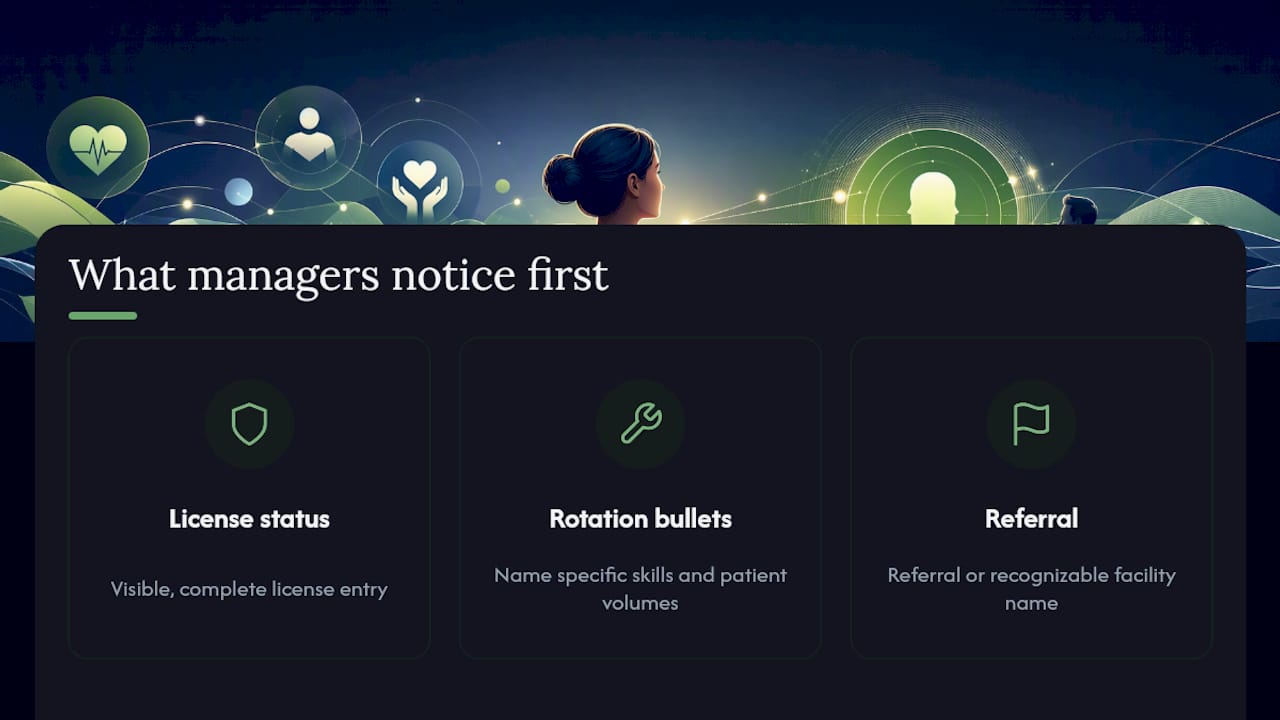
ATS does the first filter. The manager does the second. For a new grad, the shortlist is built from three signals: a visible, complete license entry; rotation bullets that name specific skills and patient volumes; and a referral or recognizable facility name. You can control all three.
AMN Healthcare notes that mistakes are expected and normal for new nurses, which means framing your application around learning, growth, and specific clinical skills is more credible than projecting false confidence. Managers know you are new. What they want to see is that you are organized, honest, and ready to learn.
Flexiblenursingcareers gets your profile in front of the right employers faster
Fixing your resume manually takes time. Flexiblenursingcareers cuts the administrative work by matching you to nursing jobs based on your verified skills, license status, and availability, so you spend less time reformatting and more time interviewing.

Your structured profile on Flexiblenursingcareers stores your license information and certifications in verified fields, which means the formatting errors that trip up ATS systems are handled at the platform level. Job alerts surface roles that match your clinical keywords, so you are not manually scanning postings and guessing which ones fit. Rapid onboarding means you can go from profile completion to active matching quickly, without a lengthy back-and-forth application process.
Complete your profile on Flexiblenursingcareers today and start matching to flexible nursing roles that fit your schedule and specialty.
Authoritative guides and templates to consult next
These resources give you concrete templates and deeper guidance to implement the fixes above.
- UMass Lowell Career Services — Nursing Resume Guide (2026) — ATS checklist and template examples with formatting rules for new-grad nursing resumes.
- University of Texas at Tyler — New Grad Nurse Resume (PDF) — Detailed font, layout, and license-entry guidance with a downloadable template.
- Rnresume — Practical ATS optimization steps and free template for new graduates.
- VantageResume — New Grad Nurse Resume: Skills & No-Experience Tips (2026) — Clinical rotation formatting examples and guidance on leading with clinical hours.
- Nurse-job-find — Cover-letter customization examples and recruiter-timing insights.
- Baton Rouge General — 5 Mistakes to Avoid When Applying for Nursing Jobs — Concise checklist of license and certification errors to avoid.
- Nox — How New Grad Nurses Find Their First RN Job in 2026 — Early-application strategy and preceptor-referral tactics for new graduates.
Sources
- Nursing resume guide with template examples (2026) | UMass Lowell Career Services
- New grad nurse resume guidance (PDF) | University of Texas at Tyler Career Success
- Rnresume
- New Grad Nurse Resume: Examples, Skills & No-Experience Tips (2026) | VantageResume
- Nurse-job-find
- 5 Mistakes to Avoid When Applying for Nursing Jobs — Baton Rouge General
- How New Grad Nurses Find Their First RN Job in 2026 | Nox