
Technology is the primary driver of speed, accuracy, and flexibility in travel nurse placement today. AI-driven job matching, digital credentialing platforms, and on-demand staffing apps have replaced the slow, paper-heavy processes that once kept nurses waiting weeks for a single assignment. The role of technology in travel nurse placement now extends far beyond basic job boards. It determines which shifts you see, what pay you're offered, and how fast you start working. This guide breaks down exactly how these tools work, where they fall short, and how you can use them to your advantage.
What digital tools are used in travel nurse placement?
Travel nurse recruitment software falls into two broad categories: recruiter-assisted platforms and gig-shift apps. Understanding the difference changes how you approach your job search.
Recruiter-assisted platforms use AI to handle the repetitive work. AI automates candidate search and scheduling tasks, freeing recruiters to focus on contract negotiations, housing support, and resolving disputes. The technology handles the volume. The recruiter handles the complexity. This combination produces better outcomes than either approach alone.

Gig-shift apps take a different path. On-demand platforms let nurses claim open shifts instantly, complete credential verification digitally, and receive automated payments without speaking to a recruiter. The speed is real. The tradeoff is that you handle everything yourself.
Digital credentialing systems sit at the center of both models. These tools verify licenses, certifications, and compliance documents automatically. AI matches nurses based on credentials and location preferences, cutting the back-and-forth that once added days to a placement. Platforms like these have made same-day placement a realistic outcome rather than an exception.
Here is a breakdown of the core digital tools in nurse staffing technology today:
- AI resume screening: Algorithms scan your profile for specialty, certifications, and work history to surface the most relevant positions.
- Digital credentialing systems: Automated tools verify licenses and compliance documents in real time, removing manual delays.
- On-demand shift apps: Nurses browse and claim open shifts directly, with no recruiter involvement required.
- Job match algorithms: These systems cross-reference your skills, location, and availability against open positions to rank the best fits.
- Automated payment processing: Gig platforms calculate and issue pay without manual payroll steps.
Pro Tip: Keep your profile updated on every platform you use. Outdated certifications or missing specialty details cause AI systems to skip you for positions you are fully qualified to fill.
How does technology improve placement speed and job fit?
The speed difference between traditional agencies and digital platforms is significant. Traditional staffing agencies charge a markup of 20–40% on top of a nurse's base pay rate, and placement through those channels typically takes weeks. Digital platforms compress that timeline to hours. That gap matters when a hospital needs coverage by Monday and you want to start earning now.
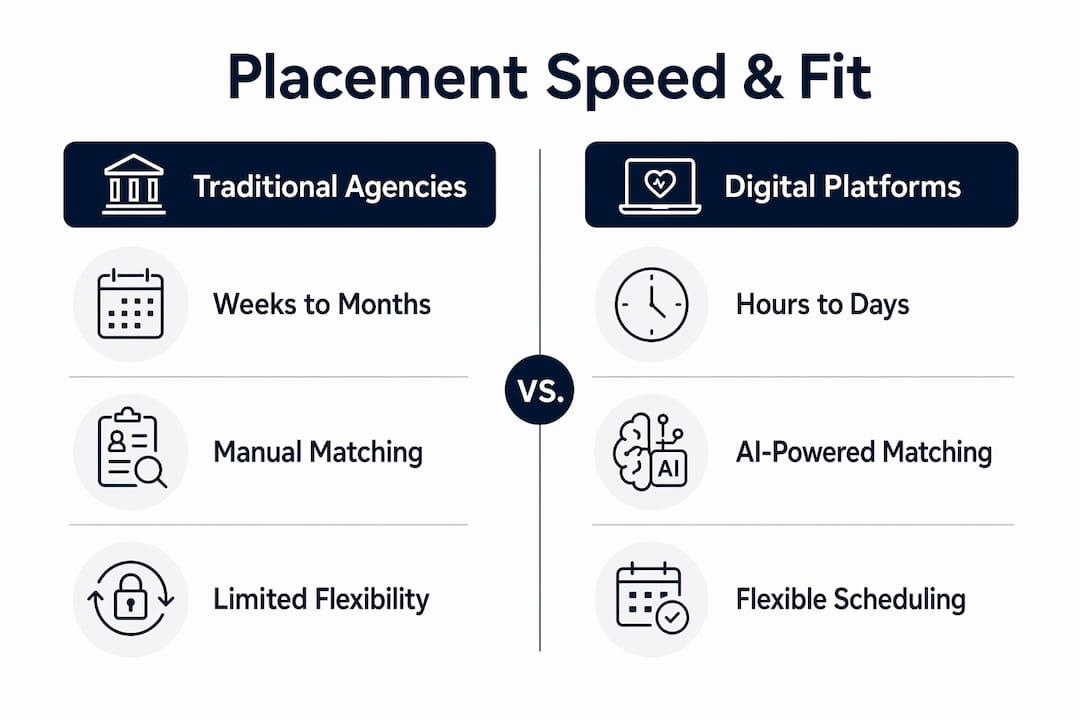
Job fit has improved alongside speed. AI-powered matching platforms integrate a nurse's skills, certifications, and prior behavior to surface positions that align with actual qualifications. The result is fewer mismatches, fewer early contract exits, and better experiences for both nurses and facilities.
Scheduling flexibility is one of the clearest benefits. Flexible scheduling through AI-driven platforms reduces burnout and improves retention among travel nurses. When you control which shifts you accept and when you work, you protect your energy and your career longevity.
| Factor | Traditional agency | Digital platform |
|---|---|---|
| Placement timeline | Several weeks | Hours to same day |
| Agency markup | 20–40% on base pay | Reduced or eliminated |
| Credential verification | Manual, paper-based | Automated, real-time |
| Shift flexibility | Recruiter-controlled | Nurse-controlled |
| Human support | Dedicated recruiter | Limited or self-service |
The table above shows why digital staffing platforms have gained ground quickly. Speed and control are the two things travel nurses consistently say they want most.
What are the limitations of technology-driven placement models?
Technology in nursing placements is not a perfect system. The most important limitation is one most platforms will not advertise openly.
AI screening tools adjust initial job offers by 5–10% based on how quickly a nurse accepts contracts. Candidates who accept fast get categorized into lower negotiation tiers. The system reads speed as desperation and prices accordingly. This is not a bug. It is a deliberate feature of how agency AI manages cost.
Gig-shift apps carry a different set of risks. Gig platforms lack the dedicated human intermediation found in traditional agencies. When a contract dispute arises, a shift gets canceled at the last minute, or a facility misrepresents conditions, you have no recruiter to call. The platform's automated system was not built to handle those situations.
Here are the key limitations to watch for:
- Pay tiering by acceptance speed: Accepting offers too quickly signals low negotiation leverage to AI systems.
- No human advocate in disputes: Gig apps offer speed but leave you without support when things go wrong.
- Profile data gaps: Incomplete nurse profiles produce poor AI matches and irrelevant job suggestions.
- Algorithmic blind spots: AI cannot assess soft factors like unit culture fit or a manager's leadership style.
- Overreliance on automation: Platforms that remove recruiters entirely lose the ability to handle complex, nuanced situations.
Pro Tip: When using any AI-driven platform, take 24–48 hours before accepting an offer. Negotiating even a small increase signals to the algorithm that you are not a quick-accept candidate, which can protect your pay tier on future placements.
The recruiter-less model has real weaknesses that become visible the moment something goes wrong. Technology handles routine placements well. It handles exceptions poorly.
How can travel nurses use technology to improve their career options?
Getting the most from nurse staffing technology requires active management of your digital presence and a clear strategy for how you engage with platforms.
-
Complete your profile in full. Every certification, specialty, and preferred location you add improves the accuracy of AI matching. Gaps in your profile push you toward less relevant positions and lower-paying tiers.
-
List your premium certifications prominently. Certifications like CCRN, CEN, or PALS trigger AI filters that surface higher-acuity, higher-paying assignments. Platforms scan for these terms directly.
-
Claim shifts during off-peak hours. On-demand platforms often surface the best shifts early in the morning or late at night, before high-traffic periods when competition increases.
-
Communicate preferences clearly and specifically. Vague preferences like "flexible" produce vague matches. Stating a specific state, shift type, and specialty narrows the algorithm toward positions that actually fit your life.
-
Maintain at least one recruiter relationship. Human advocacy remains essential when contract disputes, facility issues, or licensing complications arise. A recruiter who knows your history can resolve in one call what an automated system cannot resolve at all.
-
Use real-time matching tools for scheduling control. Real-time job matching gives you the ability to build a schedule around your life rather than accepting whatever a recruiter has available that week.
The impact of tech on travel nursing is greatest when you treat platforms as tools you control, not systems that control you. Nurses who actively manage their profiles and negotiate offers consistently outperform those who accept the first match the algorithm surfaces.
Key Takeaways
Technology reduces travel nurse placement time from weeks to hours, but nurses who understand how AI systems work earn more and experience fewer mismatches.
| Point | Details |
|---|---|
| AI speeds up placement | Digital platforms compress placement timelines from weeks to same-day through automated matching. |
| Pay tiers are algorithm-driven | Accepting offers too fast can reduce your initial pay offer by 5–10% due to AI negotiation tiering. |
| Profile quality drives match quality | Incomplete profiles produce poor AI matches; full, current profiles surface better positions. |
| Human recruiters still matter | Gig platforms lack human advocates; maintain at least one recruiter relationship for complex situations. |
| Scheduling control reduces burnout | Flexible shift selection through digital tools improves nurse satisfaction and long-term retention. |
What I've learned watching AI reshape nurse placement
The most common mistake I see travel nurses make is treating technology as a neutral system. It is not. Every platform has incentives built into its algorithm, and those incentives do not always align with yours.
The agencies and platforms that get this right are the ones that use AI to handle volume and speed while keeping humans in the loop for anything that requires judgment. That combination works. Pure automation, where a nurse never speaks to a person, works fine until it doesn't. And when it fails, it fails hard.
What I find genuinely promising is how automation in healthcare job placement has shifted power toward nurses who know how to use it. You can now see more positions, compare them faster, and claim shifts without waiting for a recruiter to return your call on a Tuesday afternoon. That is a real improvement.
The nurses who thrive in this environment are not the ones who chase every new app. They are the ones who pick two or three platforms, keep their profiles sharp, negotiate deliberately, and maintain a human relationship they can call when the algorithm gets it wrong. Technology is a tool. Use it like one.
— Flexible
Flexiblenursingcareers and your next placement
Flexiblenursingcareers was built around exactly the model described above: AI-driven matching paired with real human support, not one or the other.

The platform connects travel nurses with positions matched to their specialty, certifications, and availability in real time. Credential verification is automated. Shift claiming is instant. And when you need a person, one is available. If you are ready to see how nurse-controlled placement works in practice, sign in or create your account at Flexiblenursingcareers and browse open positions today. The process takes minutes, not weeks.
FAQ
What is the role of technology in travel nurse placement?
Technology automates job matching, credential verification, and scheduling in travel nurse placement. It reduces placement time from weeks to hours and improves the accuracy of job-nurse fit.
How does AI affect travel nurse pay rates?
AI systems adjust initial offers by 5–10% based on how quickly a nurse accepts contracts. Nurses who negotiate rather than accept immediately tend to receive better pay tiers.
What is the difference between a gig-shift app and a recruiter-assisted platform?
Gig-shift apps let nurses claim shifts independently with no recruiter involvement. Recruiter-assisted platforms use AI for matching but keep human recruiters available for support, negotiations, and dispute resolution.
Why does profile completeness matter on digital staffing platforms?
Automated systems rely on accurate data to generate relevant matches. Missing certifications or outdated specialty information causes AI to surface irrelevant positions and lower-priority placements.
Can technology fully replace human recruiters in travel nursing?
Technology handles routine placements efficiently, but human advocacy remains essential for contract disputes, complex licensing issues, and situations where judgment and empathy are required.