
Yes, you can do local travel nursing, and it's more common than most nurses realize. It shows up as local contract work, PRN shifts, or short-term assignments close to home, not the cross-country relocations people picture when they hear "travel nurse."
The fastest route in is a specialist staffing platform that supports real-time local matching, like NurseFlex Jobs, with location-radius filters turned on. From there, three things move you forward today: set your search radius to your actual commute tolerance, pull together your license and certification documents, and apply to two or three nearby listings before the day ends.
Key Takeaways
Local travel nursing succeeds when you pair a real-time matching platform with a complete credential packet and a clear read on contract terms before you sign.
| Point | Details |
|---|---|
| Local travel nursing is real | It typically runs as PRN, block coverage, or 4 to 13 week contracts close to home, not relocation-based work. |
| Filters cut search time | Use radius, specialty, and keyword filters like "local contract" or "PRN" to surface live nearby openings faster. |
| Contract terms need verification | Confirm start/end dates, cancellation policy, overtime rules, and guaranteed hours before accepting any offer. |
| Document prep speeds onboarding | An active license, certifications, immunizations, and references ready in advance shortens time to first shift. |
| NurseFlex Jobs matches locally in real time | Location-radius filters, posted pay ranges, and credential verification are built into the platform's matching process. |
Table of Contents
- Where Can You Find Local Travel Nursing Jobs?
- What Is Local Travel Nursing, and How Is It Different?
- What Do Local Contracts Actually Pay, and How Long Do They Run?
- How Do You Evaluate a Platform or a Local Offer?
- How Long Does It Take to Apply and Start Working?
- How Does NurseFlex Jobs Speed Up Local Placements?
- When Does Local Travel Nursing Actually Make Sense?
- Ready to Search Local Contracts Near You?
- Where to Verify Listings and Platform Terms
- Sources
Where Can You Find Local Travel Nursing Jobs?
Four channels produce most of the live listings worth your time:
- Specialist staffing platforms with real-time matching, filtered to your radius and specialty.
- Hospital and health system career pages, where facilities post openings directly. HCA Healthcare maintains one of the larger examples, and its career portal shows how workforce partnerships surface local roles.
- General job boards with location and keyword filters, including niche aggregators like Rr that pull in regional postings.
- Local staffing agencies that specialize in a single metro area or hospital network.
Once you're on any of these, filter by radius first, then layer in keywords like "local contract," "PRN," or "short-term," plus your specialty and preferred shift type. Narrow filters beat broad searches, since a generic "travel nurse" search buries local roles under long-distance listings.
Pro Tip: Set up saved searches and email alerts on two or three platforms at once. Local roles fill fast, and an alert often beats a manual search by hours.
What Is Local Travel Nursing, and How Is It Different?
Local travel nursing means short-term, nearby assignments, usually within your home state or a reasonable commute, filling staffing gaps without requiring relocation. It's not a separate job category so much as a different shape of the same work.
Three differences matter most compared to traditional travel nursing. Duration tends to run shorter, often 4 to 13 weeks instead of a standard 13-week minimum built around relocation. Housing and stipend packages rarely apply, since you're driving in rather than living on-site. And license reciprocity is simpler when you're already licensed in-state or hold a multistate compact license, since you skip the cross-state licensing wait entirely.

You'll see local travel nursing most often in PRN pools, block shift coverage, holiday staffing gaps, and short seasonal contracts where a facility needs help now, not in six weeks.
What Do Local Contracts Actually Pay, and How Long Do They Run?
Contract length and pay structure vary more in local work than in traditional 13-week travel contracts, and knowing the shape of each type helps you compare offers honestly.
PRN and per diem work pays by the shift with no guaranteed hours. Short-term contracts running 4 to 13 weeks usually come with a set schedule and sometimes guaranteed hours. Block coverage fills a specific known gap, like a maternity leave or a facility's seasonal surge.
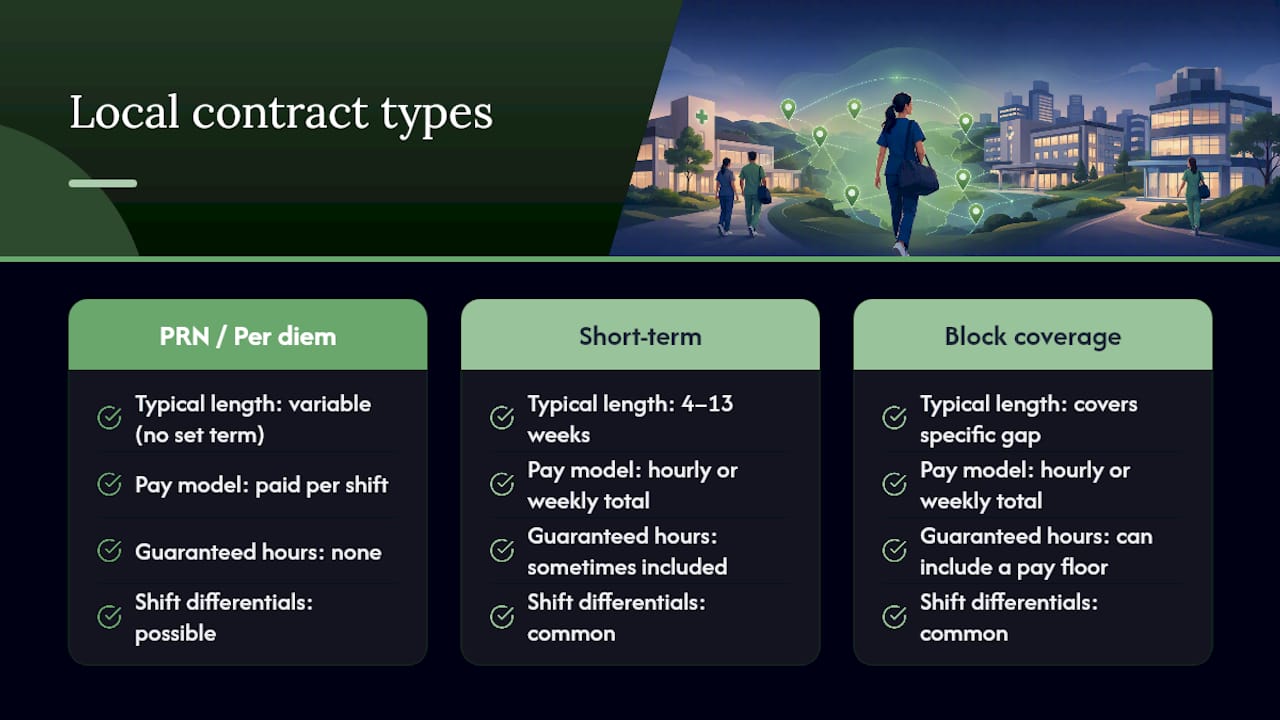
Pay itself typically shows up as an hourly wage or weekly total, often with shift differentials for nights, weekends, or holidays. Some contracts include guaranteed hours as a pay floor, which protects you if census drops mid-contract. Benefits vary widely. Some local roles include none, others offer limited health coverage or a stipend equivalent.
Before signing anything, confirm four things: exact start and end dates, the cancellation policy and who can invoke it, overtime rules, and the specific scope of duties you're expected to cover. Contract types differ enough that assuming standard terms is a common way nurses get shorted on pay or hours.
How Do You Evaluate a Platform or a Local Offer?
Not every platform or offer deserves your credentials and your time. A short checklist filters out the weak ones fast.
For the platform itself, look for:
- Real-time job matching instead of static listings that go stale.
- Posted pay ranges or transparent weekly pay, not "competitive pay" with no number attached.
- Quick onboarding with clear steps, not an open-ended "we'll be in touch."
- Active local listings updated recently, not a job board padded with expired posts.
- Clear privacy and terms pages. Reviewing a platform's privacy policy and terms of service before sharing credentials is standard due diligence, not overcaution.
For an individual offer, verify the posted pay or guaranteed hours in writing, confirm exact shift expectations before you accept, and read the cancellation and liability terms closely. Terms of use pages from staffing partners often spell out exactly what happens if a contract ends early, and that clause matters more than the pay rate in a surprising number of disputes.
Watch for red flags: vague pay language ("DOE" with no range), no written contract, requests for upfront fees of any kind, or a platform that skips credential verification entirely. A platform that doesn't check your license and certifications isn't protecting the facility, and it isn't protecting you either.
How Long Does It Take to Apply and Start Working?
The path from application to first shift follows a fairly predictable sequence:
- Apply through your chosen platform or hospital career page.
- Recruiter contact, usually within a day or two on responsive platforms.
- Credential verification, covering your license, certifications, and work history.
- Background check and drug screen, typically a few business days.
- Orientation and first shift, scheduled once verification clears.
Have your documents ready before you apply: active RN license, ACLS/BLS certifications, immunization records, recent clinical references, and photo ID. A complete packet is the single biggest lever you control over your own timeline, and pairing it with in-state licensure and an instant-match platform shortens the wait from application to paycheck.
How Does NurseFlex Jobs Speed Up Local Placements?
NurseFlex Jobs was built around the exact bottleneck local travel nursing usually hits: too much manual back-and-forth between application and first shift. The platform runs real-time job matching against your specialty and availability, with location-radius filtering that surfaces only assignments within the distance you actually want to drive.
Once your profile is set, instant notifications flag new nearby roles as they post rather than making you refresh a job board. Facilities get faster access to qualified candidates, and you get faster visibility into legitimate openings, backed by credential verification on the front end and posted pay ranges instead of guesswork. That combination is what shortens the stretch between "I want a local contract" and "I'm working one."
When Does Local Travel Nursing Actually Make Sense?
Local travel nursing works best when your priorities point toward stability with variety, not variety at any cost. Family obligations, a short commute you actually want to keep, or wanting varied shifts without uprooting your life all favor staying local.
It's also a smart way to test a new specialty or facility type before committing to a full-length travel contract elsewhere. Longer travel assignments still win on pay premiums and the novelty of a new city. Local work wins on continuity and control over your own schedule.
Ready to Search Local Contracts Near You?
NurseFlex Jobs cuts out the waiting that slows down most local job searches. Instead of scanning five different hospital career pages and hoping something nearby posts, you set your radius and specialty once, and the platform matches you against openings as they go live.

Posted pay ranges mean you're not guessing what a shift is worth before you apply, and credential verification runs early so you're not stuck mid-onboarding wondering why a background check is taking three weeks. If you're ready to see what's open near you right now, create a profile and browse current nursing jobs to start matching against local contracts today.
Where to Verify Listings and Platform Terms
Check hospital career portals like HCA Healthcare's for direct local postings, and review a platform's privacy and terms pages before submitting credentials. HealthTrust's workforce pages offer one example of how staffing partnerships get documented publicly.