
Start with a master resume that holds everything, then cut it to one tailored page per application. That single habit separates candidates who get callbacks from those who don't. Here is the nursing resume checklist new graduates need before hitting submit:
-
Contact header — full name, phone, professional email, city/state, LinkedIn URL
-
Professional summary — 2–3 sentences targeting the specific unit or role
-
Licensure and certifications — RN license number (or "NCLEX-RN: pending — expected [month/year]"), BLS, ACLS if applicable
-
Education — degree, school, graduation date, GPA if 3.5 or above
-
Clinical rotations — listed as job-like entries with unit, facility, dates, hours, and 3 bullets each
-
Relevant work experience — any paid or unpaid healthcare-adjacent roles
-
Skills section — hard and soft skills, both acronym and full certification names
-
Optional sections — honors, memberships, volunteer work, languages
-
Tailoring pass — keywords from the job posting woven into bullets and summary
-
Final file check — saved as PDF, named correctly, one page confirmed
Use the Rnresume to run through each item before every submission.
Key Takeaways
A one-page, ATS-ready resume built from a detailed master resume is the most reliable path to a first nursing job interview.
| Point | Details |
|---|---|
| Master resume first | Build a complete master resume before tailoring; it saves time on every application. |
| Clinical rotations as jobs | Format each rotation with unit, facility, dates, hours, and 3 action-verb bullets. |
| Licensure always visible | List RN license number or NCLEX pending date near the top of every version. |
| ATS formatting rules | Use single-column PDF with standard headers; no tables, graphics, or text boxes. |
| Flexiblenursingcareers matching | Create a profile to get real-time matches to entry-level nursing roles without manual searching. |
Table of Contents
- Why does a targeted, ATS-friendly resume matter for new nursing graduates?
- Section-by-section checklist: what goes under each heading
- How do you write strong experience bullets for a nursing resume?
- What ATS formatting rules should your nursing resume follow?
- How do you build a master resume and tailor it for each job?
- Annotated sample resumes and templates for new grads
- What do hiring managers actually prioritize on new-grad resumes?
- Pre-submission checklist: final checks before you send
- What new-grad resumes actually get right — and what most miss
- Your next step after finishing your resume
- Sources
Why does a targeted, ATS-friendly resume matter for new nursing graduates?
A targeted resume does two jobs at once: it clears the automated filter and convinces the human who reads it next. Most hospital systems use applicant tracking systems (ATS) to screen resumes before a recruiter ever opens one. If your resume doesn't contain the right keywords in a readable format, it gets filtered out regardless of your qualifications.
For new grads, the stakes are higher. You don't have years of paid nursing experience to fall back on, so the structure and content of your resume carry more weight. Clinical rotations, licensure status, and certifications are the signals hiring managers use to judge your readiness on day one. Placing those items near the top of your resume, as Nursegrid recommends, tells a recruiter immediately that you are clinically prepared.
Recruiters typically spend only a few seconds on an initial resume scan. A clean, one-page document with clear section headers and relevant keywords keeps your name in the pile. A cluttered two-page resume with graphics and missing license information does not.
Pro Tip: Hiring managers at hospital systems report that the most common reason a new-grad resume gets passed over is not lack of experience — it's missing or unclear licensure status. Put your RN license number (or NCLEX pending date) in the header or directly below your name so it's impossible to miss.
Career centers consistently recommend tailoring your resume to each posting by mapping your clinical rotation language to the job description's exact phrasing. According to Fresno State's nursing resume guide, matching your language to the posting increases the likelihood that both the ATS and the recruiter recognize your fit for the role.
Section-by-section checklist: what goes under each heading
Getting the content right matters more than getting the design right. Here is what belongs in each section, with sample phrasing you can copy and adapt.
Contact header
Include your full legal name, a direct phone number, a professional email address (firstname.lastname@gmail.com, not nursenightowl99), your city and state, and a LinkedIn profile URL. Skip your full street address — city and state is enough.
Sample: Jane Doe, BSN, RN | Chicago, IL | jane.doe@email.com | 312-555-0100 | linkedin.com/in/janedoe
Professional summary
Write 2–3 sentences that name your degree, your strongest clinical area, and what you bring to this specific role. Avoid generic phrases like "hardworking team player." Tie it directly to the unit you're applying for.
Sample: "Recent BSN graduate with 600+ clinical hours across medical-surgical and telemetry units. NCLEX-RN passed May 2026. Seeking a med-surg position at Northwestern Memorial where I can apply evidence-based care skills developed during a 120-hour adult acute care rotation."
Licensure and certifications
List your RN license with the state, license number, and expiration date. If you haven't passed the NCLEX yet, write "NCLEX-RN: pending — expected [month/year]." Include BLS (Basic Life Support) and any other certifications on separate lines with expiration dates.
According to Nursegrid's new-grad resume template, placing licensure near the top signals clinical readiness before a recruiter reads a single bullet point.
Education
List your most recent degree first: degree name, school, city/state, and graduation month and year. Include your GPA only if it is 3.5 or higher. If you graduated with honors (cum laude, Dean's List), include it on the same line.
Sample: Bachelor of Science in Nursing (BSN) | University of Illinois at Chicago | Chicago, IL | May 2026 | GPA: 3.7 | Dean's List
Clinical rotations
This is the most important section for a new-grad resume. Format each rotation like a job entry: unit type, facility name, city/state, dates, and total hours. Follow with 3–5 action-oriented bullets. NurseZee's first-job guide specifically recommends listing patient load and hours to give hiring managers a concrete sense of your exposure.
Sample entry:
Medical-Surgical Rotation | Northwestern Memorial Hospital | Chicago, IL | Jan 2026 – Apr 2026 | 120 hours
- Assessed and monitored 4–6 post-operative patients per shift, documenting vitals and pain scores in Epic EHR
- Administered oral and IV medications under RN supervision, verifying five rights of medication administration
- Educated patients on discharge instructions for wound care and activity restrictions
Work experience
Include any paid or unpaid healthcare-adjacent roles: CNA, patient care technician, medical scribe, home health aide, or hospital volunteer. If you have no healthcare experience, include other jobs that show reliability, communication, and patient-facing skills. Frame every bullet around transferable skills.
Unpaid and extracurricular experiences count. Simple Nursing's resume guide notes that simulation projects and volunteer work help new grads demonstrate hands-on engagement when paid nursing experience is limited.
Skills section
List hard skills (IV insertion, phlebotomy, EHR systems like Epic or Cerner, wound care, telemetry monitoring) and soft skills (patient education, care coordination, critical thinking). Write out both the full name and the acronym for every certification: "Basic Life Support (BLS)" and "Advanced Cardiovascular Life Support (ACLS)." This approach satisfies ATS keyword matching for both the spelled-out version and the abbreviation, as Nightingale College's skills guide recommends.
Optional sections
If space allows, add memberships (Student Nurses' Association, Sigma Theta Tau), volunteer work, languages, or relevant honors. These items signal professional commitment and help you stand out from candidates with identical clinical backgrounds.
Section order and space rules
How do you write strong experience bullets for a nursing resume?
Lead every bullet with an action verb, then describe the task, the method or context, and the measurable result when you have one. That three-part structure turns a vague duty into a concrete achievement.

Before: Helped patients with medications. After: Administered oral and IV medications to 4–6 patients per shift, verifying the five rights of medication administration and documenting in Epic EHR with zero errors during a 120-hour rotation.
The difference is specificity. Numbers, system names, and patient loads give hiring managers something to evaluate.
Action verbs for nursing resumes
Use verbs that match clinical nursing duties. Rotate through this list rather than repeating the same verb:
- Assessment: Assessed, monitored, evaluated, screened, identified
- Treatment and care: Administered, performed, implemented, applied, assisted
- Communication: Educated, counseled, collaborated, communicated, reported
- Documentation: Documented, recorded, charted, updated, maintained
- Coordination: Coordinated, prioritized, triaged, delegated, organized
- Safety and compliance: Verified, confirmed, adhered, followed, ensured
Career services at Fresno State recommend quantifying clinical work wherever possible — patients per shift, hours completed, types of procedures performed.
Three ready-to-copy bullet templates
Use these STAR-lite templates and fill in your own details:
-
Task + method + result: [Action verb] + [clinical task] + [method or setting] + [measurable outcome or scope]. Example: Triaged 8–10 patients per shift in a Level II trauma ED rotation, applying SBAR communication to hand off critical findings to attending RNs.
-
Patient education + outcome: Educated [patient population] on [topic] using [method], resulting in [outcome or observation]. Example: Educated post-surgical patients on wound care protocols using teach-back method, confirming comprehension before discharge.
-
Collaboration + system: Collaborated with [team] to [task], documenting findings in [EHR system]. Example: Collaborated with interdisciplinary care team to update care plans for 5 patients daily, documenting assessments in Cerner.
Pro Tip: If you genuinely cannot quantify a result, add scope instead: the number of patients, the unit type, the hours, or the acuity level. "Monitored telemetry for 6 cardiac patients during a 96-hour ICU rotation" is stronger than "monitored patients" even without a measurable outcome.
What ATS formatting rules should your nursing resume follow?
Save your resume as a PDF and use a clean, single-column layout. That combination passes most ATS parsers and still reads well to a human. The University of Northwestern's nursing resume guide recommends keeping formatting minimal so the document parses correctly across different systems.
Formatting do's
- Use standard section headers: "Education," "Clinical Experience," "Certifications," "Skills"
- Choose a readable font at an appropriate size (see table below)
- Keep margins between 0.5 and 1 inch
- Use consistent bullet style (solid circles or dashes, not custom symbols)
- Submit as PDF unless the job posting specifically requests a Word document
Formatting don'ts
- No tables, text boxes, or columns inside the resume body
- No photos, logos, or graphics of any kind
- No headers or footers containing critical information (ATS often skips them)
- No colored backgrounds or decorative borders
- No unusual fonts or font sizes below 10pt
Missing BLS certification, unclear licensure status, and graphics are among the most common auto-reject triggers identified in ATS screening.
Recommended fonts, sizes, and file types
| Element | Recommended option | Avoid |
|---|---|---|
| Body font | Calibri, Arial, Georgia | Script, decorative, or novelty fonts |
| Name/header font size | 14pt | Below 12pt |
| Body text font size | 10pt | Below 10pt |
| Section header size | 11pt bold | Inconsistent sizing |
| File format | PDF (default), DOCX if required | JPG, PNG, pages files |
File naming: Use a clear, professional file name. Format it as: LastName_FirstName_RN_Resume.pdf. Never submit a file named "resume_final_v3_REAL.pdf."
How do you build a master resume and tailor it for each job?
Keep one detailed master resume with every rotation, skill, certification, and experience you've ever had. For each application, copy it, cut it to one page, and swap in the language from that specific job posting. University of Northwestern's guide explicitly recommends this master-plus-tailored approach to save time without sacrificing relevance.
Step-by-step tailoring process
- Pull the job description. Copy the full text into a separate document.
- Highlight keywords. Look for unit-specific terms (telemetry, PACU, L&D), required certifications (BLS, ACLS, NRP), EHR systems (Epic, Cerner), and soft skills (patient education, charge nurse support).
- Map keywords to your rotations. Find the rotation or experience that best matches each keyword and confirm your bullet uses the same language.
- Write both forms of every acronym. If the posting says "Basic Life Support (BLS)," use both the full name and the abbreviation in your skills section. ATS systems may search for either form.
- Reorder your rotations. Move the rotation most relevant to the target unit to the top of your clinical experience section.
- Rewrite your summary. Drop in the unit name, the facility name if you know it, and the specific skill the posting emphasizes.
- Cut to one page. Remove rotations that don't match the target unit, trim bullets to the three strongest per entry, and move extra items to your master resume.
Pro Tip: Create a simple spreadsheet with one row per job application: job title, facility, date submitted, and the two or three keywords you added. This takes 90 seconds and prevents you from accidentally submitting the wrong version of your resume.
Tailoring your resume to match the job description is one of the most consistent recommendations from career centers and nurse recruiters alike. According to Fresno State's career center, mapping clinical rotation language to the posting's exact phrasing directly increases recruiter interest. For more on avoiding common keyword and tailoring mistakes, the NP job search mistakes guide on the Flexiblenursingcareers blog covers patterns that apply to new grads as well.
Annotated sample resumes and templates for new grads
The fastest way to use a template is to find the one closest to your target unit, then swap in your own rotations and keywords. Simple Nursing's free template library includes downloadable PDF and DOCX formats with pre-built section structures for new grads.
| Template type | Best for | Key adjustment needed |
|---|---|---|
| Med-surg new grad | First hospital job, general acute care | Emphasize patient load per shift and EHR system |
| ICU/critical care | Step-down or ICU rotations | Lead with critical care hours and ACLS certification |
| Labor and delivery | OB/GYN or L&D rotations | Highlight NRP certification and maternal-newborn hours |
| Emergency department | ED rotation experience | Lead with triage exposure and fast-paced environment bullets |
| Telehealth/ambulatory | Remote or clinic-based roles | Emphasize patient education, phone triage, and EHR documentation |
When space is tight, cut in this order: remove rotations unrelated to the target unit first, then trim bullets from four to three per entry, then move honors and memberships to your master resume or cover letter. Never cut licensure, BLS, or your summary.
For specialty-specific roles, check the clinical specialties page on Flexiblenursingcareers to see which units are actively hiring — that tells you which rotations to lead with.
What do hiring managers actually prioritize on new-grad resumes?
Hiring managers prioritize three things: clinical experience mapped to the job, clear licensure status, and evidence of professional commitment. Everything else supports those three signals.
Evidence from career centers and nurse recruiters consistently points to the same patterns. Nursegrid's hiring guidance notes that memberships, volunteer work, and conference attendance help new grads differentiate themselves from candidates with identical clinical backgrounds. When two applicants have the same rotations and the same GPA, the one with a Student Nurses' Association membership and a volunteer shift at a free clinic stands out.
Three things to always include
- Clinical rotations with patient load and hours. A bullet that says "completed a 120-hour med-surg rotation caring for 4–6 patients per shift" tells a hiring manager far more than "completed clinical rotations."
- NCLEX and license status. State it clearly: passed, pending with expected date, or licensed with number and expiration. Ambiguity here is a fast path to the reject pile.
- Relevant certifications with expiration dates. BLS is the minimum. ACLS, NRP, or PALS depending on your target unit. List the full name and the acronym.
Three things to leave off
- Photos. They are not standard in U.S. nursing resumes and can introduce unconscious bias into the screening process.
- Personal data such as age, marital status, or Social Security number. None of this belongs on a resume.
- Vague bullets. "Assisted with patient care" tells a hiring manager nothing. Replace every vague bullet before you submit.
The top skills employers prioritize in 2026 include EHR proficiency, patient education, and care coordination — all of which you can demonstrate through well-written rotation bullets.
Pre-submission checklist: final checks before you send
Run through this list every time, for every application. It takes five minutes and prevents the most common auto-reject triggers.
- File format: Saved as PDF unless the posting requires DOCX
- File name: LastName_FirstName_RN_Resume.pdf (no spaces, no "final_v2")
- One page confirmed: Print preview shows exactly one page
- Header complete: Name, phone, professional email, city/state, LinkedIn
- License status visible: RN license number or "NCLEX-RN pending — expected [month/year]"
- BLS listed: Full name "Basic Life Support (BLS)" with expiration date
- Keywords checked: At least 3–5 terms from the job posting appear in your bullets or summary
- No graphics or tables: No text boxes, images, columns, or decorative elements
- Proofread: Read it aloud once; run it through Grammarly or a similar tool
- Summary is tailored: Unit name and key skill from the posting appear in your summary
Handling NCLEX-pending status: Write "NCLEX-RN: pending — expected [month/year]" in your certifications section. Most hospital systems hire new grads before licensure is confirmed, but they need to see that you have a clear timeline.
For a printable version of this checklist, the RNResume.io new-grad checklist covers every item above and includes a section for double-checking ATS-unsafe formatting.
What new-grad resumes actually get right — and what most miss
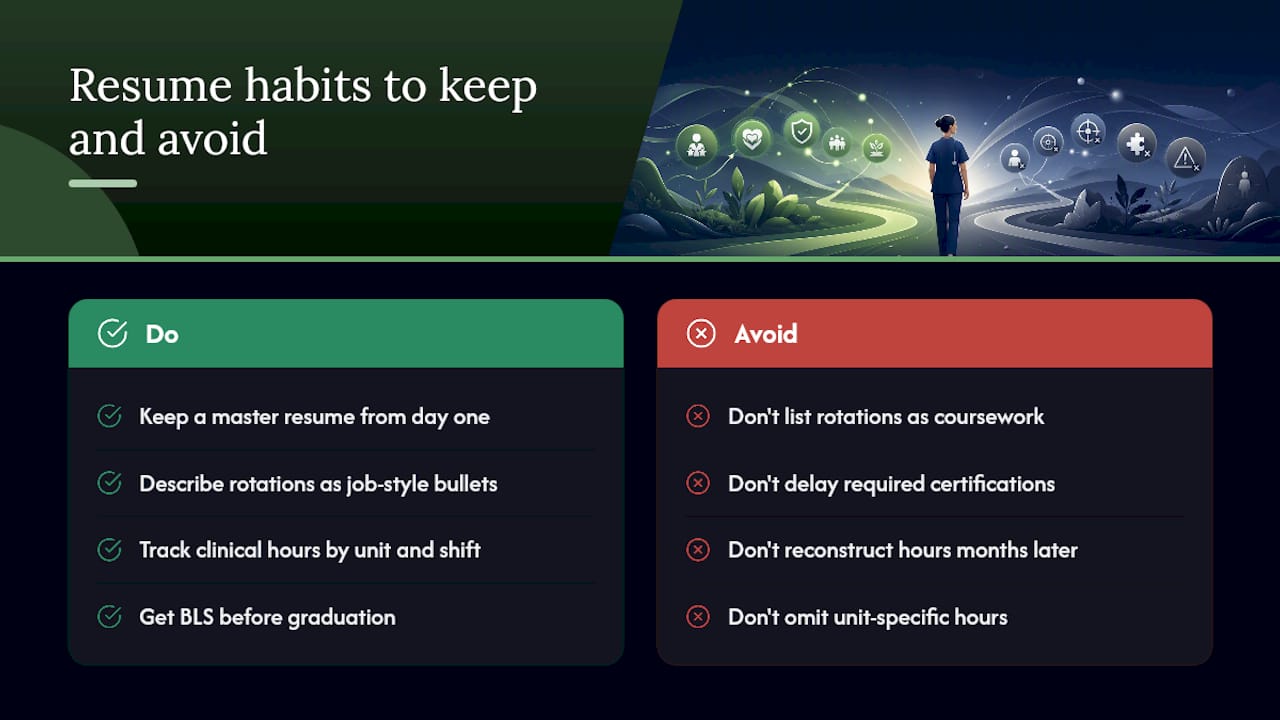
The pattern across successful new-grad resumes is consistent: they treat clinical rotations like jobs, not like coursework. The candidates who get called back fastest are the ones who write "Administered IV medications to 5 patients per shift in a 96-hour ICU rotation at a Level I trauma center" rather than "completed ICU clinical hours."
Three habits separate the resumes that work from the ones that don't.
Maintain a master resume from day one. Start it before graduation and add every rotation, simulation, volunteer shift, and certification as it happens. Trying to reconstruct hours and dates six months after graduation is harder than it sounds. Your master resume is also the document you'll update throughout your career — your first nursing job, your first specialty certification, your first charge nurse shift all belong there.
Track your clinical hours by unit type. Know your numbers: total hours, hours per unit, patient load per shift. These figures belong in your bullets and your summary. A hiring manager for a telemetry unit wants to know you've spent meaningful time on a cardiac floor, not just that you "completed rotations."
Get BLS certified before you graduate, not after. It's one of the most common auto-reject triggers when it's missing, and it signals professional readiness when it's present. The same logic applies to any specialty certification relevant to your target unit.
The Flexiblenursingcareers platform's matching process values the same elements in a candidate profile that hiring managers look for on a resume: documented clinical hours, verified certifications, and clearly stated specialty preferences. A well-built resume and a complete platform profile reinforce each other.
Your next step after finishing your resume
Flexiblenursingcareers connects new nursing graduates directly with hospitals and healthcare facilities that have open entry-level and flexible shifts — no lengthy application queue, no waiting weeks for a recruiter to respond. The platform matches your skills, certifications, and availability to real open roles in real time, so your first job search moves faster than the traditional apply-and-wait cycle.

Once your resume is ready, create a profile on Flexiblenursingcareers and upload your credentials. The matching engine surfaces roles that fit your clinical background, including telehealth nursing positions for new grads interested in remote or ambulatory care. If you'd rather keep tailoring applications manually, the checklist in this guide gives you everything you need. But if you want open shifts matched to your profile without starting from scratch on every application, browse current nursing jobs and sign up to get started.
Sources
- The Ultimate New Grad Nursing Resume Template (with Examples!) | Nursegrid
- Nursing Resume Guide – With Template & Examples (2025)
- Nursing Resume Writing Guide (PDF)
- Rnresume
- Complete Guide on Nursing Resumes | Free Templates Included