
Per diem pay covers travel meals, lodging, and incidental costs at a fixed daily rate, and it stays tax-free only when the amount matches the federal rate and the recipient files a timely expense report. Eligibility for actual employee benefits like health insurance or a 401(k) match, though, has nothing to do with the "per diem" label on your paycheck. It hinges on hours worked, measured against federal thresholds set by the ACA, ERISA, and FMLA, plus whatever your employer's specific policy adds on top.
TL;DR:
- Per diem payments stay tax-free only if they do not exceed federal rates, are substantiated by a timely expense report, and are properly documented within 60 days.
- Rates vary by locality, with GSA publishing annual updates, and higher allowances may be authorized for actual expenses up to 300% of the standard rate with proper verification.
- Benefits eligibility is determined by hours worked, not job title, with thresholds such as 30 hours weekly for ACA or 1,000 hours annually for ERISA, affecting health coverage and retirement plans.
- Proper recordkeeping, including matching expenses to specific trips and maintaining receipts, is essential to avoid reclassification as taxable wages.
- International assignments follow separate rates and documentation rules, with foreign per diem rates in local currencies, and union contracts can set higher rates but do not alter tax rules.
Table of Contents
- What Per Diem Covers and How Employers Pay It
- When Is Per Diem Pay Taxable?
- How GSA Rates Work and the 300% Exception
- Do Hours Worked, Not Job Titles, Decide Benefits Eligibility?
- Getting the Paperwork Right
- A Checklist for Employees and Employers
- How These Rules Play Out for Per Diem Nurses
- Contract, Remote, and Part-Time Nurses: Different Rules Apply
- Does International Travel Change the Rules?
- What Union Contracts Change About Per Diem Eligibility
- Per Diem vs. Mileage, Stipends, and Other Reimbursements
- When Does Per Diem Actually Make Financial Sense?
- Find Per Diem Shifts Without the Guesswork
- Sources
- FAQ
What Per Diem Covers and How Employers Pay It
Per diem is a fixed daily allowance meant to cover travel costs without requiring a receipt for every coffee or cab ride. The IRS and the General Services Administration (GSA) recognize two main flavors, and which one an employer uses depends on the trip and the industry.
Meals and incidental expenses, or M&IE, cover food, tips, and small travel costs like parking or shuttle fares. Lodging per diem covers hotel or extended-stay costs separately, and many employers pay it alongside M&IE as a combined daily rate. A third approach, actual expense reimbursement, skips the flat rate entirely and pays back whatever the traveler actually spent, backed by receipts.
Employers pick between these methods based on predictability and control:
- Meals-only per diem suits short trips where lodging is provided or unnecessary, like a single-day conference.
- Combined lodging + M&IE fits multi-day travel where costs vary by city, which is why GSA publishes separate lodging and meal rates by locality.
- Actual expense reimbursement shows up when a company wants tighter cost tracking, or when a destination's real costs run far above the standard rate.
Hospitals and healthcare staffing agencies often default to a flat meals-only per diem for short assignments, while travel nursing contracts frequently bundle lodging stipends with a separate M&IE allowance. The mix matters less than whether the amount matches what the IRS considers a reasonable, substantiated rate. That distinction decides whether the payment counts as tax-free reimbursement or taxable wages, which is the subject of the next section.
When Is Per Diem Pay Taxable?
Per diem stays off your W-2 as taxable income only when three conditions line up: the payment doesn't exceed the federal per diem rate for that location, the employee submits a compliant expense report, and that report gets filed within a reasonable period. Miss any one of those, and the IRS treats the payment as ordinary wages, subject to income tax and payroll withholding.
IRS guidance is specific about what breaks tax-free treatment. Here's what commonly triggers taxation:
- No expense report filed, or one missing the business purpose, date, and location of travel.
- Per diem paid above the applicable federal rate, with the excess portion taxed regardless of how the rest is handled.
- A flat daily allowance paid with no substantiation requirement at all, which the IRS treats as a wage supplement rather than a reimbursement.
- Reports filed well outside the reasonable period the IRS allows for substantiation.
Reasonable period, in practice, typically means within 60 days of when the expense was paid or incurred. That single number trips up more employers than any other rule in this section. A nurse who works a 12-hour travel shift in March and doesn't submit the expense report until July has likely pushed that per diem into taxable territory, even if every dollar spent was legitimate.
Employers carry the recordkeeping burden here just as much as employees. A compliant program needs a written policy, a standard expense-report template, and someone checking that reports come in on time. Employees protect themselves by treating the 60-day window like a deadline that matters, because once it passes, the tax-free status doesn't come back.
How GSA Rates Work and the 300% Exception
GSA sets standard per diem rates for the continental United States (CONUS) every fiscal year, and the FY2026 bulletin keeps FY2025 rates unchanged: a standard lodging rate of $110 per night and M&IE tiers running from $68 to $92 depending on locality. High-cost cities and specific counties get published rates above the standard, so checking your destination against GSA's own lookup tool matters more than assuming the flat rate applies everywhere.
A few mechanics are worth knowing before you rely on these numbers:
- The locality that sets your rate is based on where the work happens, not where you sleep, unless no lodging exists at the work site itself.
- On the first and last day of federal travel, M&IE pays at 75% of the full daily rate, not the full amount, since you're rarely traveling for a complete 24 hours those days.
- When a work site or installation straddles two per diem localities, the higher of the two rates applies.
Sometimes the standard rate simply doesn't cover reality; a conference books out every hotel in town, or a disaster response sends workers into a market with no available lodging near the federal rate. For those cases, the Federal Travel Regulation allows actual-expense reimbursement up to 300% of the maximum per diem rate, but only with agency authorization and documentation that standard lodging wasn't reasonably available, often verified through a FedRooms availability check first.
Do Hours Worked, Not Job Titles, Decide Benefits Eligibility?
Calling someone a "per diem employee" tells you almost nothing about whether they qualify for health insurance, retirement contributions, or paid leave. Federal statutes measure eligibility by hours worked or service time, not by the label on the pay stub, and employer policy can expand those minimums but rarely override them downward.
Four federal thresholds show up again and again in benefits conversations:
- ACA employer mandate: employers with 50 or more full-time-equivalent employees must offer health coverage to anyone averaging 30 hours per week, and companies use look-back measurement periods, often 3 to 12 months, to average out variable schedules for exactly this determination.
- ERISA retirement plans: traditional rules require plan admission after an employee logs 1,000 hours in a 12-month period.
- SECURE 2.0 pathway: many 401(k) plans must now also admit long-term, part-time workers who log 500 hours in two consecutive years, which opens the door for per diem staff who never hit the older 1,000-hour bar.
- FMLA leave protection: unpaid, job-protected leave requires 1,250 hours worked in the prior 12 months, plus at least a year of employment with that employer.
State and local laws layer on top of these federal floors. Paid sick leave mandates in states like California and New York often kick in at far lower hour counts than FMLA requires, and some apply to part-time and per diem staff specifically because those laws were written to close exactly that gap.
Pro Tip: Ask HR for the exact look-back measurement period your employer uses, not just the hours threshold. Two nurses working identical per diem schedules can land on opposite sides of ACA eligibility depending on whether their employer measures over 3 months or 12.
Employer discretion still matters. A hospital can voluntarily offer prorated PTO or a partial benefits package to per diem staff below federal thresholds, and plenty do to stay competitive in a tight labor market. What no employer can do is deny a benefit to someone who has legally crossed a federal hours threshold simply because their job title says "per diem."
Getting the Paperwork Right
Documentation is what separates tax-free per diem from a payroll headache. A compliant expense report needs the business purpose of the trip, the date, the location, and, for lodging reimbursement, an actual receipt rather than just a stated amount.
- File within 60 days. That's the reasonable-period window the IRS generally recognizes for substantiating expenses; wait longer, and the payment risks becoming taxable retroactively.
- Match the report to the trip, not the pay period. A single report covering three unrelated assignments creates ambiguity that auditors and payroll systems both flag.
- Keep lodging receipts even under a per diem system. M&IE rarely needs receipts, but lodging substantiation depends on the employer's specific policy and whether actual-expense rules apply.
- Avoid the flat, no-questions-asked allowance. Paying a round number with zero substantiation requirement is the fastest way to turn a reimbursement into wages in the eyes of the IRS.
The most common employer mistake is treating per diem as a set-and-forget benefit with no follow-up. Rates change, expense-report templates go stale, and nobody notices until a payroll audit reclassifies six months of "reimbursements" as unreported income.
A Checklist for Employees and Employers
Getting per diem eligibility right takes almost no extra effort if you build a short routine around it.
If you're the employee:
- Log your hours consistently, even across multiple per diem assignments with the same employer.
- File expense reports inside that 60-day window, every time, without exception.
- Ask HR directly what measurement period they use for benefits eligibility and where you currently stand against it.
If you're the employer:
- Publish a written per diem policy that states your chosen rate method and expense-report requirements in plain language.
- Document why you chose GSA standard rates versus actual-expense reimbursement for each program.
- Communicate benefits thresholds proactively, rather than making per diem staff ask.
Pro Tip: If you're not sure whether you're close to a benefits threshold, ask your employer for a year-to-date hours summary. Most payroll systems can generate one instantly, and it's the fastest way to settle the question without guessing.
How These Rules Play Out for Per Diem Nurses
Health systems often build their own measurement structures on top of federal minimums. A common pattern grants immediate benefits eligibility at a 75% appointment level, or eligibility after accumulating roughly 1,560 hours during a 12-month initial measurement period for staff hired on a variable schedule.
A per diem nurse who consistently picks up 30-plus hours weekly across PRN assignments can cross that threshold well before a full year passes. Keeping personal shift logs, alongside the minimum-hours rules many per diem contracts specify, makes it far easier to prove eligibility when HR runs its own count.
Contract, Remote, and Part-Time Nurses: Different Rules Apply
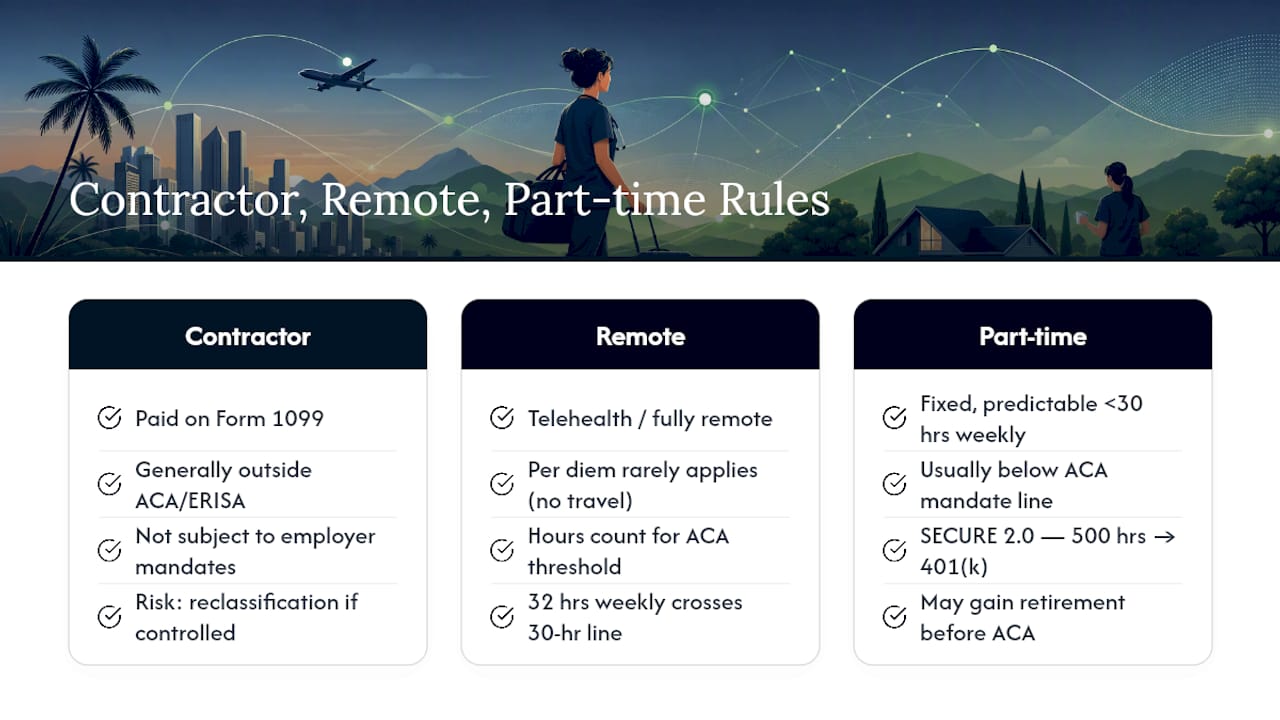
Not every non-staff nurse falls under the same eligibility framework, and confusing the categories leads to bad assumptions. A true independent contractor, paid on a 1099, generally sits outside ACA and ERISA employer-mandate calculations entirely, because those statutes govern the employer-employee relationship, not contracted services. Misclassification, though, is a real risk: if a facility controls your schedule, dictates your methods, and treats you like staff in every way except the paycheck, a court or the IRS may reclassify that relationship regardless of the contract's label.
Remote and telehealth nurses face a narrower question. Per diem travel allowances rarely apply to fully remote work since there's no travel to reimburse, but hours-based benefits eligibility still applies exactly as it would for on-site staff. A remote triage nurse logging 32 hours weekly for the same employer crosses the ACA's 30-hour threshold the same way an on-site colleague would.
Part-time employees who work fixed, predictable schedules under 30 hours weekly generally fall below ACA's mandate line, but SECURE 2.0's 500-hour, two-year pathway can still pull them into 401(k) eligibility years before ACA health coverage would ever apply. That mismatch surprises a lot of long-term part-time staff who assumed no benefits meant no benefits, period. Reviewing flexible nursing contract types before signing helps clarify which category a given role actually falls into.
Does International Travel Change the Rules?
Domestic per diem runs through GSA's CONUS rate tables, but international assignments follow an entirely separate rate structure published jointly by the State Department for foreign posts, with different lodging caps and M&IE tiers by country and city. A nurse or healthcare worker on an international humanitarian deployment isn't working off the same $110 lodging figure that applies stateside; foreign per diem rates can run substantially higher or lower depending on local cost of living.
Eligibility mechanics stay conceptually similar. The employer still needs to substantiate the payment against a published federal rate and collect a timely expense report to preserve tax-free treatment, but the applicable rate table changes entirely once the destination crosses a border. Employers running international assignments need a separate policy line addressing which rate table applies, since defaulting to CONUS numbers for an overseas post is a documentation error that surfaces quickly in an audit.
Currency also complicates things in ways domestic per diem never does. Foreign per diem rates are set and published in U.S. dollars regardless of local currency, which simplifies payroll but means employers should still confirm the current published rate rather than relying on a prior assignment's numbers, since foreign rates are revised more frequently than the stable CONUS tables.
What Union Contracts Change About Per Diem Eligibility
Collective bargaining agreements can set per diem terms that exceed federal minimums, and in unionized healthcare settings, they frequently do. A union contract might guarantee a specific per diem rate regardless of GSA's published figure, mandate benefits eligibility at a lower hours threshold than ACA requires, or bar an employer from classifying certain shift patterns as per diem at all if they resemble full-time work.
What a union contract cannot do is authorize tax treatment that violates IRS rules. Even a generous, contractually guaranteed per diem rate above the federal maximum still triggers taxable income on the excess portion; collective bargaining sets the pay, not the tax code. Nurses working under a union agreement should read the per diem and benefits sections of that contract directly rather than assuming general per diem rules apply unmodified, since the negotiated terms often supersede employer-default policy in ways that favor the worker.
Per Diem vs. Mileage, Stipends, and Other Reimbursements
Per diem doesn't operate alone. Most travel-heavy jobs, healthcare included, combine it with mileage reimbursement, relocation stipends, or housing allowances, and each carries separate substantiation rules under IRS guidance.
Mileage reimbursement uses the IRS standard mileage rate and requires its own log of miles driven, dates, and business purpose, entirely separate from meal or lodging substantiation. A relocation or housing stipend for a longer-term travel assignment often gets paid as a lump sum rather than a daily rate, and depending on structure, may not qualify for the same tax-free treatment per diem enjoys. Double-dipping is the real risk here: claiming per diem lodging while also receiving a separate housing stipend for the same nights can trigger taxable income on the overlap, since the IRS doesn't allow reimbursement for the same expense twice under two different labels.
The safest approach separates each reimbursement type on paper, even when they're paid together. A travel nurse receiving a weekly stipend, a per diem meal allowance, and mileage reimbursement should see three distinct line items, each substantiated against its own rule set, not a single blended number that makes an audit impossible to untangle later.
When Does Per Diem Actually Make Financial Sense?
Per diem pay often runs higher hourly than staff pay, but that premium has to cover what you'd otherwise get through employer benefits: health coverage, a 401(k) match, paid time off. Before taking a per diem role over a staff position, run the actual math on what private insurance or a lost match would cost you. If the premium clears that gap with room to spare, per diem can be a smart way to supplement staff work. If it doesn't, ask HR about your hours-threshold standing before deciding.
— Flexible
Find Per Diem Shifts Without the Guesswork
Once you understand how hours thresholds and documentation shape your benefits picture, the harder part is finding per diem shifts that actually add up to something. There are platforms that match nurses and healthcare professionals to real-time, flexible openings based on your specific skills and availability, cutting out the long application cycles that make it hard to track hours consistently across multiple facilities.

That consistency matters more than most job boards let on. If you're trying to cross an ACA look-back threshold or build toward SECURE 2.0's 500-hour pathway, picking up scattered, hard-to-track shifts across unrelated platforms works against you. A single place to find and log per diem assignments makes that math far easier to do honestly. Browse current openings on the NurseFlex Jobs nursing jobs page and see what flexible shifts are available in your specialty right now.
This article is general information, not a substitute for advice from a qualified lawyer. Consult a qualified legal professional about your own circumstances before acting on anything here.
Sources
- GSA Per Diem Bulletin FTR 26-01
- IRS Publication 15 / IRS per diem guidance
- Do Per Diem Jobs Get Benefits? What the Law Says — LegalClarity
FAQ
What are the per diem guidelines for 2026?
GSA's FY2026 bulletin keeps FY2025 CONUS rates in place: a $110 standard lodging rate and M&IE tiers from $68 to $92 depending on locality, with higher published rates for specific high-cost destinations.
What are the IRS guidelines for per diem payments?
Per diem stays tax-free when it doesn't exceed the federal rate and the employee substantiates it with a timely expense report, generally within 60 days; payments without documentation or above the federal rate become taxable wages.
How many miles away do you need to travel to qualify for per diem?
There's no fixed mileage rule; per diem eligibility depends on whether the trip requires an overnight stay away from your regular work location, not a specific distance threshold, and employer policy often sets the practical cutoff.
Do per diem nurses get employee benefits?
Per diem nurses can qualify for benefits once they cross federal hours thresholds like the ACA's 30-hour weekly average or ERISA's 1,000-hour rule, regardless of their per diem classification, and many health systems track this through measurement periods.