
Most per-diem nursing roles set a per-shift minimum, commonly 4 to 8 hours, and many also require a per-period minimum, such as a set number of shifts each month or a set number of hours per year. Weekend, holiday, or evening shifts often carry separate requirements. For nurses, that means planning income around cancellation policies and guaranteed-call pay. For employers, it means writing minimums that comply with federal overtime and hours-of-service regulations.
TL;DR:
- Most facilities require per-diem nurses to commit to minimum shifts ranging from 4 to 12 hours, often with additional weekend or holiday requirements.
- Per-diem pay typically averages around $48 an hour with premiums up to $30, but cancellation risk can reduce effective earnings significantly.
- Clear policy language about minimum hours, cancellation, and availability must be provided upfront to prevent disputes and promote trust.
- Staffing platforms that list detailed minimums and use real-time matching reduce last-minute no-shows and improve shift fill rates.
- Union and federal rules enforce overtime, benefits eligibility, and cancellation pay, making transparent documentation essential for compliance and fairness.
Table of Contents
- Common Per-Diem Minimum Hours Requirements Employers Set
- What Minimum Hours Mean for Your Income and Schedule
- How Employers Should Structure Minimums and Cancellation Rules
- Legal and Payroll Rules That Govern Per-Diem Hours
- How Staffing Platforms Handle Per-Diem Minimums
- Why Clear Minimums Actually Protect Everyone
- Manage Per-Diem Minimums Without the Guesswork
- Sources
Common Per-Diem Minimum Hours Requirements Employers Set
Employers rarely leave per-diem availability open-ended. Most set a floor, either on the shift level or across a scheduling period, because unpredictable staffing creates gaps in patient coverage that someone has to absorb.
Per-shift minimums are the most visible rule. Facilities often require a nurse to commit to at least several hours per shift, commonly ranging from around 4 to 12 hours, to avoid the churn of constantly re-covering partial shifts. Per-period minimums work differently: instead of shift length, they set a volume target, like two shifts a month or a fixed number of hours across the year. The American Nurses Association's per-diem guidance notes that facilities frequently pair these volume rules with weekend or holiday requirements to keep the per-diem pool actually usable on the days regular staff want off.
Real scheduling clauses spell this out plainly. Sample language collected by Law Insider shows facilities requiring a minimum number of shift availabilities per scheduling period, along with a defined process for submitting that availability in advance. Practical nursing guides cite similar patterns in the field, including examples of minimums such as a required holiday shift annually, some weekend shifts monthly, or a certain number of hours per month as availability floors.
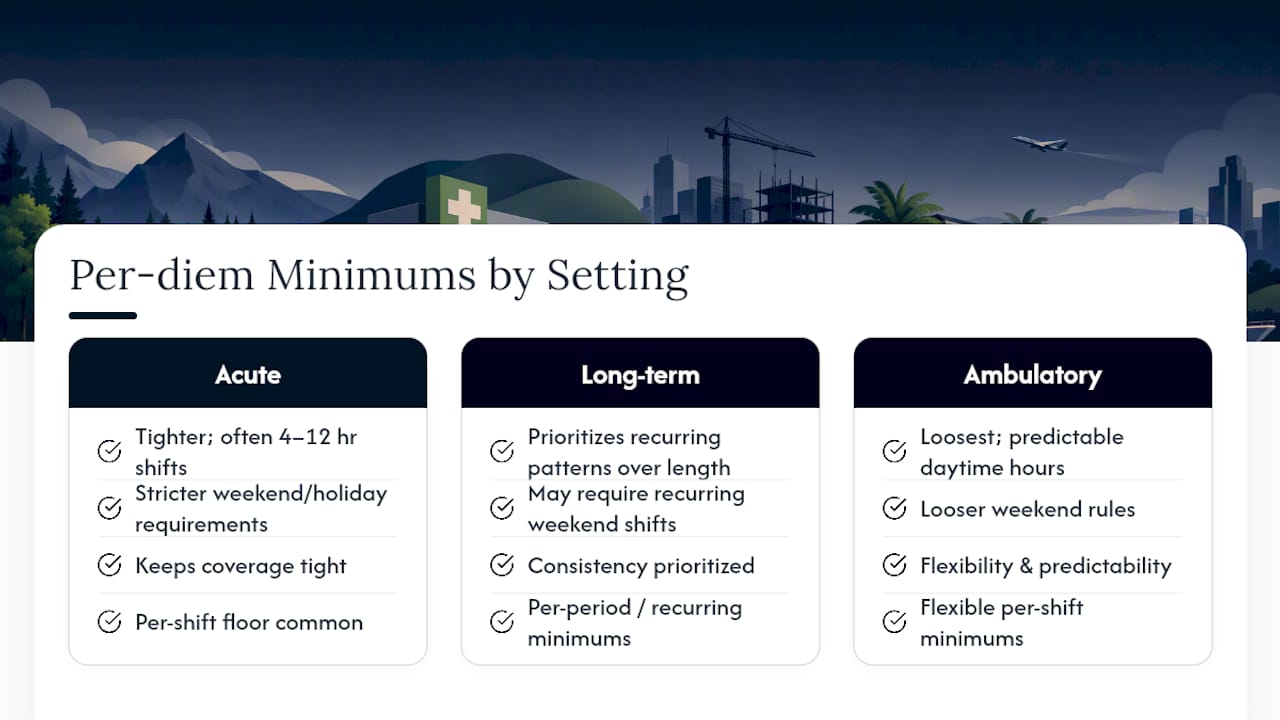
Setting type changes the math considerably. Acute care units with 24/7 coverage needs tend to set tighter per-shift minimums and stricter weekend rules. Long-term care facilities often prioritize consistency over shift length, favoring nurses who commit to a recurring pattern. Ambulatory and outpatient settings, with predictable daytime hours, tend to run the loosest minimums of the three. Job postings and internal schedules usually state these terms up front, since a mismatch discovered after onboarding is what actually damages trust between a facility and its per-diem pool.
What Minimum Hours Mean for Your Income and Schedule
A per-diem hourly premium looks great on paper until you calculate it against real hours worked. National per-diem RN pay averages around $48 an hour, with premiums of $9 to $30 an hour above staff rates depending on specialty and region. That premium exists specifically to offset the risk you're taking on: no guaranteed hours, and in many facilities, per-diem staff are the first to be canceled when census drops.
That tradeoff pushes many nurses toward holding more than one per-diem role at once, both to smooth out income and to hedge against a slow month at any single facility. Here's how to approach it:
- Map your availability cadence first. Decide how many total shifts you can realistically cover before applying to a second facility, so you don't accidentally double-book.
- Track income separately from your primary job. Per-diem pay varies week to week, so treat it like variable income, not a fixed paycheck, when budgeting.
- Confirm certification and experience expectations early. Facilities offering minimal orientation for per-diem staff typically expect one to two years of recent, unit-specific experience, since you're managing a full patient load almost immediately.
- Negotiate shift length before you accept, not after. If an 8 hour minimum doesn't fit your schedule, ask about 4 hour blocks before signing on.
Many nurses build a full flexible income around working multiple employers rather than relying on one per-diem pool.
Pro Tip: Keep a running log of which facility requires what minimum. It sounds excessive until the month you accidentally miss a weekend-shift requirement at one facility because you were covering a holiday shift at another.
How Employers Should Structure Minimums and Cancellation Rules
A minimum-hours policy only works if it's written clearly enough that a nurse can evaluate it before accepting a shift, not after. Vague language ("occasional weekends required") creates more disputes than it prevents.
Strong per-diem policies typically define:
- A specific availability window (how many days in advance nurses submit their schedule)
- Minimums by unit type, since an ICU pool and an outpatient clinic pool shouldn't share identical rules
- A reciprocal cancellation policy: what happens if the facility cancels a confirmed shift versus what happens if the nurse cancels
- How minimums get enforced, including what happens when a nurse repeatedly misses the floor
On that last point, sample clauses from union contracts show how far this can go. The University of California's per-diem nurse bargaining agreement ties special per-diem rights to a documented threshold, roughly 1,000 hours worked in the prior 12 months, along with explicit shift-count and holiday-shift requirements. That level of specificity gives both sides a clear standard to point to, instead of relying on manager discretion.
Pro Tip: Reciprocal cancellation pay isn't just fair, it's a retention tool. A nurse who's been paid for a facility-side cancellation is far more likely to accept the next shift offer without hesitation.

Facilities weighing how tight to make these rules should factor in the real cost of an unfilled shift against the risk of driving away per-diem staff with overly rigid terms.
Legal and Payroll Rules That Govern Per-Diem Hours
Per-diem status doesn't exempt anyone from federal wage law. The FLSA still requires time-and-a-half pay once a nurse crosses 40 hours in a single workweek, and that count includes per-diem shifts stacked on top of a primary job, not just hours at one facility.
The ACA adds a second layer employers have to watch. Coverage obligations are typically measured against 30 hours a week or 130 hours a month, and if a nurse's per-diem hours creep up toward that threshold across a measurement period, it can trigger benefits eligibility the facility didn't plan for.
Union contracts often formalize protections beyond these federal floors:
- Documented minimum-hours thresholds tied to special per-diem rights (per the UC bargaining agreement)
- Guaranteed-call pay when a scheduled shift gets shortened after arrival
- Documented cancellation pay when a facility cancels with insufficient notice
Payroll teams should document guaranteed-call and cancellation pay the same way they document regular hours — as a line item tied to a specific policy, not an informal manager decision, since that paper trail is what protects both the facility and the nurse if a dispute comes up later.
How Staffing Platforms Handle Per-Diem Minimums
Platforms have changed how minimums get communicated, mostly by forcing the terms into the job post itself instead of leaving them to a phone call after the nurse already said yes.
- Job posts capture the specifics up front. Shift length, per-period commitment, and cancellation terms show up before a nurse ever applies, which cuts down on the mismatch problem that plagues informal per-diem pools.
- Nurse profiles that list precise availability book faster. A profile that says "available weekends, 8 hour shifts only" gets matched more reliably than one that just says "flexible."
- Employers who post realistic lead time fill shifts more consistently. A 2026 peer-reviewed analysis of per-diem booking patterns found a median lead time of roughly 24 days between booking and shift date, meaning most per-diem work isn't last-minute at all, it's planned staffing that happens to run through a flexible pool.
- Platforms like NurseFlex Jobs use real-time matching to shorten the gap between posting and fill, which reduces the scramble that happens when a minimum-hours requirement goes unmet close to the shift date.
Setting-based differences still apply here too, especially for rural facilities that often need different minimums than urban acute-care systems running larger per-diem pools.
Why Clear Minimums Actually Protect Everyone
Vague per-diem terms don't create flexibility, they create disputes. A nurse who doesn't know the real minimum until week three is a nurse who starts looking elsewhere. A facility that can't predict which per-diem staff will actually show up isn't running a flexible pool, it's running a gamble.
The tradeoff is real: nurses want flexibility, employers want predictability, and a well-written minimum-hours policy is the only mechanism that gives both sides some of what they want without pretending the tension doesn't exist. Some platforms that force minimums and cancellation terms into the job post before a match happens tend to see fewer last-minute no-shows and faster time-to-fill, because the terms are settled before anyone signs on.
— Flexible
Manage Per-Diem Minimums Without the Guesswork
Some staffing platforms address a common problem: mismatched expectations between what a facility needs and what a nurse can actually commit to. On these platforms, minimum shift length, per-period commitments, and cancellation terms show up directly in the job posting, so there's no surprise conversation three weeks into a placement.

Staffing coordinators can get a faster path to filling per-diem gaps without chasing down availability by phone, and nurses can see the real terms, shift length, weekend or holiday expectations, cancellation rules, before they apply. That transparency is what turns a per-diem pool from a source of scheduling anxiety into something both sides can actually plan around.
If you're a nurse looking for per-diem work with clear terms up front, browse current openings on the nursing jobs page. If you're a staffing manager trying to fill per-diem gaps faster, see how posting works on the employer page.
Sources
- University of California per-diem nurse bargaining agreement (excerpt)
- American Nurses Association — Per Diem Nursing
- Peer-reviewed analysis of per-diem booking patterns (2026)
- Per Diem Nursing 2026: PRN pay & schedule flexibility — The Nursing Directory