
Healthcare vacancy cost is the total financial loss a healthcare organization incurs when a clinical or administrative position remains unfilled, covering direct expenses and lost revenue alike. The industry term for this is "cost of vacancy" (COV), and it hits harder than most administrators budget for. A general RN position costs between $1,200 and $1,500 per day in vacancy expenses alone, with specialized units reaching $2,500 or more. The average RN replacement cost sits at $60,090 per nurse, translating to annual hospital losses of $4.2 million to $6.2 million from nursing turnover. Understanding vacancy costs, calculating them accurately, and acting on that data is the difference between a staffing budget that holds and one that quietly collapses.
How is healthcare vacancy cost calculated?
The core formula for cost of vacancy is straightforward: divide the role's gross annual salary by the number of working days, then multiply by the average number of days the position stays open. That gives you the baseline productivity loss. The real number is always higher.
Direct costs added to that baseline include agency premiums, overtime paid to existing staff, recruiter fees, orientation expenses, and lost productivity during ramp-up. Fully loaded hire costs run 1.4x to 1.6x base salary when you factor in taxes, benefits, overhead, and the time it takes a new hire to reach full productivity. Ignoring that multiplier causes the most common budgeting shortfall in healthcare HR.

The table below shows how cost components stack up across three common roles:
| Cost component | Bedside RN | Nurse practitioner | Medical secretary |
|---|---|---|---|
| Daily vacancy cost | $1,200–$1,500 | $2,500+ | $150–$250 |
| Avg. days to fill | 87 days | 120+ days | 30–45 days |
| Recruitment and onboarding | $10,000–$20,000 | $25,000–$40,000 | $3,450–$8,150 |
| Fully loaded annual cost (1.5x) | $90,000–$120,000 | $180,000–$240,000 | $54,000–$71,300 |
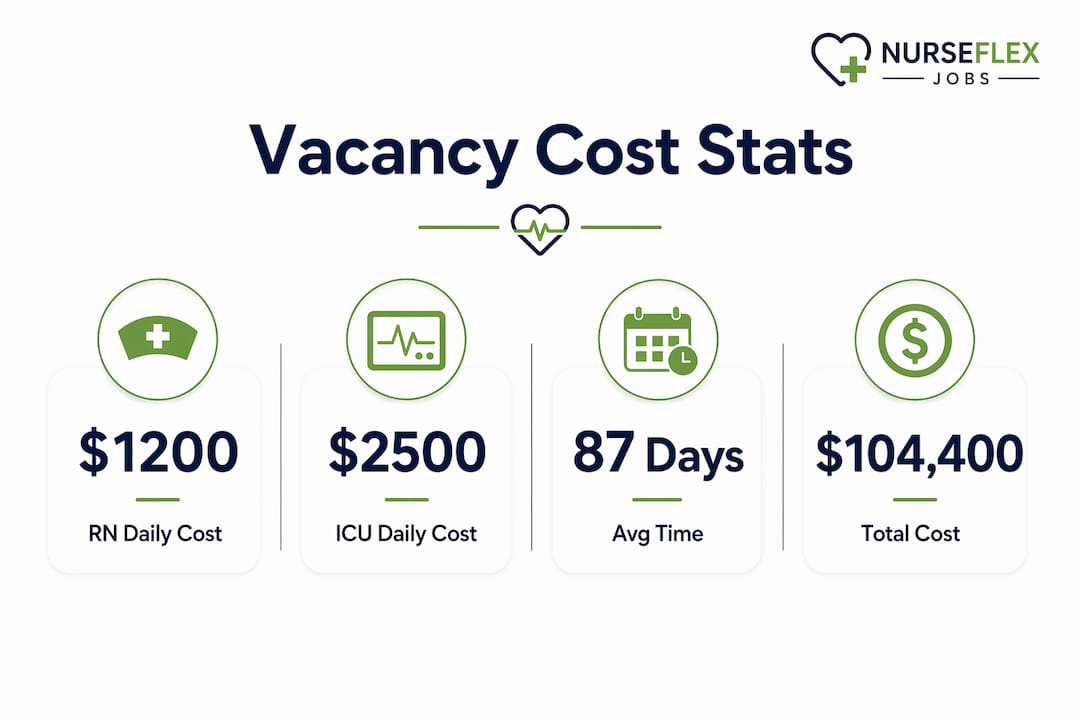
The average time to fill an RN vacancy is 87 days. At $1,200 per day, that is $104,400 in direct vacancy cost before a single recruitment dollar is spent.
Pro Tip: Pull your actual time-to-fill data from your HRIS and multiply it by the daily vacancy rate for each role category. Most administrators are surprised to find their real COV is 30–40% higher than their initial estimate.
A numbered checklist of data points you need for an accurate vacancy cost analysis:
- Gross annual salary for the open role
- Average days to fill, pulled from your last 12 months of hiring data
- Agency or overtime spend during the vacancy period
- Recruitment and advertising fees
- Orientation and training hours multiplied by trainer hourly cost
- Productivity ramp-up period (typically 90 days for clinical roles)
What drives healthcare staffing and vacancy costs?
Role type is the single biggest cost driver. ICU nurses, CRNAs, and nurse practitioners carry longer orientation periods and harder-to-source credentials. That extends both time-to-fill and the daily cost of the open seat. A CRNA vacancy, for example, can generate revenue losses that dwarf a general RN vacancy within the same 30-day window.
Geography compounds the problem. Wages in high cost-of-living metro areas like San Francisco or New York are significantly higher than rural markets, which raises the salary component in every COV calculation. Regional labor shortages also push agencies to charge higher premiums, adding another layer to the total expense.
Healthcare staffing costs have grown 20–30% since 2020, making the cost of doing nothing measurably worse each year. That growth rate means a vacancy that cost $80,000 in 2020 now costs $96,000 to $104,000 under the same conditions.
The table below compares cost drivers by role type:
| Role type | Primary cost driver | Vacancy impact level |
|---|---|---|
| Bedside RN | Overtime and agency fill | High |
| ICU/OR specialist | Specialty premium and long orientation | Very high |
| Nurse practitioner | Lost patient panel revenue | Very high |
| Medical secretary | Recruitment and onboarding | Moderate |
| CRNA | Credential scarcity and agency rates | Extreme |
Key factors that inflate the fully loaded cost of any vacancy:
- Benefits and payroll taxes add 20–30% on top of base salary
- Ramp-up productivity losses reduce output for 60–90 days post-hire
- Burnout-driven turnover among remaining staff creates secondary vacancies
- Canceled procedures and delayed referrals from unfilled provider roles generate direct revenue loss
Pro Tip: Track vacancy rate and turnover rate together on a single dashboard. Treating them as separate metrics causes administrators to miss the compounding financial risk they create when both are elevated simultaneously.
What practical strategies can reduce healthcare vacancy costs?
Retention is the highest-return investment in vacancy cost reduction. Every 1% improvement in RN turnover saves the average hospital approximately $295,000 annually. That figure makes retention programs, flexible scheduling, and career development spending look cheap by comparison.
Cross-training existing staff is the fastest way to reduce the operational impact of an open seat. When a medical-surgical nurse can cover a step-down unit, the vacancy does not immediately translate into agency spend. Optimizing capacity and cross-training is more cost-effective than filling high-cost vacancies through premium labor channels.
Specialized recruiters who source by population reduce time-to-fill for credentialed roles like NPs and physicians more effectively than generalist HR teams. Shorter time-to-fill directly cuts the daily vacancy cost accumulation. Healthcare-specific platforms also outperform general job boards for nurse hiring because candidate pools are pre-screened and available faster. You can see how this plays out in practice by reviewing why healthcare platforms beat job boards for nurse placement speed.
For administrative roles, virtual staffing cuts labor costs significantly. Administrative labor costs drop 60–75% when organizations shift from in-house medical secretaries to virtual staffing models. The average fully loaded annual cost for an in-house medical secretary runs $54,000 to $71,300. Virtual alternatives deliver the same function at a fraction of that cost.
Best practices to reduce vacancy and turnover costs:
- Set a target time-to-fill for each role category and measure against it monthly
- Build a talent pipeline for high-turnover roles before vacancies open
- Partner with a healthcare-specific staffing platform for clinical roles
- Implement structured onboarding to shorten the productivity ramp-up period
- Offer flexible scheduling to reduce voluntary turnover among nurses
- Use virtual staffing for administrative functions where in-person presence is not required
- Conduct stay interviews quarterly to identify flight risks before they become vacancies
Pro Tip: Review your common hiring delays by role type. Eliminating even one week from your average time-to-fill for RN positions saves over $8,400 per vacancy at the $1,200 daily rate.
How do vacancy costs compound and affect overall operations?
A single vacancy rarely stays a single vacancy. Prolonged vacancies increase staff burnout, which drives turnover among the nurses covering the open shift. That secondary turnover creates new vacancies, and the cycle escalates costs well beyond the original open position. This is what researchers call downstream turnover, and it is the most underestimated cost in healthcare staffing.
Consider a 90-day RN vacancy on a 20-bed medical-surgical unit. Direct vacancy costs at $1,200 per day total $108,000. Overtime and agency fill during that period add another $30,000 to $50,000. If one additional nurse leaves due to burnout from covering the vacancy, the hospital absorbs another $60,090 in replacement costs. The total cost of that single 90-day vacancy now exceeds $200,000.
NP and PA vacancies carry a separate and often larger financial risk. An unfilled NP position means lost patient panel revenue, delayed referrals, and canceled procedures. NP and PA vacancies cause revenue losses that most planning models fail to capture because they focus on salary cost rather than revenue generation.
"Vacancy and turnover are not separate staffing problems. They are one compounding financial risk that grows the longer it goes unaddressed."
Hidden costs that administrators frequently miss:
- Patient dissatisfaction scores decline when staffing ratios drop, affecting reimbursement
- Referral relationships erode when provider vacancies delay specialist access
- Agency and travel nurse contracts lock in premium rates that persist beyond the vacancy
- Remaining staff productivity drops as workload increases, reducing billable output
Early intervention is the only cost-effective response. Monitoring vacancy duration weekly and triggering escalation protocols at 30 days prevents the compounding effect from taking hold.
Key Takeaways
Healthcare vacancy cost is a compounding financial risk that grows with every day a position stays open, making early intervention and retention investment the most cost-effective response available to administrators.
| Point | Details |
|---|---|
| Daily vacancy cost is significant | General RN vacancies cost $1,200–$1,500 per day; specialized roles exceed $2,500 daily. |
| Fully loaded costs exceed base salary | Factor in 1.4x–1.6x base salary to capture taxes, benefits, and ramp-up losses accurately. |
| Retention delivers measurable ROI | Every 1% improvement in RN turnover saves a hospital approximately $295,000 annually. |
| Vacancies compound over time | A 90-day vacancy can exceed $200,000 when downstream turnover and agency costs are included. |
| Virtual staffing cuts admin costs | Shifting administrative roles to virtual models reduces labor costs by 60–75% versus in-house hiring. |
What I've learned about the real cost of leaving seats empty
Most administrators I speak with track turnover cost as a line item and vacancy cost as a footnote. That framing is backwards. The vacancy is where the financial damage starts. Turnover is just the invoice that arrives later.
The organizations that manage vacancy costs well share one habit: they treat time-to-fill as a financial metric, not just an HR metric. They know their daily COV by role category the same way a CFO knows daily cash burn. That discipline changes how quickly decisions get made when a position opens.
Retention investment consistently delivers better returns than aggressive hiring. A flexible scheduling program that costs $50,000 annually to administer can prevent two or three RN departures. At $60,090 per replacement, that is a clear financial win. The math is not complicated. The organizational will to prioritize it is the harder part.
Technology has genuinely changed what is possible in reducing time-to-fill. Healthcare-specific platforms with real-time matching cut placement timelines in ways that general job boards cannot replicate. The shift from reactive hiring to proactive pipeline management is where the biggest cost reductions happen.
— Flexible
How Flexiblenursingcareers helps cut vacancy costs
Flexiblenursingcareers connects healthcare organizations with qualified nurses and clinical professionals faster than traditional hiring channels. Shorter vacancy duration means lower daily cost accumulation, less overtime spend, and reduced reliance on expensive agency contracts.

The platform uses real-time skills-based matching to place candidates based on credentials, availability, and unit fit. That precision reduces the time administrators spend screening and shortens the gap between posting and placement. For HR managers working to bring down healthcare staffing costs, Flexiblenursingcareers offers a direct path to faster fills without the premium labor markup. Sign in or create your account at Flexiblenursingcareers to connect with pre-screened healthcare professionals ready to work.
FAQ
What is healthcare vacancy cost?
Healthcare vacancy cost is the total financial loss from an unfilled staff position, including lost productivity, overtime, agency fees, and recruitment expenses. The industry term is cost of vacancy (COV).
How much does an RN vacancy cost per day?
General RN vacancies cost between $1,200 and $1,500 per day. Specialized units such as ICU or OR can exceed $2,500 per day.
How long does it take to fill an RN vacancy?
The average time to fill an RN vacancy is approximately 87 days, which means a single open position can accumulate over $100,000 in direct vacancy costs before a hire is made.
What is the fastest way to reduce vacancy costs?
Improving RN retention is the highest-return action. Every 1% reduction in turnover saves the average hospital around $295,000 annually, making retention programs more cost-effective than most hiring investments.
Does virtual staffing actually reduce healthcare labor costs?
Virtual staffing reduces administrative labor costs by 60–75% compared to in-house hiring. The fully loaded annual cost for an in-house medical secretary runs $54,000 to $71,300, making virtual alternatives a significant budget lever for administrative functions.