
You can switch nursing specialties mid-career. It happens constantly. Sermo's workforce data confirms that burnout, schedule needs, and the desire for a different pace drive a high share of nurses to consider a specialty change, with surveys showing 35% of NPs have switched at least once. The path forward is straightforward: do a quick self-assessment, check your state board for any licensure requirements, and pick one low-commitment way to test the target specialty before you invest in retraining.
Your immediate next steps:
- Run a 15-minute skills audit: list your clinical strengths, schedule preferences, and what you want more or less of at work.
- Visit your state board's website to confirm whether your target specialty requires additional certification, supervised hours, or a new license.
- Pick one low-risk test: a shadow shift, a per diem day, or a flexible short-term role through a platform like Flexiblenursingcareers.
Pro Tip: Before you research degree programs, spend two shifts in the target specialty. What you learn in 16 hours beats any brochure.
Key Takeaways
Switching nursing specialties mid-career is achievable at any stage when you test first, plan your credentials early, and keep your license active throughout.
| Point | Details |
|---|---|
| Test before retraining | Shadow or pick up a per diem shift before enrolling in any program. |
| Check state board early | Licensure and supervised-hour requirements vary by state and target role. |
| Short certs deliver fast ROI | Certifications costing $500–$5,000 can unlock roles paying $90,000–$130,000. |
| Keep your RN license active | A lapsed license can add 3–12 months to your timeline before you can work. |
| Flexiblenursingcareers | Real-time matching to short-term specialty shifts lets you test roles while you earn. |
Table of Contents
- How to switch nursing specialties mid-career: your step-by-step roadmap
- Common specialties and careers nurses move into
- What education, certification, and state-licensure steps to expect
- How to translate your nursing skills for a new specialty
- Low-risk ways to get experience before you commit
- Costs, funding, and employer support for retraining
- Sample timelines for switching specialties
- Key decision checklist and red flags
- A frank note on what this transition actually takes
- Try a specialty shift before you retrain
- Sources
How to switch nursing specialties mid-career: your step-by-step roadmap
A staged transition approach consistently reduces risk. Follow these milestones in order.
- Self-assessment. Map your transferable clinical skills (triage, patient education, documentation, care coordination) against the demands of your target specialty. Note schedule constraints and financial runway.
- Research credential requirements. Confirm whether the target role needs a new certification (ACLS, PALS, a specialty cert through ANCC), additional supervised hours, or a graduate degree. Check your state board early.
- Choose an entry path. Short certifications work for most lateral moves. Bridge programs or MSN routes apply when the target role is advanced practice. Internal transfers work when your hospital already has the specialty unit.
- Build hands-on experience. Shadow, cross-train, or pick up per diem shifts in the target area. Flexible short-term roles let you test fit without leaving your current position.
- Execute the job search. Rewrite your resume to lead with transferable outcomes, gather references from the new specialty, and set a target application date.
HealthTrust's eight-tip checklist reinforces this sequence: update your resume, research certification needs, use per diem roles for experience, and lean on recruiters who specialize in your target area.
Pro Tip: Ask your nurse manager about internal cross-training before you look externally. Hospitals often fund orientation programs for in-house transfers, which cuts your cost to near zero.
Common specialties and careers nurses move into
NurseJournal's career-change analysis identifies therapist roles as the most common pivot for nurses, with median salaries ranging from pharmacy technicians up to health services managers and projected job growth varying depending on the role.

Roles like health services manager, physical therapist, and mental health counselor show the strongest combination of pay and growth. Note that most of these moves take you off the bedside and, in many cases, require a separate state license distinct from your RN credential. Pharmacy technician is the fastest entry but carries the lowest ceiling.
What education, certification, and state-licensure steps to expect
The American Nurses Association notes that accelerated programs compress training for degree-holders, but clinical components remain in-person and state-level requirements vary significantly.
Path options by target role:
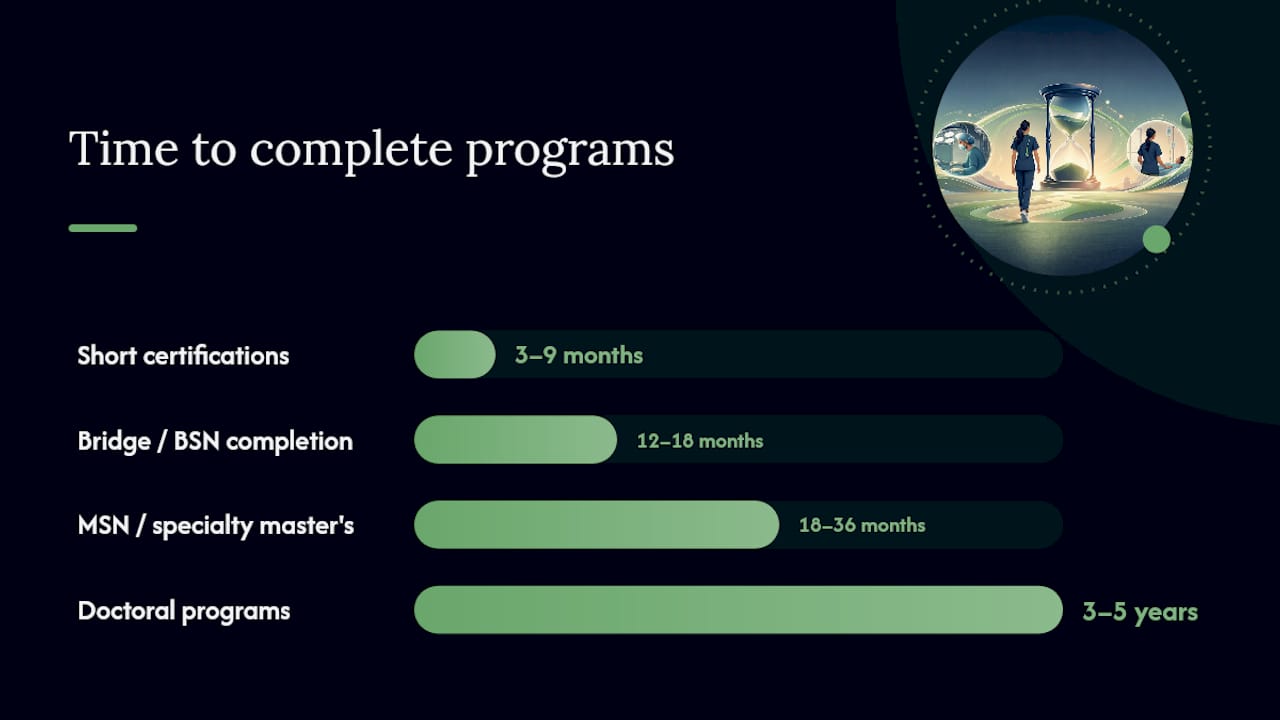
- Short certifications (3–9 months, roughly $500–$5,000): ACLS, PALS, CNI, or specialty certs through ANCC. Best for lateral clinical moves (ICU to ED, med-surg to oncology).
- Bridge or BSN completion (12–18 months): Required if you hold an ADN and the target role or employer mandates a BSN.
- MSN or specialty master's (18–36 months): Needed for NP, CRNA, CNS, or clinical education roles.
- Doctoral programs (3–5 years): Required for DNP or research-focused positions.
State-licensure checklist:
- Confirm whether the target specialty requires a separate license (PT, OT, SLP, LCSW all do).
- Check endorsement or reciprocity rules if you plan to work in a different state.
- Verify supervised clinical-hour requirements before starting a program.
Pro Tip: Keep your RN license active throughout the pivot. Reactivating a lapsed license can add 3–12 months and extra continuing education requirements, which delays your timeline and your income.
How to translate your nursing skills for a new specialty
Your existing skills carry more weight than most job postings suggest. Knowing how to reframe them for a new audience is what closes the gap.
High-value transferable skills and how to reframe them:
- Clinical assessment → "Conducted rapid patient assessments across 8–12 patients per shift, reducing escalation events."
- Patient education → "Developed and delivered discharge education programs, contributing to measurable reductions in 30-day readmissions."
- Care coordination → "Coordinated multidisciplinary care plans across five departments, improving throughput and reducing average length of stay."
- Documentation and compliance → "Maintained 100% chart accuracy under Joint Commission audit standards."
- Triage and prioritization → "Managed high-acuity triage in a 40-bed ED, consistently meeting 4-hour door-to-provider targets."
Three interview snippets that work:
- "My background in ICU gave me a strong foundation in rapid clinical decision-making, which maps directly to the fast-paced environment you described."
- "I've spent three years coordinating care across specialties, so I understand the communication gaps your team is trying to close."
- "I completed [target cert] specifically to build the technical skills this role requires, on top of my existing clinical base."
Add micro-credentials (CPHQ for quality, CHES for health education, or a project management cert) to signal commitment without a full degree. A brief portfolio showing one quality improvement project or a training module you built is often more persuasive than an extra line on a resume.
Low-risk ways to get experience before you commit
Testing a specialty before retraining is the single best way to avoid a costly mistake. Internal transfers and fellowship programs are the most accessible starting point because hospitals often fund them and they require no external application.
Your options, ranked by ease of access:
- Internal float pool or cross-training: Request a temporary assignment to the target unit. Many hospitals have formal cross-training tracks.
- Per diem shifts: Pick up occasional shifts in the target specialty while keeping your primary role.
- Shadow days: Ask a charge nurse or manager directly for a 4–8 hour shadow. Most will say yes.
- Flexible platform roles: Platforms like Flexiblenursingcareers match you to short-term specialty shifts in real time, so you can try a unit without a long-term commitment.
- Volunteering or certificate practicums: Some short certifications include a clinical practicum that counts as documented experience.
Networking and mentorship are critical to finding these openings. Many shifts and cross-training slots are filled through referrals before they are ever posted. Joining a specialty association and attending even one local event can surface opportunities that never appear on a job board.
Pro Tip: Document every shadow shift and cross-training day in a simple log: date, unit, skills practiced, and one clinical takeaway. This log becomes a talking point in interviews and a reference for your resume.
Costs, funding, and employer support for retraining
Short certifications typically cost several hundred to a few thousand dollars including exam fees. Graduate degrees can vary widely in cost depending on program type and institution. Non-bedside pivots through short certifications often deliver the fastest ROI, with roles like clinical informatics paying $90,000–$130,000 after a 3–9 month credential.
Funding sources to check first:
- Employer tuition reimbursement: Many hospital systems offer $2,000–$10,000 per year. Ask HR before you enroll anywhere.
- Federal student loans: Available for accredited degree programs; income-driven repayment plans reduce short-term pressure.
- Scholarships: AACN, ONS, and specialty nursing associations offer targeted scholarships for nurses pursuing advanced credentials.
- GI Bill: Covers tuition and living expenses for eligible veterans in approved programs.
- Employer-sponsored fellowships: Some health systems fund specialty transition fellowships with a service commitment in return.
While retraining, per diem or flexible platform work keeps income flowing without requiring a full schedule. Reducing to 0.6 FTE and adding two per diem shifts per month often covers the gap.
Sample timelines for switching specialties
Timeline 1: Rapid test and transfer (6 months)
- Months 1–2: Shadow shifts, internal cross-training request, skills audit.
- Months 3–4: Complete one short certification if required; build references.
- Months 5–6: Apply internally or externally; start in new role.
Timeline 2: Certification plus cross-training (6–12 months)
- Months 1–3: Enroll in target certification program; continue current role.
- Months 4–6: Complete cert; pick up per diem shifts in target specialty.
- Months 7–12: Apply for target roles with cert and documented experience in hand.
Timeline 3: Graduate-degree pivot (18–36 months)
- Months 1–3: Research programs, apply, confirm state licensure requirements.
- Months 4–18: Complete coursework; maintain active RN license; work per diem.
- Months 19–36: Finish clinical hours, sit for licensure exam, begin job search.
Pro Tip: Set a 90-day checkpoint for each timeline. If you have not completed the milestone, decide whether to adjust the path or the deadline, not both at once.
Milestone checklist:
- Self-assessment complete
- State board requirements confirmed
- Funding source identified
- First shadow or per diem shift completed
- Certification enrolled or completed
- Resume updated for target specialty
- Three references secured from new specialty
- Applications submitted
Key decision checklist and red flags
Before committing to a full pivot, run through these checkpoints.
Decision checklist:
- Does your skills profile match the target role's core requirements?
- Is there local or regional demand for the role (check BLS Occupational Outlook and job boards)?
- Can you cover living expenses during retraining?
- Does your employer offer tuition support or internal transfer options?
- Have you spent time in the target specialty (shadow, per diem, or cross-training)?
Red flags that suggest pausing:
- Fewer than 10 open roles in your metro area for the target specialty.
- Pay expectations exceed the role's median salary by more than 20%.
- Licensure delays of 6+ months with no interim work option.
- Health or caregiving constraints that make a full-time program unrealistic right now.
When red flags appear, the lower-risk move is to test via flexible short-term roles rather than enroll in a degree program. That keeps income stable and gives you real data before a large commitment.
A frank note on what this transition actually takes
Switching specialties is one of the most rewarding moves a nurse can make. It is also one that rewards planning over impulse. The nurses who navigate it well share one habit: they test before they invest. They pick up a per diem shift, shadow for a day, or take on a short cross-training assignment before they spend a dollar on tuition.
The other thing they get right is timing. Keeping your RN license active, maintaining your continuing education, and preserving your clinical references throughout the pivot protects your options if the new specialty turns out to be a poor fit. A specialty change is not a one-way door, but it is easier to walk back through when your credentials are current.
Flexiblenursingcareers exists precisely for this stage: real-time matching to short-term specialty shifts so you can test a unit, build references, and keep earning while you decide. That is a lower-risk starting point than any degree program.
Try a specialty shift before you retrain
Retraining costs time and money. Testing costs neither. Flexiblenursingcareers matches you to short-term specialty shifts in real time, based on your skills, availability, and the units you want to try. You keep your income, build references in the new specialty, and get the firsthand data you need to decide whether a full pivot is worth it.

No lengthy application. No long-term commitment. Sign up at Flexiblenursingcareers and browse available specialty shifts today.
Sources
- Career Change Options for Nurses | NurseJournal
- Changing careers from nursing | Mirrai Careers
- Nursing as a second career | American Nurses Association (NursingWorld)
- Changing nursing specialties | Sermo resources
- How to Change Nursing Specialties: 8 Tips from HealthTrust