
Registered nurses ready to advance to nurse practitioner level need three things: an accredited graduate NP program (MSN or DNP), a national board certification, and an active state APRN license. Pick your population focus first. Everything else follows from that choice.
The BLS projects much faster-than-average employment growth for NPs, driven by primary care demand and a national push toward prevention. That growth means opportunity, but only if you enter the right specialty, in the right state, with the right credentials.
Your immediate next steps:
- Choose a patient population focus (family, psychiatric, pediatric, adult-gerontology, etc.)
- Check your state Board of Nursing's scope-of-practice category (Full, Reduced, or Restricted)
- Research CCNE- or ACEN-accredited MSN or DNP programs that match your focus
- Estimate your timeline: Several years from BSN to NP certification, depending on route
- Explore flexible NP roles on Flexiblenursingcareers while you plan your path
Realistic timeline at a glance:
- BSN to MSN (NP track): typically 2–3 years full-time or 3–4 years part-time
- BSN to DNP: typically 3–4 years full-time
- ADN to BSN bridge, then MSN: add 1–2 years for the BSN completion step
- Post-master's NP certificate (for MSN-prepared nurses changing focus): 1–2 years
Pro Tip: Before applying to any program, call your state Board of Nursing and confirm that the program's population focus and degree level will satisfy your state's APRN licensure requirements. Requirements vary, and discovering a mismatch after graduation is costly.
Table of Contents
- What pathway to nurse practitioner fits your starting point?
- Which NP specialty matches your goals?
- What education and certification do you need to practice?
- How long does it take, and what does it cost?
- How does your state's scope of practice affect your career?
- What advancement options open up after certification?
- How do you choose the right NP program?
- How do you stay certified and keep your license active?
- Job search tips for new NPs
- How to transition from RN to NP effectively
- Key Takeaways
- What experienced NPs and program directors actually tell you
- Flexiblenursingcareers connects new NPs with the right roles faster
- Useful sources and where to go next
What pathway to nurse practitioner fits your starting point?
Your entry point determines your route. There is no single "best" path, but there is a best path for your current credentials and life situation.
| Entry Point | Route | Degree Outcome | Typical Time | Best For |
|---|---|---|---|---|
| BSN + active RN license | BSN → MSN (NP track) | MSN | 2–3 years FT | RNs with clinical experience ready to specialize |
| BSN + active RN license | BSN → DNP | DNP | 3–4 years FT | RNs targeting leadership, research, or highest clinical credential |
| ADN + active RN license | ADN → BSN bridge → MSN | MSN | 4–6 years total | RNs who need BSN completion before grad school |
| Non-nurse with bachelor's | Direct-entry MSN or DNP | MSN or DNP | 3–4 years | Career changers; includes RN licensure preparation |
| MSN-prepared NP | Post-master's NP certificate | Certificate | 1–2 years | NPs adding a second population focus or changing specialty |
The MSN remains the most common entry credential for NP practice. The DNP is growing as a preferred terminal degree, and AACN standards note that many programs are phasing out master's-level preparation in favor of doctoral preparation. If you are early in your planning, a DNP-track program positions you for a higher career ceiling, particularly in leadership and academic roles.
One important distinction: not all APRN roles share the same admission expectations. Certified Registered Nurse Anesthetists (CRNAs) typically require ICU experience before admission, and Certified Nurse Midwives (CNMs) have their own clinical prerequisites. NP tracks are generally more accessible from a broader range of RN backgrounds.
Accreditation matters. Only programs accredited by the Commission on Collegiate Nursing Education (CCNE) or the Accreditation Commission for Education in Nursing (ACEN) qualify graduates to sit for national NP board exams. Verify accreditation status before you apply.
- Check CCNE accreditation at ccneaccreditation.org
- Check ACEN accreditation at acenursing.org
- Confirm your target certifying body (AANP or ANCC) accepts graduates from your program
Pro Tip: Ask each program's admissions office for its most recent board pass rates by population focus. Programs with pass rates below 85% warrant a closer look at clinical placement quality and faculty support.
Which NP specialty matches your goals?
Your population focus determines your board exam, your practice settings, and your long-term earning potential. Choose it based on where you want to spend your clinical life, not just where jobs are plentiful today.
- Family Nurse Practitioner (FNP): The most versatile credential. FNPs see patients across the lifespan in primary care, urgent care, retail clinics, and telehealth. High demand, broad geographic flexibility, and the widest range of employer types.
- Adult-Gerontology Primary Care NP (AGPCNP): Focuses on adults and older adults in outpatient settings. Strong fit for RNs with medical-surgical or long-term care backgrounds.
- Adult-Gerontology Acute Care NP (AGACNP): Hospital-based, high-acuity practice. Common in ICUs, hospitalist teams, and surgical services. Narrower scope than FNP but higher inpatient compensation in many markets.
- Psychiatric-Mental Health NP (PMHNP): One of the fastest-growing specialties due to the national mental health provider shortage. Practice settings range from outpatient psychiatry to inpatient behavioral health to telehealth-only practices.
- Pediatric NP (PNP): Primary care (CPNP-PC) or acute care (CPNP-AC) tracks. Requires a separate board exam through PNCB. Strong fit for pediatric or NICU-experienced RNs.
- Women's Health NP (WHNP): Reproductive and gynecologic care across the lifespan. Common in OB/GYN offices, family planning clinics, and women's health centers.
- Neonatal NP (NNP): NICU-focused, highly specialized. Typically requires NICU RN experience before admission and commands strong compensation in tertiary care centers.
Switching specialties after certification is possible but requires formal academic retraining and a new board exam. Plan your population focus carefully the first time.
Pro Tip: Shadow an NP in your target specialty for at least two shifts before committing to a program. The day-to-day reality of outpatient psychiatry and inpatient acute care are very different, even if both carry the "NP" title.
What education and certification do you need to practice?
To become an NP, you must hold an active RN license, complete an accredited graduate NP program, and pass a national board certification exam aligned to your population focus. State APRN licensure follows certification.

| Step | Requirement | Who Governs |
|---|---|---|
| Active RN license | Current, unencumbered state RN license | State Board of Nursing |
| Graduate NP education | MSN or DNP from CCNE- or ACEN-accredited program | CCNE / ACEN |
| Core coursework | Advanced pathophysiology, pharmacology, physical assessment | AACN standards |
| Clinical hours | Minimum 500 hours (many programs require 600–750+) | Program / certifying body |
| National certification | Board exam from AANP, ANCC, or PNCB | AANP / ANCC / PNCB |
| State APRN license | Application to state Board of Nursing post-certification | State Board of Nursing |
| DEA registration | Required if prescribing controlled substances | DEA (federal) |
Certifying body alignment by population focus:
- AANP: Family (FNP-C), Adult-Gerontology Primary Care (A-GNP), Emergency (ENP-C)
- ANCC: Family (FNP-BC), Adult-Gerontology Primary Care (AGPCNP-BC), Psychiatric-Mental Health (PMHNP-BC), Pediatric Primary Care (PPCNP-BC)
- PNCB: Pediatric Primary Care (CPNP-PC), Pediatric Acute Care (CPNP-AC)
Both AANP and ANCC offer family and adult-gerontology certifications. Research pass rates and exam format for each before choosing. Some employers and states have preferences.
Numbered certification sequence:
- Confirm your program is CCNE- or ACEN-accredited
- Complete all required clinical hours and coursework
- Apply for graduation and receive your official transcript
- Submit your board exam application (AANP, ANCC, or PNCB)
- Pass the national certification exam
- Apply to your state Board of Nursing for APRN licensure
- Register with the DEA if your practice includes controlled substances
The AANP emphasizes that evidence-based practice and prevention are central to the NP role. Continuing education is built into recertification, not treated as optional.
How long does it take, and what does it cost?
Clinical hours, timelines, and tuition vary by route. Here is a realistic breakdown.
| Route | Clinical Hours (Typical) | Time to NP Certification | Estimated Tuition Range |
|---|---|---|---|
| BSN → MSN (NP track) | 500–750 hours | 2–3 years FT | $30,000–$70,000 |
| BSN → DNP | Several hundred clinical hours | 3–4 years FT | $50,000–$100,000+ |
| ADN → BSN → MSN | 500–750 hours | 4–6 years total | $40,000–$80,000 |
| Post-master's certificate | 300–500 hours | 1–2 years | $15,000–$40,000 |
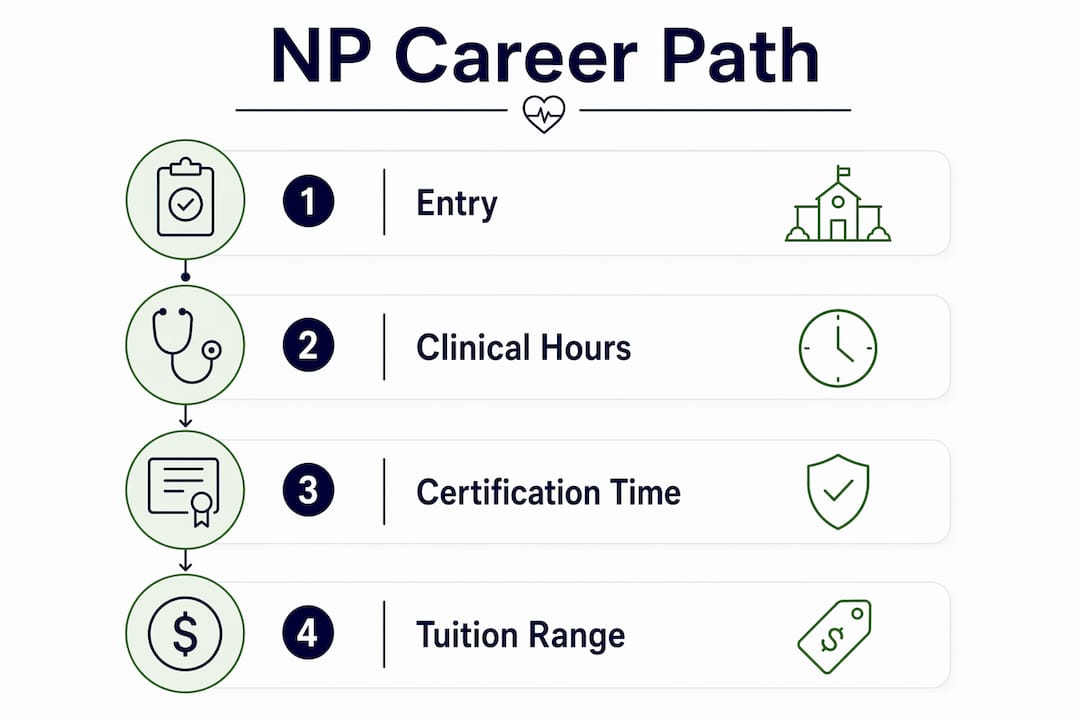
Most programs require a minimum number of clinical hours to strengthen board exam readiness. Some states add their own minimums, so verify with your state Board of Nursing.
After graduation, plan for additional time to reach full independent competence. Structured mentorship and residency programs shorten that transition significantly.
Funding options:
- Federal student loans (FAFSA, HRSA nursing scholarships for underserved-area commitments)
- Employer tuition reimbursement (many hospital systems offer $3,000–$10,000 per year)
- NURSE Corps Scholarship Program and Loan Repayment Program
- State-specific workforce grants for NPs committing to shortage areas
Numbered action timeline:
- Months 1–3: Research programs, confirm accreditation, request transcripts, secure letters of recommendation
- Months 3–6: Submit applications, apply for financial aid, negotiate employer tuition support
- Months 6–12: Begin coursework, identify clinical preceptors early (do not wait for the program to place you)
- Years 1–3: Complete clinical rotations, sit for boards, apply for state APRN license and DEA registration
Pro Tip: Finding your own clinical preceptor before the program requires it gives you more control over placement quality and specialty alignment. Build that relationship 6–12 months before your clinical year starts.
How does your state's scope of practice affect your career?
State scope-of-practice laws fall into three categories, and the category your state sits in directly affects your autonomy, income potential, and ability to open an independent practice.
- Full Practice Authority (FPA): NPs can evaluate, diagnose, order and interpret tests, and prescribe medications, including controlled substances, without physician oversight. Many U.S. states and territories have adopted FPA.
- Reduced Practice: NPs can practice independently in some areas but require a collaborative agreement with a physician for specific functions, such as prescribing controlled substances.
- Restricted Practice: NPs must work under direct physician supervision for most or all clinical functions. These states typically require a formal collaborative practice agreement.
Why this matters for your career: Full practice authority states allow NPs to open independent clinics, carry their own patient panels, and operate as autonomous providers. In restricted states, you need a collaborating physician, which adds cost, limits entrepreneurship, and can cap your earning ceiling. If opening your own practice is a goal, your state's practice category is as important as your specialty choice.
Where you practice matters as much as what you specialize in. NPs in full-practice states report broader hiring options, higher negotiating leverage, and more direct paths to practice ownership.
How to look up your state's rules:
- Visit your state Board of Nursing website directly (search "[state name] Board of Nursing APRN scope of practice")
- Review the AANP's state practice environment map at aanp.org
- Ask prospective employers specifically whether a collaborative agreement is required and who bears the cost
Pro Tip: If you are considering relocating for your NP career, compare scope-of-practice categories before comparing salaries. A $10,000 salary difference between two states can disappear quickly when one requires you to pay for a collaborative physician agreement.
What advancement options open up after certification?
Initial NP certification is the floor, not the ceiling. Career progression for NPs typically follows one of several tracks after the first 1–2 years of practice.
- Post-graduate residency or fellowship: One to two years of intensive mentorship in a specialty such as critical care, oncology, or surgery. Not required for licensure, but residencies accelerate competency and often lead directly into specialized or leadership roles.
- Specialty procedures and certifications: Adding procedural skills (dermoscopy, joint injections, colposcopy) or specialty certifications expands your scope within a practice and typically raises compensation.
- Clinical leadership and management: NP director, clinical coordinator, or department chief roles. Usually require 3–5 years of NP experience plus demonstrated leadership in quality improvement or team management.
- Academia and education: NP faculty positions, clinical preceptor roles, and adjunct teaching. A DNP or PhD is typically required for tenure-track positions.
- Telehealth: NPs in full-practice states can build telehealth-only practices or join national telehealth platforms. Scale is the advantage here; a single NP can serve patients across a state without geographic limits.
- Locum tenens and travel NP work: Early-career NPs use travel NP contracts strategically to trial different practice settings, explore full-practice states, and build a broader clinical resume before committing to a permanent role.
Numbered advancement sequence for the first five years:
- Year 1: Prioritize clinical competency and mentorship. Accept structured orientation programs.
- Year 2: Identify a specialty or procedural niche. Begin building a professional network.
- Year 3: Consider a residency, fellowship, or leadership role. Evaluate state scope and relocation options.
- Years 4–5: Pursue additional certifications, telehealth expansion, or practice ownership if in a full-practice state.
How do you choose the right NP program?
Program quality varies more than tuition rates suggest. These criteria separate strong programs from ones that look good on paper.
- Accreditation: CCNE or ACEN only. Non-accredited programs disqualify you from national board exams.
- Board pass rates: Ask for pass rates by population focus, not just overall program rates.
- Clinical placement support: Does the program place you, or do you find your own preceptors? Programs with established preceptor networks reduce placement delays.
- Faculty credentials: Are faculty practicing NPs or primarily academics? Practicing faculty bring current clinical context.
- Format flexibility: Online-hybrid programs allow you to keep working as an RN while completing coursework. Confirm clinical hour requirements are manageable with your schedule.
- Employer partnerships: Some programs have formal hiring pipelines with health systems. Ask admissions whether any employer partners offer tuition reimbursement or post-graduation hiring preference.
Questions to ask before you commit:
- What is your NCLEX and board pass rate for my target population focus?
- How does the program support clinical placement, and what happens if a placement falls through?
- What is the average time from graduation to board certification for recent graduates?
- Are there employer partners who offer tuition support or post-graduation hiring?
- How many clinical hours does the program require, and does that exceed the state minimum?
Your population focus, set at program entry, drives your certification eligibility and practice settings for the rest of your career. Choosing a program that aligns with your target specialty from day one prevents costly retraining later.
Pro Tip: Request a conversation with a recent graduate, not just a current student. Ask them specifically about clinical placement quality and how long it took to feel competent after graduation.
How do you stay certified and keep your license active?
Recertification is not a one-time event. Every major certifying body runs a renewal cycle, and missing a deadline can interrupt your ability to practice.
AANP recertification: Every five years. Requires 100 continuing education (CE) hours, including pharmacology credits, or a recertification exam.
ANCC recertification: Every five years. Requires 75 CE hours plus professional development activities, or a recertification exam.
PNCB recertification: Every five years. Requires CE hours and practice hour documentation, or a recertification exam.
State license renewal:
- Renewal cycles vary by state, typically every 1–2 years
- Most states require CE documentation at renewal; some conduct audits
- Failure to renew on time can result in inactive status, which stops your ability to practice
- The Nurse Licensure Compact (NLC) allows multistate practice for qualifying RNs, but APRN multistate licensure is governed separately; check your state's participation status
Numbered recertification plan:
- Track CE credits from day one of certification, not the year before renewal
- Use employer-provided CE (conferences, in-services, online modules) to offset out-of-pocket costs
- Set a calendar reminder 12 months before your certification expiration date
- Confirm your state license renewal date separately from your national certification date; they are not the same
- Budget $200–$500 annually for CE courses, renewal fees, and professional memberships
Pro Tip: Many professional organizations, including AANP and ANCC, offer CE bundles at member rates that cost less than individual courses. Membership often pays for itself in CE savings alone.
Job search tips for new NPs
Your first NP role sets the trajectory for your clinical development. Approach the search with the same rigor you applied to program selection.
Resume and application:
- Lead with your NP certification and population focus in the first line of your resume, not your RN experience
- Quantify clinical hours completed and patient volume from your graduate rotations
- List your certifying body and certification number; employers verify this
- Tailor your resume to the practice setting (inpatient vs. outpatient language differs significantly)
Interview preparation:
- Prepare clinical scenario answers for your population focus (e.g., a new PMHNP should expect medication management and crisis assessment scenarios)
- Know your state's scope-of-practice category and be ready to discuss collaborative agreement expectations
- Ask about onboarding length, mentorship structure, and patient panel ramp-up timeline
- Review how to evaluate NP job offers before negotiating compensation
Networking:
- Join AANP or your specialty's professional organization before graduation; student membership rates are lower
- Attend state NP association meetings to meet hiring managers and preceptors
- Build your online professional profile early; employers search for candidates before posting jobs
How to transition from RN to NP effectively
The RN-to-NP transition is a role identity shift, not just a credential upgrade. Many new NPs underestimate how different the clinical decision-making responsibility feels.
Before you graduate:
- Choose clinical rotations that mirror your target practice setting as closely as possible
- Build relationships with NP preceptors who practice in your target specialty; these connections often lead to job offers
- Use your RN experience strategically: if you want to become an AGACNP, prioritize ICU or step-down RN experience before applying
During the transition year:
- Accept a structured NP orientation program if offered, even if it extends your ramp-up period
- Seek out a formal or informal mentor who is an experienced NP in your specialty
- Expect a competence curve of 12–24 months before feeling fully independent; this is normal and well-documented
Practical steps:
- Notify your state Board of Nursing when your APRN license is active; do not practice as an NP before licensure is confirmed
- Update your malpractice insurance to NP-level coverage before your first NP shift
- Inform your employer of your exact certification date so onboarding paperwork is ready
Networking in nursing during your RN years builds the preceptor and mentor relationships that make the NP transition faster and less isolating.
Key Takeaways
Advancing your nurse practitioner career path requires choosing your population focus before selecting a program, then completing accredited graduate education, national board certification, and state APRN licensure in sequence.
| Point | Details |
|---|---|
| Choose population focus first | Your specialty determines your board exam, practice settings, and long-term earning potential. |
| Accreditation is non-negotiable | Only CCNE- or ACEN-accredited programs qualify you to sit for AANP, ANCC, or PNCB board exams. |
| State scope shapes your ceiling | Full practice authority states allow independent clinics and autonomous prescribing; restricted states require physician collaboration. |
| Plan for 2–4 years total | BSN to NP certification typically takes 2–3 years (MSN) or 3–4 years (DNP) of full-time study. |
| Flexiblenursingcareers speeds your first placement | New and advancing NPs can use Flexiblenursingcareers to find specialty-matched, flexible, and travel NP roles with rapid onboarding. |
What experienced NPs and program directors actually tell you
The advice that does not make it into program brochures tends to be the most useful.
Program directors consistently say the same thing: treat graduate NP education as the starting point for lifelong clinical development, not the finish line. The NPs who advance fastest are the ones who enter programs already knowing which patient population they are passionate about. Passion sustains the depth of study that graduate training demands.
The most common pitfall new NPs face is underestimating the time required to transition from RN to independent NP practice; graduation does not equal competence. The 12–24 month post-graduation period is a real clinical development phase, and NPs who skip structured mentorship or rush into independent practice without adequate orientation tend to plateau earlier.
A second pitfall: assuming that certification timelines and state licensure timelines are the same. They are not. You can pass your boards and still wait weeks or months for your state APRN license to process, depending on the state. Plan for that gap. Do not give notice at your RN job until your APRN license is confirmed active.
The NPs who use early-career locum tenens or travel contracts strategically, rather than defaulting to the first permanent offer, often end up with a broader clinical foundation and better negotiating leverage when they do settle into a permanent role.
Flexiblenursingcareers connects new NPs with the right roles faster
Passing your boards is the milestone. Finding the right first NP role is the next one.
Flexiblenursingcareers matches newly certified and advancing NPs with flexible, specialty-filtered job opportunities in real time. You set your population focus, availability, and preferred practice setting. The platform surfaces matched openings, including short-term locum contracts, travel NP positions, and permanent roles, without the back-and-forth of traditional applications.

Three ways new NPs use Flexiblenursingcareers right now:
- Trial a full-practice state before committing to a permanent role, using a short-term travel NP contract to experience autonomous practice firsthand
- Filter by specialty area to find openings that match your exact population focus and clinical background
- Onboard quickly with rapid credentialing support, so the gap between certification and your first NP shift stays short
Ready to find your next NP role? Browse current NP openings on Flexiblenursingcareers and set your specialty filters today.
Useful sources and where to go next
- AANP: Certification requirements, state practice environment map, and CE resources for FNP-C and other AANP-certified NPs
- ANCC: Board exam eligibility, recertification requirements, and PMHNP-BC, FNP-BC, and AGPCNP-BC details
- U.S. Bureau of Labor Statistics: Employment projections, median wages, and work setting data for NPs
- State Boards of Nursing: Search "[your state] Board of Nursing APRN" for scope-of-practice rules, licensure application requirements, and CE audit policies
- CCNE: Verify program accreditation status before applying to any MSN or DNP program
- ACEN: Alternative accreditation body; check here if a program is not CCNE-accredited
- Flexiblenursingcareers Education Hub: Program discovery resources and guidance for nurses exploring NP degree options