
Credentialing is defined as the formal process of verifying a healthcare provider's licenses, education, training, board certifications, and work history before they deliver patient care. The role of credentialing in hospital hiring goes far beyond a background check. It is the primary gatekeeper for patient safety, legal compliance, and operational readiness. Standards set by the Joint Commission and the National Committee for Quality Assurance (NCQA) make credentialing mandatory for hospital accreditation. The process is also recurring, not one-time. Providers must be re-credentialed every 24–36 months to confirm no new disciplinary or licensure issues have emerged. For healthcare administrators and recruiters, understanding this process is the foundation of every sound hiring decision.
What are the key steps in the credentialing process for healthcare providers?
The credentialing process in healthcare follows a defined sequence of verification steps. Primary source verification is the starting point. This means contacting licensing boards, medical schools, residency programs, and certification bodies directly to confirm every credential a provider claims. No third-party summaries. No self-reported documents taken at face value.
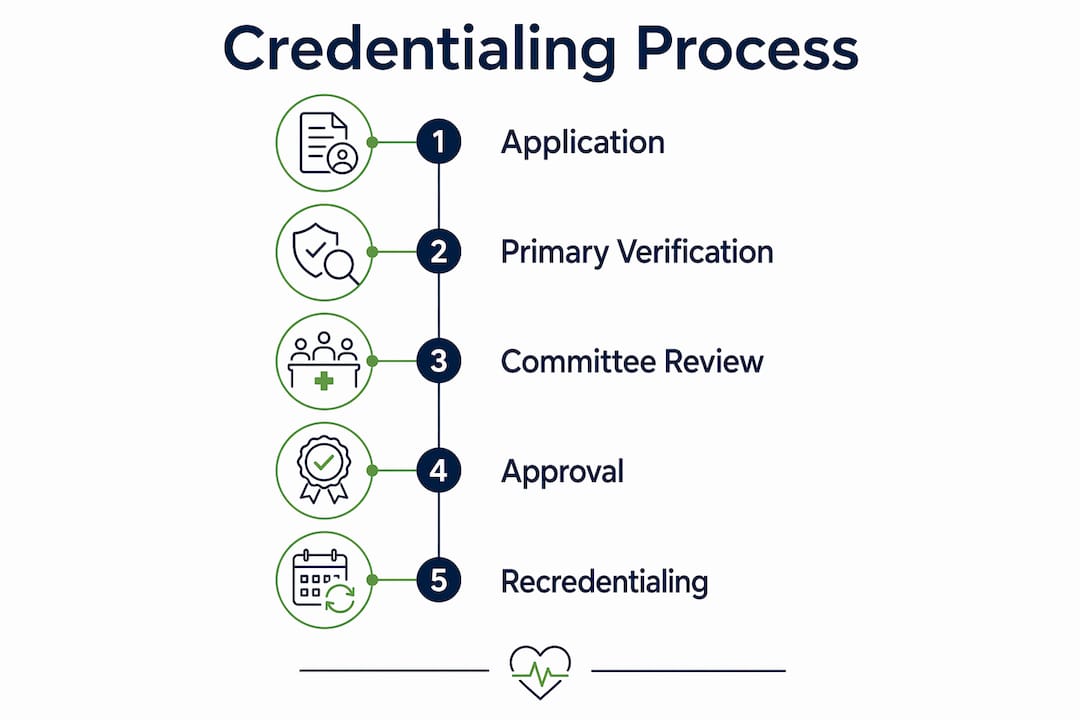
After primary source verification, the hospital's credentialing committee reviews the file and makes a recommendation. This step feeds into privileging, which is a separate but related process. Privileging authorizes a provider to perform specific clinical services within that facility. A surgeon may be credentialed as a physician but must be privileged separately to perform laparoscopic procedures at your hospital.

Credentialing takes 90–120 days, privileging adds 30–45 days, and payer enrollment typically adds another 45–90 days. That means complete provider onboarding can span 90–180 days from start to finish. That timeline is not a bureaucratic inconvenience. It is a hard operational constraint that shapes every hiring plan.
Common bottlenecks in the process include duplicate data entry across systems, manual follow-ups with licensing boards, and incomplete provider applications. CAQH ProView is the industry standard for centralizing credential data, but incomplete profiles block payer applications and extend delays further. Administrators who treat CAQH profile completion as a prerequisite before any payer application is submitted cut weeks off the timeline.
Pro Tip: Assign a dedicated credentialing coordinator to each new hire at the offer stage. Starting verification before the provider's first day is the single most effective way to reduce onboarding delays.
The cyclical nature of re-credentialing every 24–36 months means your credentialing team is never idle. Building a calendar-based renewal system prevents lapses that can trigger accreditation reviews or billing interruptions.
How does credentialing affect hospital hiring efficiency and financial outcomes?
Credentialing delays do not just slow hiring. They create direct financial losses. Hospitals often pay providers who are credentialed but not yet enrolled with payers, meaning the provider is active but generating zero billable revenue. That gap between salary cost and billing capacity is a measurable drain on operating margins.
The financial risks compound quickly:
- Over 50% of medical practices report increased insurance claim denials linked to credentialing qualification issues. Denials require costly rework and delay reimbursement cycles.
- Hospitals that employ providers without completed credentialing face negligent credentialing lawsuits. These cases have cost institutions millions in settlements and legal fees.
- Loss of accreditation from the Joint Commission is a direct consequence of credentialing failures. Accreditation loss affects payer contracts, federal funding, and patient volume simultaneously.
- Credentialing bottlenecks reduce patient access and strain existing staff, creating a staffing gap that often requires expensive temporary coverage.
The operational cost of a single delayed provider hire extends well beyond the credentialing department. Scheduling gaps force overtime, locum tenens contracts, and patient referrals to competing facilities. Each of those outcomes carries a price tag.
Credentialing has shifted from a back-office compliance function to a strategic workforce planning priority. Administrators who treat it as a post-hire formality consistently face longer onboarding timelines and higher operational costs than those who integrate it into the front end of recruitment.
What best practices help administrators optimize credentialing in hospital hiring?
Improving hospital staff credentialing starts with timing. Starting credentialing early in the recruiting cycle, ideally at the point of offer acceptance, prevents the 60–90 day bottlenecks that limit care capacity and revenue. Waiting until a provider's first week is the most common and most costly mistake administrators make.
Here are the credentialing best practices that produce consistent results:
- Integrate credentialing with your HRIS and EMR. Effective credentialing teams connect with HR information systems and electronic medical records platforms to automate verification alerts, document collection, and committee workflows. This reduces manual errors and compresses timelines significantly.
- Run credentialing, privileging, and payer enrollment in parallel. These three processes have different owners and different timelines, but they share verification data. Coordinating them simultaneously rather than sequentially removes weeks from total onboarding time.
- Require CAQH ProView completion before any payer application. An incomplete CAQH profile blocks enrollment and restarts the clock. Make profile completion a condition of the hiring process, not an afterthought.
- Maintain audit-ready documentation at all times. Committee reviews move faster when files are complete, organized, and consistently formatted. Gaps in documentation are the leading cause of committee deferrals.
- Use automation for re-credentialing alerts. Automated credentialing platforms reduce credentialing times from 30 days to as few as 6 days in documented case studies, with administrative costs dropping significantly. That is not a marginal improvement. It changes the economics of provider onboarding.
- Treat credentialing as a candidate experience factor. Providers who experience a disorganized, slow credentialing process form a negative first impression of your institution. A well-managed hiring process improves offer acceptance rates and early retention.
- Consider outsourcing when in-house capacity is limited. Managed credentialing services handle primary source verification, follow-ups, and committee preparation. For smaller hospitals or those with high hiring volume, outsourcing is often faster and more cost-effective than building internal capacity.
Pro Tip: Build a healthcare credential checklist for every role type you hire. Standardized checklists prevent missing documents and reduce back-and-forth with providers during the application phase.
How do credentialing, privileging, and payer enrollment differ?
Credentialing, privileging, and payer enrollment are separate processes with distinct purposes, timelines, and governing bodies. Conflating them is one of the most expensive operational errors a hospital can make.
| Process | Purpose | Governing Body | Typical Timeline |
|---|---|---|---|
| Credentialing | Verifies provider qualifications, licenses, and training | Joint Commission, NCQA | 90–120 days |
| Privileging | Authorizes specific clinical services at a facility | Hospital medical staff committee | 30–45 days |
| Payer enrollment | Establishes billing relationships with insurance networks | Individual payers, CMS | 45–90 days |
Credentialing is the foundation. Without it, neither privileging nor payer enrollment can proceed. Privileging is facility-specific, meaning a provider credentialed at one hospital must be privileged separately at each additional facility where they practice. Payer enrollment is contractual. It determines whether a provider can bill a specific insurer for services rendered.
Mistaking these three processes as one causes months of revenue loss and compliance risk. A provider can be fully credentialed and privileged but unable to bill Medicare because payer enrollment is incomplete. That scenario is more common than most administrators realize, and it produces exactly the kind of revenue leakage that erodes operating margins quietly.
The processes often run in parallel but are managed by different teams with different audit cycles. Coordination between the credentialing department, the medical staff office, and the revenue cycle team is not optional. It is the operational requirement that prevents providers from falling into the gap between "active" and "billable."
Key Takeaways
Credentialing is the non-negotiable foundation of hospital hiring, and delays in the process directly cost hospitals revenue, accreditation standing, and patient access.
| Point | Details |
|---|---|
| Start credentialing at offer acceptance | Waiting until a provider's first day adds 60–90 days of avoidable delay to onboarding. |
| Separate the three processes | Credentialing, privileging, and payer enrollment have different owners, timelines, and governing bodies. |
| Financial risk is real | Over 50% of practices report claim denials tied to credentialing issues, and hospitals pay non-billing providers during enrollment gaps. |
| Automation cuts timelines sharply | Automated platforms have reduced credentialing from 30 days to 6 days in documented cases. |
| CAQH ProView is mandatory | Incomplete CAQH profiles block payer enrollment and extend total onboarding time significantly. |
What I've learned about credentialing after years in healthcare staffing
Most hospital administrators treat credentialing as a compliance checkbox. That framing is the root cause of most onboarding failures I've seen. Credentialing is not a formality that follows a hire. It is a workflow that must run alongside recruitment from the moment a candidate accepts an offer.
The hospitals that get this right share one habit: their credentialing teams sit in on workforce planning meetings. They know the hiring pipeline weeks before an offer goes out. That advance notice is what allows them to start primary source verification early, flag potential issues before they become delays, and coordinate with payer enrollment teams without scrambling.
The shift to automation is real and the results are not marginal. Institutions that have moved from paper-based credentialing to integrated platforms report dramatically faster onboarding and fewer committee deferrals. The resistance to automation in this space usually comes from familiarity with legacy processes, not from any genuine operational advantage those processes provide.
The candidate experience angle is underappreciated. Providers talk to each other. A disorganized credentialing process signals institutional dysfunction. A fast, clear, well-communicated process signals that your hospital respects their time. That signal affects whether a top candidate accepts your offer or takes one from another facility. Credentialing is, quietly, a recruiting tool.
— Flexible
Flexiblenursingcareers connects you with credentialing-ready healthcare roles
Healthcare administrators who need qualified, credentialing-aware candidates do not have to start from scratch. Flexiblenursingcareers matches healthcare employers with professionals whose credentials are already organized and ready for verification, reducing the administrative load on your hiring team from day one.

Whether you are filling nursing roles or building out a broader clinical team, Flexiblenursingcareers gives you access to candidates who understand the credentialing process and come prepared. Explore nursing job opportunities for your facility, or visit the employer hiring portal to see how the platform supports faster, compliant onboarding for hospitals of every size.
FAQ
What is the role of credentialing in hospital hiring?
Credentialing verifies a provider's licenses, education, board certifications, and training before they deliver patient care. It is the mandatory first step in hospital hiring and a requirement for Joint Commission accreditation.
How long does the credentialing process take?
Credentialing takes 90–120 days, privileging adds 30–45 days, and payer enrollment adds 45–90 days. Total provider onboarding can span 90–180 days depending on workflow efficiency and application completeness.
What happens if a hospital skips or delays credentialing?
Hospitals that skip credentialing face negligent credentialing lawsuits, insurance claim denials, and risk losing accreditation. Over 50% of medical practices report increased claim denials tied directly to credentialing qualification issues.
What is the difference between credentialing and privileging?
Credentialing verifies a provider's qualifications across the profession. Privileging authorizes that provider to perform specific clinical services at a particular facility. Both are required before a provider can practice, but they are managed by different teams and follow different timelines.
How can hospitals speed up the credentialing process?
Starting credentialing at offer acceptance, requiring complete CAQH ProView profiles before payer applications, and using automated credentialing platforms are the three most effective ways to reduce onboarding timelines. Automation alone has cut credentialing from 30 days to 6 days in documented case studies.