
Healthcare hiring moves slowly because internal process friction, not applicant scarcity, is the dominant cause of delay. Healthcare roles average 56 days to fill in 2026, and the bottlenecks driving that number sit inside the organization, not outside it. Approval chains, interviewer scheduling conflicts, and slow feedback loops add weeks before a single offer reaches a qualified candidate. Understanding why healthcare hiring is slow is the first step toward fixing it.
Why healthcare hiring moves slowly: the core bottlenecks
The industry term for this problem is "time-to-hire friction," and it describes every internal delay between a job opening and a signed offer. Most hiring managers assume the shortage of qualified applicants is the main obstacle. The data says otherwise.
34% of healthcare organizations reported slow hiring as a key challenge in 2025, with outcomes worse than in 2024. That trend reflects a system under pressure from its own internal design, not just a thin talent pool. Approval workflows, feedback cycles, and scheduling conflicts compound into weeks of lost time before a candidate ever receives an offer.

What are the primary internal bottlenecks slowing healthcare hiring?
Four internal factors consistently extend time-to-hire in healthcare organizations. Each one is fixable, but most facilities treat them as unavoidable.
Approval chain delays. Most healthcare organizations require multiple sign-offs before a job is even posted. Department heads, HR directors, and finance teams each hold a gate. A role that needs three approvals before posting can sit idle for two weeks before a single application arrives.
Limited interviewer availability. Clinicians' patient care responsibilities directly delay feedback cycles, cause interview cancelations, and stall candidate progression. A nurse manager running a 12-hour shift cannot reliably block time for back-to-back interviews. This is the most significant bottleneck in healthcare hiring, and it is structural.
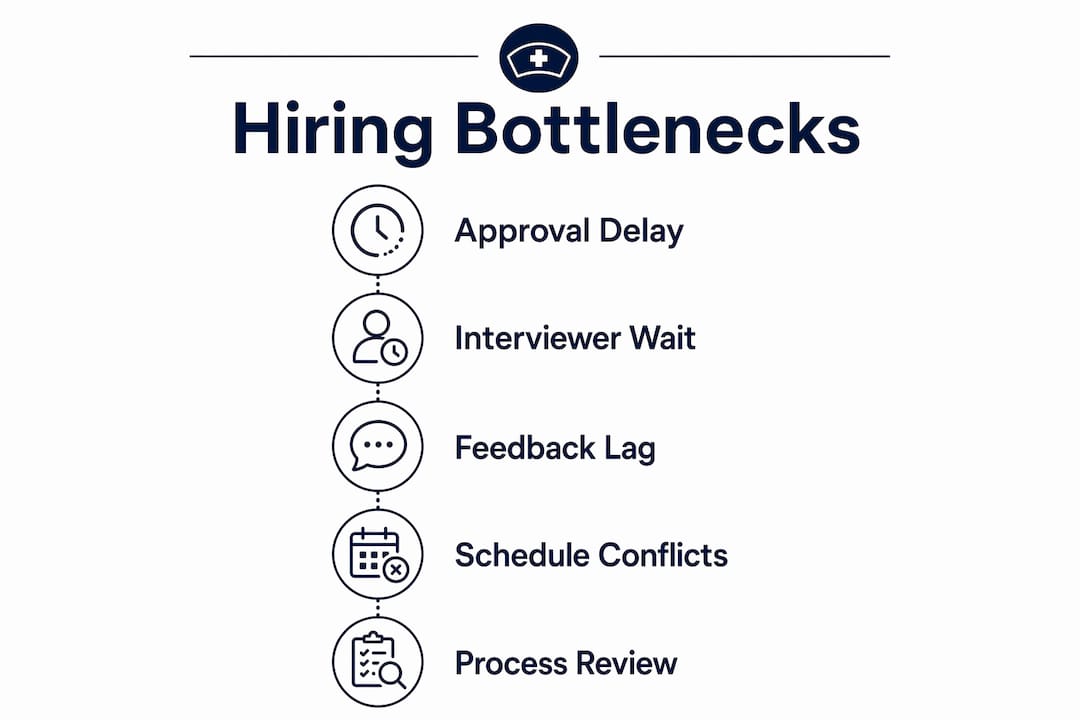
Slow hiring manager feedback. After an interview, candidates often wait days for a response. That lag signals disorganization to the candidate and gives competing employers time to move faster. Standardized scorecards reduce this delay by giving interviewers a clear framework to complete immediately after each conversation.
Background check and offer generation timing. Many organizations initiate background checks only after a verbal offer, adding another 5–10 days to the process. Starting checks earlier, or in parallel with final interviews, compresses this phase significantly.
- Approval chains add an average of 7–14 days before a role is posted
- Interview scheduling conflicts cause the most frequent candidate drop-off
- Feedback delays signal poor candidate experience and accelerate withdrawals
- Late-stage background checks extend time-to-hire by nearly two weeks
Pro Tip: Map your hiring process end-to-end and assign a time budget to each stage. Most teams are surprised to find that internal handoffs consume more time than any single step.
How does competition affect time-to-hire in healthcare?
The external market makes slow internal processes even more costly. Registered nurses receive multiple competing offers within 10 days of applying. If your hiring process runs longer than 21 days, you will lose top candidates to faster competitors. That is not a warning. It is a documented pattern.
The nursing shortage compounds this pressure. The current shortage is a structural issue accelerated by retirement waves and pandemic burnout. Experienced RNs are not just scarce. They are actively being recruited by multiple employers simultaneously, which means your process speed is a competitive differentiator.
"Losing a qualified RN to a faster competitor is not a sourcing failure. It is a process failure."
Heavy reliance on travel nurses reflects this dynamic. Travel nurse contracts at premium rates persist precisely because permanent hiring pipelines move too slowly to fill critical gaps. A 13-week travel contract costs significantly more than a permanent hire. Organizations that fix their internal process speed reduce their dependence on that expensive stopgap.
The candidate volume challenge also cuts both ways. High application volume creates the illusion of a strong pipeline, but manual screening of large pools adds days to the process. Skills mismatches within that volume mean recruiters spend time on unqualified applicants while qualified ones accept other offers.
- RNs exit the market within 10–21 days of applying
- Travel nurse reliance signals a permanent hiring pipeline failure
- High application volume without smart screening tools slows initial review
- Retirement-driven shortages reduce the available pool of experienced candidates
What role do technology and process design play in hiring speed?
Outdated hiring technology is a direct cause of healthcare staffing delays. Many facilities still rely on manual resume review, email-based scheduling, and disconnected applicant tracking systems. Each manual step adds time and introduces error.
The "purple squirrel" problem makes this worse. Over-selectivity in candidate criteria delays time to first interview and increases manual screening burden. When a job description requires 15 specific qualifications for a role that genuinely needs 8, the recruiter filters out viable candidates and extends the search unnecessarily. Hiring teams that hold out for a perfect match consistently lose good candidates to employers with more realistic criteria.
Structured asynchronous screening compresses the time to initial interview. Video screening tools let candidates respond on their own schedule, removing the back-and-forth of live scheduling. Recruiters review responses in batches, which is faster than coordinating individual phone screens across time zones and shift schedules.
| Approach | Impact on time-to-hire |
|---|---|
| Manual phone screening | Adds 5–10 days per candidate batch |
| Asynchronous video screening | Reduces initial review to 1–3 days |
| Rigid "purple squirrel" criteria | Extends search by weeks, increases drop-off |
| Flexible, skills-based criteria | Expands viable pool, speeds first interview |
| Disconnected ATS and scheduling tools | Creates handoff delays between stages |
| Integrated hiring platform | Reduces administrative lag across stages |
Pro Tip: Audit your job descriptions annually. Remove requirements that are preferences, not true qualifications. A shorter, more accurate list attracts more viable candidates and speeds initial screening.
The role of technology in hospital hiring is not just about automation. It is about removing the manual coordination burden that falls on already-stretched clinical and HR staff.
How can healthcare organizations improve hiring speed without sacrificing quality?
Speed and quality are not opposites in healthcare hiring. The organizations that hire fastest also tend to have the clearest processes. Here is what actually works.
-
Reduce approval layers. Identify every sign-off required before a role is posted and before an offer is extended. Remove any approval that does not add a meaningful check. Pre-approved headcount budgets eliminate the most common early delay.
-
Schedule interviewers in advance. Block recurring interview slots on clinical staff calendars before a role is even posted. This removes the scheduling scramble that causes the most frequent candidate drop-off.
-
Standardize feedback with scorecards. Give every interviewer a one-page scorecard with five to seven criteria. Require completion within 24 hours of the interview. This cuts feedback lag from days to hours.
-
Start background checks earlier. Initiate the process after a verbal commitment, not after a written offer. Running checks in parallel with final negotiations saves 5–10 days.
-
Use asynchronous screening tools. Platforms that support video or text-based screening let candidates respond outside business hours. This is especially valuable when recruiting nurses who work nights or rotating shifts.
-
Set a realistic candidate profile. Define the minimum viable qualifications for the role. Hire for those, then develop from there. Organizations that improve hiring speed consistently report that flexible criteria produce better long-term retention than rigid ones.
Pro Tip: Set a 21-day target for your end-to-end process and measure every stage against it. You cannot fix what you do not track.
Healthcare hiring results are worse in 2025 than in 2024, which means the cost of inaction is rising. Every week a role stays open, patient care suffers and travel nurse costs climb. The organizations closing that gap are the ones treating hiring speed as an operational priority, not an HR afterthought.
Key Takeaways
Healthcare hiring moves slowly because internal process friction, not applicant scarcity, drives the majority of delay, and fixing that friction requires deliberate process redesign at every stage.
| Point | Details |
|---|---|
| Internal friction is the main cause | Approval chains, feedback lags, and scheduling conflicts add more delay than applicant shortages. |
| Top candidates exit fast | RNs receive competing offers within 10 days; processes longer than 21 days lose top talent. |
| Over-selectivity extends searches | Rigid "purple squirrel" criteria filter out viable candidates and slow time to first interview. |
| Asynchronous tools compress timelines | Video and text screening reduces initial review from days to hours without sacrificing quality. |
| Speed and quality align | Organizations with clear, fast processes consistently report better hiring outcomes than slower peers. |
What I've learned about slow healthcare hiring that most guides miss
Working closely with healthcare hiring managers, the pattern I see most often is not a technology gap. It is a cultural one. Clinicians who double as interviewers are not avoiding recruiting duties. They are genuinely overwhelmed by patient care demands. The system asks them to do two full-time jobs simultaneously, and hiring always loses.
The fix is not a new software platform. It is organizational permission. When leadership signals that interview time is protected time, not optional time, scheduling conflicts drop immediately. I have watched facilities cut their time-to-hire by weeks simply by blocking two hours per week on a charge nurse's calendar and treating that block as non-negotiable.
The other thing most guides miss is the cost of over-selectivity. Hiring managers often defend rigid criteria as protecting quality. The data shows the opposite. Holding out for a perfect candidate while a qualified one accepts another offer is not quality control. It is a process failure dressed up as a standard.
The organizations that hire well in healthcare are not the ones with the most sophisticated tools. They are the ones that treat hiring as a clinical operation: defined steps, clear owners, and measurable outcomes at every stage.
— Flexible
How Flexiblenursingcareers connects you to faster placements
Slow hiring processes cost healthcare facilities more than time. They cost patient care quality and staff morale. Flexiblenursingcareers was built to address exactly that gap.

Flexiblenursingcareers connects healthcare professionals with flexible job opportunities matched to their skills, availability, and preferences in real time. The platform removes the lengthy application process that causes most candidate drop-off, letting registered nurses and healthcare workers start working quickly. For hiring managers, that means filling critical roles without waiting 56 days. Sign in or create your account at Flexiblenursingcareers and see how fast a well-matched placement can move.
FAQ
What is the average time to fill a healthcare role in 2026?
Healthcare roles average 56 days to fill in 2026. Internal process friction, not applicant scarcity, is the primary driver of that timeline.
Why do healthcare organizations lose top nursing candidates?
Registered nurses receive multiple competing offers within 10 days of applying. Any hiring process that runs longer than 21 days risks losing top candidates to faster employers.
What is the biggest internal bottleneck in healthcare hiring?
Limited interviewer availability is the most significant internal bottleneck. Clinicians' patient care responsibilities delay feedback cycles and cause frequent interview cancelations.
What does "purple squirrel" hiring mean in healthcare recruitment?
"Purple squirrel" hiring refers to searching for a candidate who meets every listed qualification perfectly. This over-selectivity creates artificial talent shortages and extends time-to-hire by filtering out viable candidates.
How does travel nurse reliance connect to slow permanent hiring?
Heavy reliance on travel nurses is a symptom of slow permanent hiring pipelines. When permanent roles take too long to fill, facilities pay premium rates for 13-week travel contracts as a stopgap.