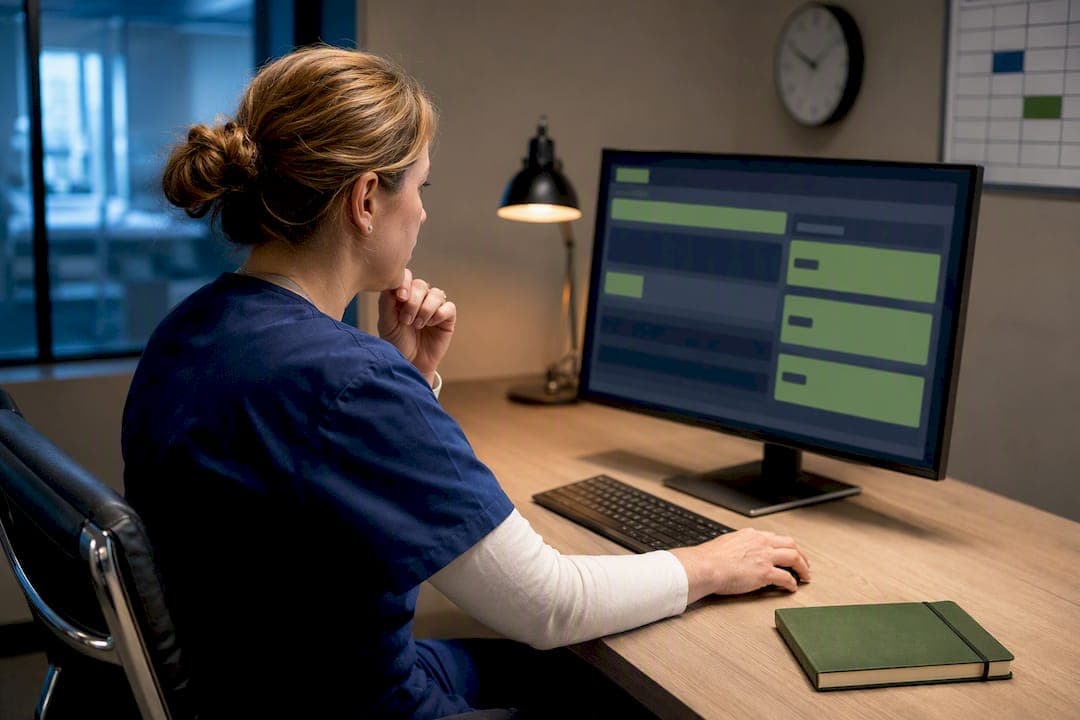
An open shift marketplace is a platform where nurses and other clinicians browse and claim available shifts directly, while facilities post staffing needs and get matched by algorithm instead of a recruiter's phone call. The recommended move for both sides is straightforward: pick a vetted marketplace with real-time matching and fast onboarding rather than defaulting to a traditional agency. NurseFlex Jobs is built around exactly that model.
TL;DR:
- Choice of platform should prioritize coverage, verification processes, and speed of fill, especially for specialized or urgent shifts.
- First-time clinician onboarding can take days to weeks due to credential and license checks, but subsequent shifts claim within minutes.
- Relying solely on marketplaces risks operational issues like no-shows and skill mismatches; building a favorites list helps mitigate these problems.
- Pricing is generally pay-per-shift with the facility bearing the fee, but facilities should verify hidden costs such as rush fees or cancellation penalties.
- For facilities, pilot programs of three to six weeks enable comparison of fill rate and cost against existing staffing methods before expanding.
Table of Contents
- What Is an Open Shift Marketplace and How Does It Work?
- Is Picking Up Shifts Through a Marketplace Worth It for Nurses?
- What Should Facilities Know Before Relying on a Marketplace?
- How Do You Choose the Right Marketplace for Your Facility or Career?
- What Does an Open Shift Marketplace Actually Cost?
- How Long Does It Take to Fill an Open Shift?
- What Legal and Compliance Issues Should You Watch For?
- Ready to Try a Marketplace? Here's Where NurseFlex Fits
- Why We Think Marketplaces Are the Right Default, Not Just an Option
- Sources
What Is an Open Shift Marketplace and How Does It Work?
Think of it as the mechanism that replaced the agency phone tree. A facility posts an open shift with its specialty requirements, pay rate, and timing. The marketplace's algorithm matches that posting against a pool of pre-verified clinicians based on skills, availability, and location, then pushes the opening to qualified candidates through a mobile app. Vertical labor marketplaces use exactly this posting-to-matching structure to cut out the layers a staffing agency traditionally added.
The flow generally looks like this:
- A facility posts a shift with unit, specialty, and rate details.
- The platform matches it against nurses whose credentials and availability fit.
- The nurse claims the shift through the app, often within minutes of the alert.
- Credential and license verification runs automatically before the shift is confirmed.
- Onboarding documents, background screens, and facility-specific requirements get uploaded once and reused across future bookings.
That last point matters more than it sounds. Traditional agencies re-verify and re-onboard clinicians for every new contract, which eats days. Internal float pools skip verification friction but are capped by whoever already works at that facility. A marketplace splits the difference: broader reach than an internal pool, faster turnaround than an agency, because credential checks happen once and travel with the clinician's profile.
Is Picking Up Shifts Through a Marketplace Worth It for Nurses?
For most nurses, yes, with some conditions attached. You get to choose which shifts fit your calendar instead of waiting for a scheduler to call, and workforce strategists point to that autonomy as a real driver of job satisfaction and retention. Pay can run higher than a standard staff rate, particularly for last-minute or specialty coverage, and the contingent nursing market has grown as more clinicians use these platforms to supplement income.
The trade-offs are real too. Many marketplace shifts classify you as a contractor rather than a facility employee, which usually means no built-in benefits and pay that can shift with demand. Read the classification terms before you assume a shift comes with the same protections as staff work.
Before accepting any individual shift, run through this:
- Confirm the unit type and acuity level match your actual scope and comfort.
- Check the posted rate against your usual per-shift pay for that specialty.
- Verify the facility's cancellation and no-show policy.
- Look at clinician reviews or ratings for that facility if the platform offers them.
- Confirm your credentials and certifications are current in your profile before you commit.
Pro Tip: Build a "favorites" list of facilities that treated you well on past shifts. Marketplaces that let you flag preferred sites, like the ones covered here, make it easier to get rebooked automatically instead of starting from zero every time.
What Should Facilities Know Before Relying on a Marketplace?
Faster fills are the headline benefit. A marketplace draws from a pool that spans well beyond your local agency's roster, which matters most when you need a specialty clinician, an ICU nurse, or someone certified for a niche unit at 6 a.m. on a Sunday. Multi-site systems can also route clinicians across locations based on where demand is actually spiking, something a single-site agency contract rarely supports.
The risks are operational, not existential. No-shows happen. Skill mix and cultural fit vary shift to shift. Mitigate that with a few concrete tactics:
- Use credential filters for drug testing and workforce compliance so only clinicians meeting your unit's minimum requirements ever see the posting.
- Build a favorites list of clinicians who performed well and route future shifts to them first.
- Set a cancellation window with a penalty clause built into the marketplace's terms.
- Compare marketplace fill speed against your internal float pool before assuming external sourcing is always faster.
Internal shift-claiming still has a place. Facilities that lean on PRN and float staff for internal claiming often see lower agency spend, because those staff already know facility policy and need less orientation. The smartest setups run both: internal claiming first, marketplace as the overflow valve. Track fill rate, time-to-fill, cost per shift, and clinician return rate across both channels so you know which one is actually earning its keep.
How Do You Choose the Right Marketplace for Your Facility or Career?
Not every platform deserves your trust or your staffing budget. Run a short evaluation before committing to any one marketplace, whether you're a nurse picking where to build a profile or a hiring manager deciding where to post.
Prioritize these criteria in roughly this order:
- Coverage: Does the platform have enough clinicians in your specialty and geography to fill shifts reliably?
- Verification and compliance: Are license checks, background screens, and certification tracking built in, or bolted on?
- Speed: What's the platform's average time-to-fill for shifts like yours?
- Pricing model: Pay-per-shift versus subscription, and which fits your volume?
- Support and reporting: Can you pull fill-rate and cost data without asking a rep for a manual export?
When you talk to a vendor, ask for numbers, not adjectives. Request average time-to-fill by specialty, total clinician pool size in your region, historical fill rate, and typical onboarding duration for a new clinician. A platform that hesitates to share these is telling you something.
Statistic to watch: marketplace platforms commonly combine pay-as-you-go pricing with credential verification and rating systems that let facilities rebook trusted clinicians directly, which is the combination worth testing for first.
A compact pilot works better than a full switch. Run one unit or one shift category through the marketplace for three to six weeks. Track fill rate, average time-to-fill, no-show rate, and cost per shift against your current baseline. If fill rate beats your agency average and cost per shift holds steady or drops, expand the pilot. If either number slips, you've lost six weeks, not a year of budget.
What Does an Open Shift Marketplace Actually Cost?
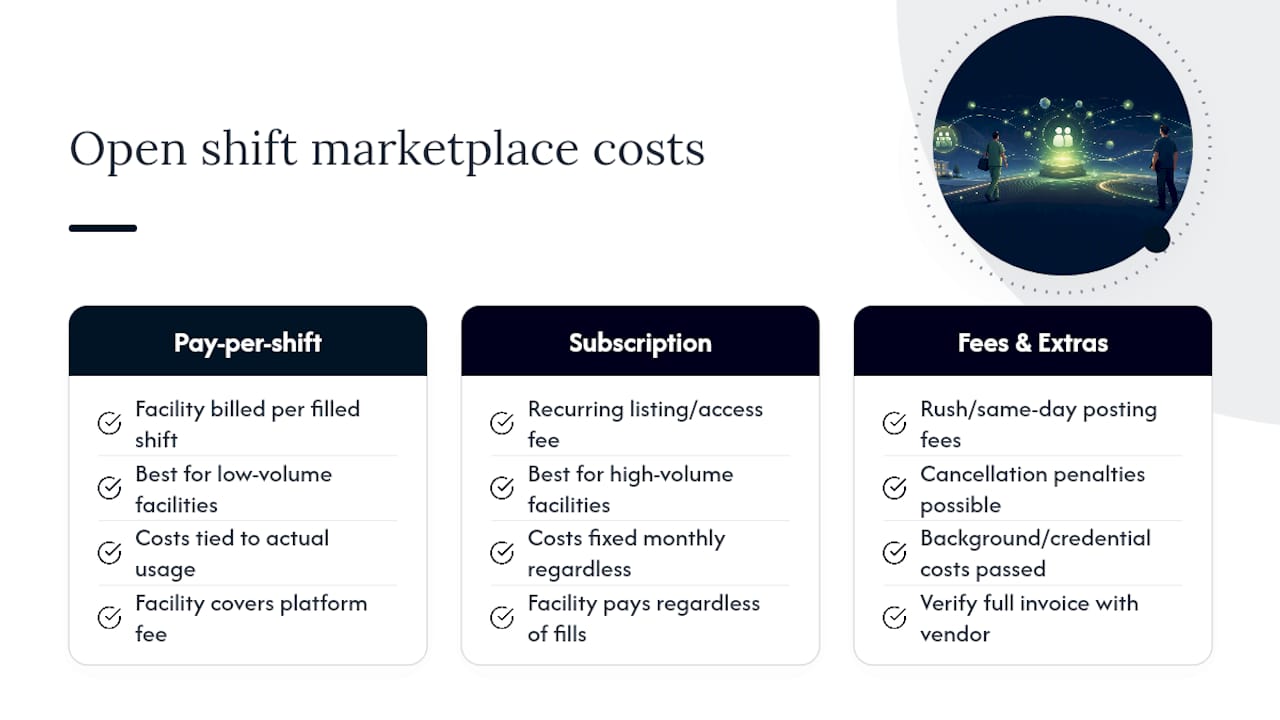
Pricing structures split mostly into two camps: pay-per-shift and subscription. Pay-per-shift charges the facility a placement fee only when a shift gets filled, which keeps costs tied directly to usage. Subscription models charge a recurring listing or access fee regardless of how many shifts get filled that month, which can work out cheaper for high-volume facilities but riskier for low-volume ones.
Clinicians on most marketplaces don't pay to use the platform. Facilities cover the fee, whether structured as a flat per-shift charge or a percentage of the shift's pay rate. That fee typically sits well below a traditional agency markup, since the marketplace model strips out the recruiter layer that agencies bill for.
Watch for a few line items that don't always show up in the headline pricing: rush fees for same-day postings, cancellation penalties if a facility pulls a shift after a clinician has claimed it, and background screen or credential verification costs that some platforms pass through separately. Ask a vendor to walk through a full invoice for a typical filled shift, not just the advertised rate, before you commit budget to a full rollout.
For nurses, the pay rate posted on a shift is generally the rate you receive, with the platform's fee absorbed on the facility side. Confirm this explicitly in the platform's terms, since a small number of marketplaces do deduct a service fee from the clinician's payout instead.
How Long Does It Take to Fill an Open Shift?
Timelines vary by specialty and urgency, but the general shape holds across most marketplaces. A routine shift posted several days out typically fills within hours of going live, since the algorithm pushes it to qualified, available clinicians immediately rather than waiting for a recruiter to start making calls.
Same-day and urgent postings behave differently. A last-minute ICU or specialty opening can still get filled within an hour or two if the local clinician pool is deep enough, but thinner specialty pools in rural or lower-density regions can leave a shift open for a full day or longer.
Onboarding time affects the first fill more than any fill after that. A brand-new clinician joining a marketplace usually spends anywhere from a few days to two weeks getting credentials, licenses, and background checks verified before their profile goes live for matching. Once that verification is done, it carries forward, so every subsequent shift claim happens in minutes, not days.
For facilities running a pilot, expect the first two weeks to be the slowest as the clinician pool in your specific specialty and radius builds engagement with your postings. Fill speed typically improves as the platform's algorithm learns your posting patterns and as more clinicians in your area rate your facility as a good place to pick up shifts.
What Legal and Compliance Issues Should You Watch For?
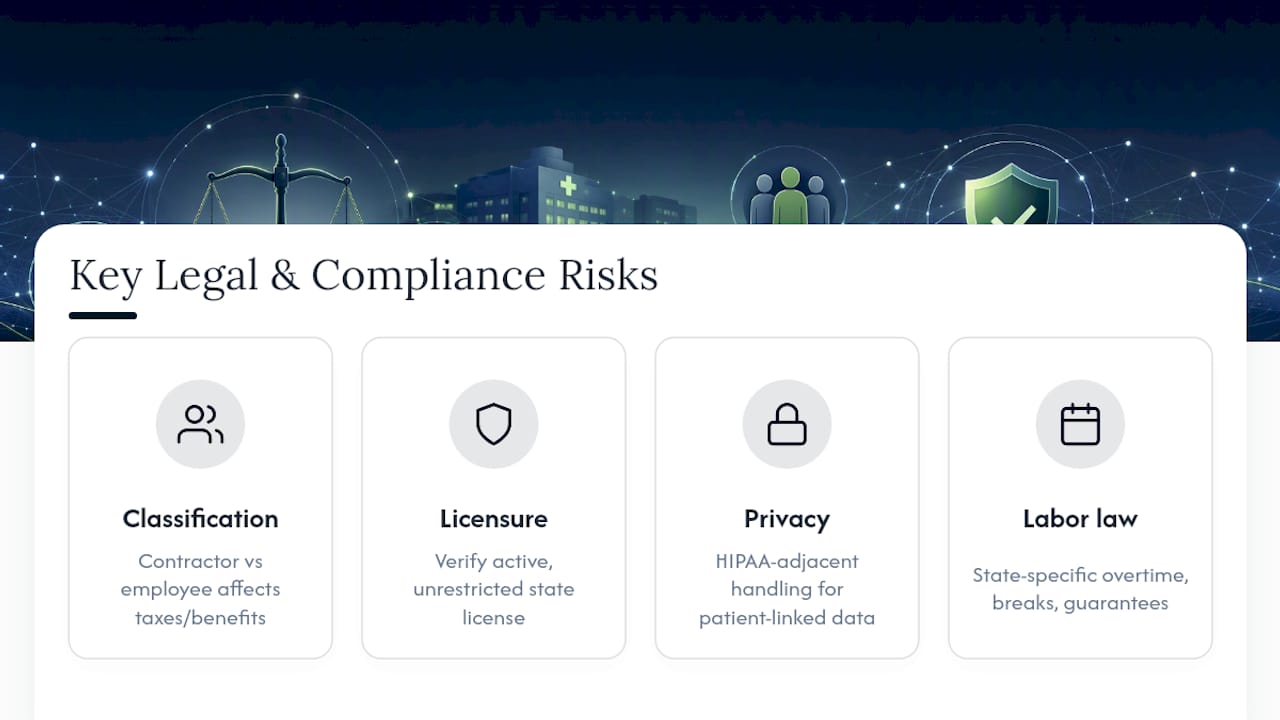
Worker classification is the biggest compliance question on either side of the transaction. Most marketplace clinicians work as independent contractors rather than employees, which affects tax withholding, overtime rules, and eligibility for benefits. Facilities need to confirm that a platform's classification model matches labor law in their state, since misclassification exposure falls on the facility as much as the platform.
Licensure compliance doesn't disappear just because a platform handles verification. Facilities remain responsible for confirming that any clinician working in their building holds an active, unrestricted license for that state, particularly for multistate compacts where reciprocity rules vary. Don't treat a platform's credential check as a substitute for your own final verification step.
Data privacy carries real weight too. Marketplaces store sensitive information, including license numbers, background check results, and in some cases patient-adjacent scheduling data. Facilities should confirm a platform's data handling practices meet HIPAA-adjacent standards for any information that touches patient assignments, and nurses should read what a platform does with their credential and background data before uploading it.
Labor law also touches minimum shift guarantees, overtime calculation across multiple facilities, and break requirements, all of which vary by state. A marketplace operating across state lines needs to apply the correct rules per posting, not a single blanket policy.
Ready to Try a Marketplace? Here's Where NurseFlex Fits
Everything covered above, coverage, verification, speed, pricing clarity, is the checklist NurseFlex Jobs was built around. The platform matches clinicians to open shifts in real time based on skills, availability, and preferences, and handles credential verification during onboarding so a completed profile carries forward to every future shift claim instead of resetting each time.

For nurses, that means less time spent chasing recruiters and more time choosing shifts that actually fit your schedule and specialty. If you're weighing travel assignments against local per-diem work, the same profile and verification carry across both. Register for open nursing shifts and your credentials go live once, then follow you into every match.
For facilities and hiring managers, NurseFlex maps directly to the pilot framework outlined earlier: measurable fill rate, transparent per-shift pricing instead of buried agency markups, and a growing clinician pool across specialties. If you're running short-staffed and want to test faster time-to-fill against your current agency spend, post a shift or request a pilot and compare the numbers directly against your baseline.
Why We Think Marketplaces Are the Right Default, Not Just an Option
The retention and autonomy data on marketplace staffing lines up with what most workforce planners have suspected for years: nurses who control their own schedule stay in the profession longer and report higher engagement. That's not a minor operational detail. It's the difference between a workforce that burns out and churns, and one that sticks around because the work fits their life instead of fighting it.
The trade-offs deserve honesty, not spin. Contractor classification means variable pay and thinner protections compared to staff roles, and facilities that skip their own credential double-check are taking on risk a platform can't fully absorb for them. Mitigate both with clear terms up front and a pilot before a full commitment.
Test small, measure fill rate and cost per shift against your baseline, and scale what actually works.
— Flexible
Sources
- Replace legacy healthcare staffing with a vertical marketplace for workers | TechCrunch
- Uber for Nurses? | Medscape
- The Best Healthcare Staffing Marketplaces for Short-Staffing - Electronic Health Reporter