
What is contingency healthcare staffing?
Contingency healthcare staffing is the practice of deploying temporary healthcare professionals to fill clinical gaps caused by variable patient demand, unexpected absences, or short-term workforce shortages. The goal is simple: keep patient care running safely when your permanent staff cannot cover the need alone.
You'll encounter this approach under several forms:
- PRN (pro re nata) staff: Local clinicians who work on an as-needed basis, filling single shifts or short gaps
- Travel clinicians: Nurses, therapists, or technicians placed on fixed-term contracts, typically 13 weeks or longer
- Temporary workers: Short-term hires for acute shortages, special projects, or immediate coverage needs
- Float pool staff: Internal employees cross-trained to move between units based on daily demand
Each form serves a different operational need. Knowing which one fits your situation is where effective workforce planning starts.
How contingency staffing differs from contingent workforce management
These two terms sound similar but describe very different things. Contingency staffing focuses on temporary clinical coverage, activated when patient volume spikes or staff are unavailable. Contingent workforce management is the broader, ongoing oversight of every non-permanent worker across your organization.
Key distinctions:
- Scope: Contingency staffing addresses immediate clinical gaps; workforce management governs the full non-permanent labor strategy
- Objective: Contingency staffing prioritizes continuity and resilience; routine workforce management prioritizes efficiency and cost control
- Timeframe: Contingency staffing is reactive or pre-planned for specific triggers; workforce management is an ongoing operational function
- Ownership: Contingency staffing often sits with nursing leadership or HR; workforce management typically involves finance, operations, and compliance
Understanding this distinction helps you build the right plan for the right problem.
Categories of contingent healthcare workers
Contingent workers fall into three primary categories, each suited to different coverage scenarios.

PRN staff are your most flexible local resource. They work as-needed, often picking up single shifts, and typically already know your facility's systems and culture. Response time is fast, and onboarding is minimal.
Travel clinicians commit to fixed-term assignments, usually 13 weeks or more. They're best deployed for sustained coverage gaps, such as a prolonged leave of absence or a chronic unit shortage. Travel nurses and allied health travelers bring specialized skills but require more lead time to place.
Traditional temporary workers fill immediate, short-term needs, often sourced through staffing agencies for acute shortages or project-based work. They're the fastest external option but carry the highest onboarding burden.
Beyond these three, two additional categories are worth noting:
- Allied health contingent staff: Physical therapists, respiratory therapists, imaging technicians, and similar roles available on a temporary basis
- Telehealth clinicians: Remote providers who can extend coverage without physical presence, particularly useful for after-hours or rural access gaps
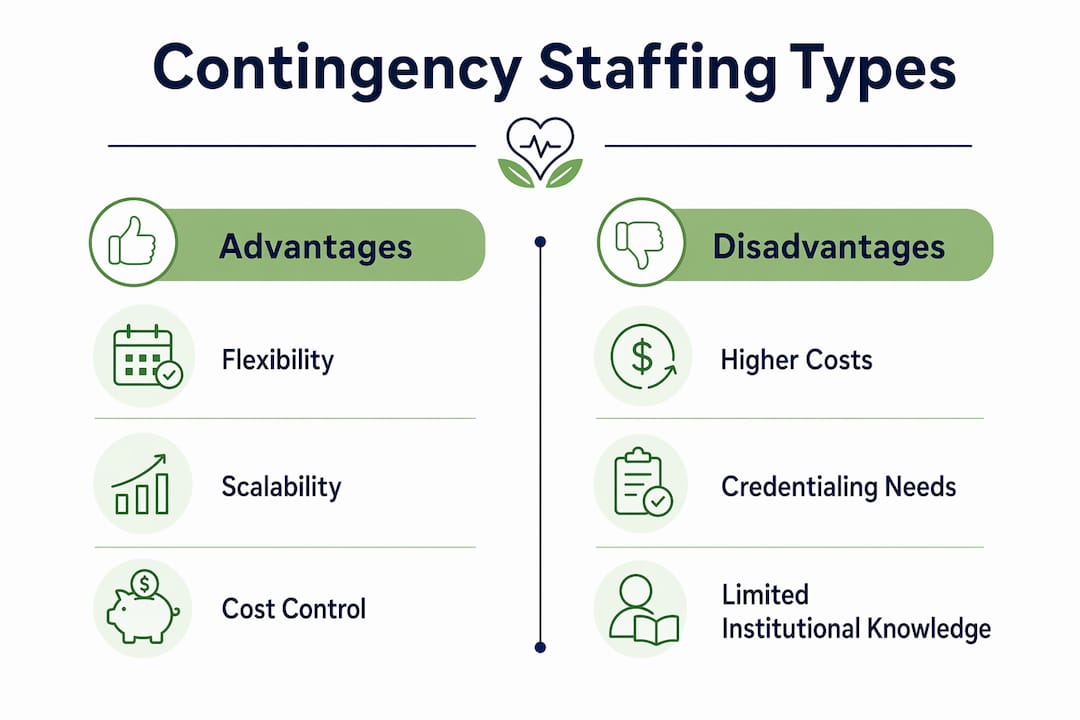
Advantages and disadvantages of contingency staffing
Contingency staffing solves real problems, but it creates new ones if you rely on it too heavily.
Advantages:
- Rapid deployment to manage unexpected patient surges
- Reduces burnout risk by supplementing the workforce at critical times
- Access to specialized clinical skills not available in your permanent staff
- Avoids the long-term cost of overstaffing during predictable low-demand periods
- Supports continuity when permanent staff take extended leave
Disadvantages:
- Higher per-shift or per-assignment wages, especially for travel clinicians
- Onboarding delays reduce immediate productivity
- Temporary staff often lack institutional knowledge, creating care continuity risks
- Heavy reliance on contingent workers can weaken team cohesion
- Quality control requires active credentialing oversight
| Factor | Advantage | Disadvantage |
|---|---|---|
| Flexibility | Scales up or down with demand | Requires pre-built activation systems |
| Cost | Avoids permanent overstaffing | Higher per-assignment wages |
| Skills access | Brings specialized expertise | Inconsistent familiarity with your protocols |
| Staff wellbeing | Reduces permanent staff burnout | Can create "us vs. them" team dynamics |
| Care quality | Maintains coverage levels | Continuity gaps if turnover is high |
Pro Tip: Travel clinicians often command higher wages and expenses than PRN or temp staff. Reserve them for sustained shortages where the coverage duration justifies the cost.
How contingent workers differ from permanent employees
The differences go beyond contract length. Understanding them helps you set the right expectations and avoid compliance gaps.
- Employment terms: Contingent workers operate under temporary contracts or agency agreements; permanent employees hold ongoing positions with defined job security
- Compensation: Contingent workers are paid per assignment, contract, or hour, typically without employer-sponsored benefits such as health insurance or retirement plans
- Institutional knowledge: Permanent staff carry deep familiarity with your facility's workflows, patient populations, and team culture; contingent workers must be oriented each time
- Credentialing obligations: Both groups require verified licenses, but contingent workers need expedited credentialing checks before each deployment
- Scope of practice: Contingent workers must be matched to roles within their verified competencies; deploying them outside their credentialed scope creates liability
- Cultural integration: Permanent employees build long-term relationships with colleagues and patients; contingent workers rotate out, which can affect care continuity on complex cases
When should you activate contingency healthcare staffing?
Timing matters. Deploying contingent staff too late creates crisis conditions; deploying too early drives up costs without real need.
CDC guidance recommends implementing contingency strategies sequentially, before reaching crisis capacity. That means planning minimum staffing thresholds, identifying supplemental labor pools, and establishing orientation protocols in advance, not during the shortage itself.
Situations that typically warrant activation:
- Seasonal surges: Flu season, summer trauma peaks, or predictable census spikes
- Leave of absence coverage: Extended medical, parental, or FMLA leave by permanent staff
- Pandemic or outbreak response: Rapid demand increases that exceed your permanent roster
- New service line launches: Temporary specialist coverage while permanent hiring is completed
- Strike or workforce disruption: Maintaining patient care during labor actions
Pro Tip: Build your contingency staffing plan as an executable system with defined trigger thresholds, such as a specific absenteeism percentage or census level. Waiting until a shortage is already critical forces reactive decisions that accelerate staff burnout.
Flexible staffing models that blend a stable core of full-time employees with internal float pools and external contingent workers tend to deliver better operational agility than models that minimize permanent staff and lean heavily on temporary coverage.
Strategic best practices for contingency healthcare staffing
Getting contingency staffing right requires more than calling an agency when a shift goes uncovered. Research consistently points to pre-planning, credentialing rigor, and hybrid staffing models as the foundation of effective deployment.

Credentialing and clinical equivalency come first. Temporary staff often lack institutional knowledge and require clear clinical equivalency definitions before safe deployment. That means specifying the exact credential, skill, and experience requirements for each role you might fill with a contingent worker, before you need to fill it.
Maintain a strong permanent core. Relying solely on temporary staff is counterproductive. Permanent staff provide the institutional knowledge and care continuity that complex patients depend on. Flexible staffing models that maintain higher baseline permanent staff while deploying contingent workers for variation achieve better patient outcomes and cost-effectiveness than low-baseline, heavily contingent models.
Build executable plans, not documents. Contingency staffing plans must function as trigger-based systems with defined activation conditions. A plan that requires a committee decision every time a threshold is crossed will always lag behind the need.
Additional best practices:
- Pre-negotiate contracts with staffing agencies before shortages occur
- Create standardized orientation checklists for contingent workers by unit type
- Track contingent worker performance data to inform future deployment decisions
- Integrate contingent staff into team huddles and handoff protocols from day one
- Review your contingency recruitment strategy annually, not only during a crisis
Contingency staffing works best as a planned component of your workforce strategy, not a fallback you reach for when everything else has failed.
Key Takeaways
Contingency healthcare staffing works when it is pre-planned, credentialing-verified, and integrated into a hybrid model that keeps a strong permanent core at the center.
| Point | Details |
|---|---|
| Define it clearly | Contingency staffing deploys temporary clinicians to cover demand variability and short-term workforce gaps. |
| Plan before the shortage | CDC guidance recommends sequential implementation with defined thresholds before crisis conditions develop. |
| Match worker type to need | PRN staff suit single-shift gaps; travel clinicians cover sustained shortages of extended duration. |
| Keep a permanent core | Models with higher baseline permanent staff deliver better patient outcomes than heavily contingent approaches. |
| Credential every deployment | Clinical equivalency definitions must be set in advance to avoid scope-of-practice and safety risks. |
Ready to connect your facility with qualified contingent nurses and healthcare professionals? 
Flexiblenursingcareers matches healthcare employers with verified, flexible clinicians ready to fill gaps fast. Whether you need PRN coverage tonight or a travel nurse for a 13-week contract, the platform's real-time matching puts the right professional in front of you without the lengthy back-and-forth. Post your staffing needs or browse available nursing jobs today.