
Healthcare placement speed is defined as the total time from a job requisition opening to a qualified candidate accepting a role. The industry standard term is "time-to-fill," and it is one of the most closely watched healthcare staffing metrics in workforce management. The median time-to-hire across healthcare roles sits at 41 days, but that number masks enormous variation by role type, geography, and credentialing complexity. Slow placements cost facilities money, strain existing staff, and put patient care continuity at risk. Fast placements, done right, keep units staffed, budgets stable, and nurses working.
What is healthcare placement speed, and why does it matter?
Healthcare placement speed measures how quickly a staffing need becomes a filled position. The clock starts when a facility opens a requisition and stops when a candidate formally accepts the offer. Every day in between represents a gap in coverage, a shift that gets covered by overtime, or a patient who waits longer for care.
The gap between fastest and hardest-to-fill roles is widening. Entry-level clinical support roles fill in under 30 days. Specialized physician roles take 120 days or more. That spread reflects the real complexity of healthcare hiring, where credentialing, licensure verification, and clinical fit assessments add layers that do not exist in most other industries.

Two key performance indicators anchor placement speed in healthcare operations: shift fill rate and credential compliance rate. The target shift fill rate sits between 85% and 95%, while credential compliance must reach 98% or higher. These numbers are not aspirational. They are the floor for regulatory safety and operational stability.
What factors influence healthcare placement speed?
Role complexity is the single biggest driver of placement time. Entry-level positions like patient care technicians or medical assistants move quickly because the credential requirements are limited and the candidate pool is large. Specialized roles like ICU nurses, surgical technologists, or hospitalists require multi-step license verification, background checks, and clinical competency reviews that add weeks to the process.
Several variables either accelerate or slow placement speed:
- Credentialing requirements: License verification, DEA registration, and specialty certifications each add processing time. A single missing document can pause a placement for days.
- Geographic labor supply: Urban markets have deeper candidate pools. Rural facilities often wait longer because fewer qualified candidates live within a reasonable commute.
- Sourcing strategy: Facilities that rely on reactive job postings fill roles more slowly than those with pre-vetted candidate pipelines.
- Candidate engagement: Slow responses to offers or incomplete application files extend timelines on the candidate side.
- Compliance checkpoints: Facilities with strict credentialing protocols take longer to place candidates but face fewer regulatory risks downstream.
Understanding common hiring delays helps both employers and job seekers identify where their process loses time.
Pro Tip: If you are a job seeker, treat your credential file like a live document. Keep licenses, certifications, and immunization records current and uploaded before you apply. Facilities move faster on candidates whose files are already complete.
How is healthcare placement speed measured and benchmarked?
Four metrics define placement speed in healthcare staffing. Time-to-fill measures the full span from requisition to accepted offer. Time-to-hire measures the span from first candidate contact to acceptance. Shift fill rate tracks what percentage of open shifts get covered within a target window. Credential compliance rate measures how many placed candidates meet all regulatory and facility requirements.
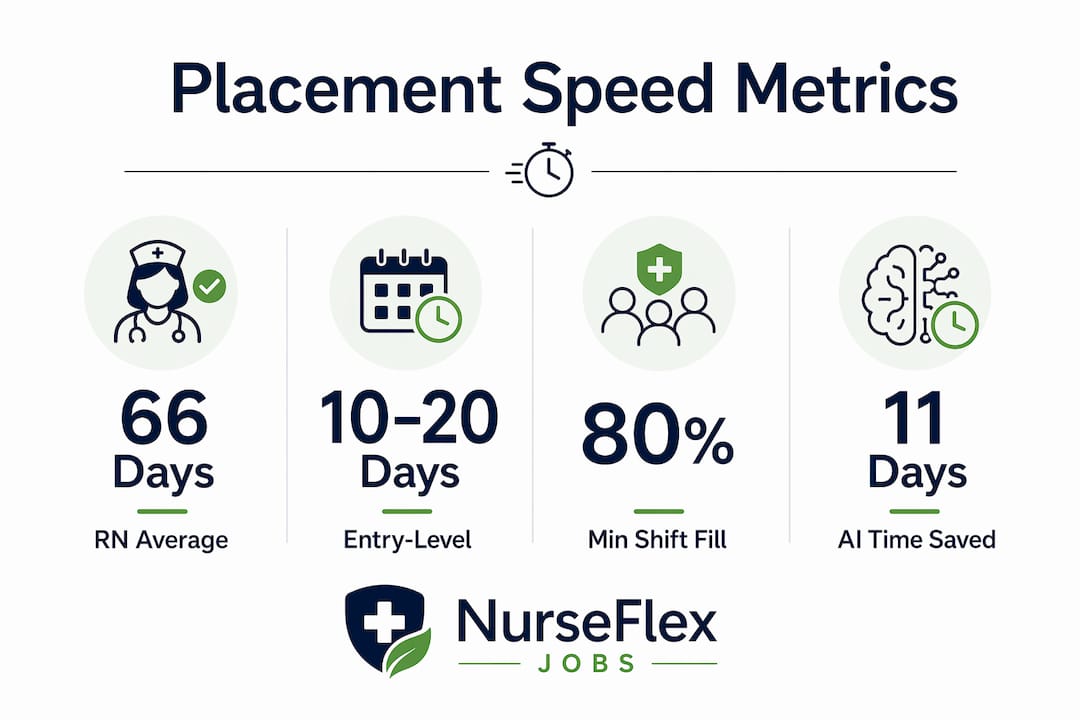
Filling an RN role takes 66 days on average, and sourcing consumes 70% of that time. That means only 30% of the hiring timeline goes to interviews, credentialing, and offer negotiation. Facilities that cut sourcing time through pre-built talent pools or real-time matching platforms see the most dramatic reductions in overall fill time.
The table below shows average placement times by role category, based on current industry benchmarks:
| Role category | Average time-to-fill |
|---|---|
| Entry-level support (CNA, MA) | 10–20 days |
| Registered Nurse (RN) | 66 days |
| Allied health specialist | 45–75 days |
| Specialized physician | 120–180+ days |
These benchmarks give facilities a reference point for evaluating their own performance. A facility filling RN roles in 45 days is outperforming the national average. One taking 90 days has a process problem worth diagnosing.
Urgent fill capability is another benchmark worth tracking. Facilities with strong staffing readiness can cover urgent shift needs within 8 hours. That metric reflects the depth of a pre-vetted candidate bench, not just the speed of the formal hiring process.
What role does technology and AI play in accelerating placement speed?
AI reduces the operational drag in healthcare recruiting without replacing the clinical judgment that safe placements require. AI tools reduce time-to-hire by 11 days on a 41-day median baseline. That reduction comes from automating the most time-consuming administrative steps in the process.
The specific tasks where AI delivers the most value include:
- Document intake: AI reads, sorts, and flags credential documents faster than manual review.
- Credential tracking: Automated systems alert recruiters when a license is expiring or a document is missing before it becomes a placement blocker.
- Candidate matching: Algorithms match candidates to open roles based on skills, availability, and location in real time.
- Communication workflows: Automated messaging keeps candidates engaged during the process, reducing drop-off from slow follow-up.
AI supports document intake and flags missing credentials, but humans verify and decide clinical fit. That distinction matters. A system can confirm that a nurse holds an active RN license. Only a clinical reviewer can assess whether that nurse's experience matches the acuity level of the unit.
The strongest staffing operations use a human-in-the-loop model. AI handles volume and speed. Recruiters and clinical reviewers handle judgment and accountability. Understanding automation in job placement helps facilities build this balance deliberately rather than by accident.
Pro Tip: Employers should audit their credentialing workflow before adding AI tools. Automating a broken process makes it faster but not better. Fix the process first, then automate.
Why does placement speed matter for patient care and workforce management?
Slow placements do not just create scheduling headaches. They produce measurable harm across three dimensions: patient care quality, staff health, and facility finances.
"Facilities with shift fill rates sustained below 80% face a compounding problem. Existing staff absorb the extra shifts through overtime, which accelerates burnout. Burnout drives attrition. Attrition creates more open shifts. The cycle repeats until the facility faces a workforce crisis, not just a staffing gap."
The data supports this directly. Sustained shift fill rates below 80% lead to overtime-driven burnout and attrition. Facilities that let fill rates drop and stay low are not just understaffed. They are actively eroding the workforce they have.
For job seekers, placement speed reflects market responsiveness. A platform or facility that places candidates quickly signals an organized process, clear communication, and respect for the candidate's time. Slow placements often indicate disorganized credentialing workflows or unclear hiring authority, both of which predict a difficult employment experience.
The compliance dimension adds another layer. 98% credential compliance is the minimum standard. Rushing placements to hit speed targets while cutting credential corners creates regulatory exposure and care quality risks that far outweigh the cost of a slower, compliant hire.
The benefits of fast, compliant placement include:
- Reduced overtime costs for facilities
- Lower agency spend on last-minute coverage
- Improved patient-to-nurse ratios on units
- Higher job satisfaction for placed candidates
- Stronger retention rates over the first 90 days
Job seekers who complete their healthcare profile before applying experience faster placement because facilities do not have to chase documents. A complete file moves through credentialing in days, not weeks.
Key Takeaways
Healthcare placement speed is the most direct measure of staffing system health, and facilities that track it with precision consistently outperform those that manage by intuition alone.
| Point | Details |
|---|---|
| Time-to-fill is the core metric | It measures the full span from requisition to accepted offer, with a national median of 41 days. |
| Role complexity drives variation | Entry-level roles fill in 10–20 days; specialized physician roles take 120–180+ days. |
| Shift fill rate targets matter | Facilities should maintain an 85–95% shift fill rate to prevent burnout and attrition cycles. |
| AI cuts time but not judgment | AI reduces time-to-hire by 11 days on average, but clinical reviewers must verify fit and safety. |
| Complete profiles accelerate placement | Job seekers with full credential files move through hiring faster than those with incomplete records. |
What I've learned about placement speed after years in healthcare staffing
The conversation about placement speed almost always starts with the wrong question. Facilities ask, "How do we fill roles faster?" The better question is, "Where exactly are we losing time, and why?"
In my experience, the answer is almost always credentialing. Not sourcing, not interviews, not offers. Credentialing. A candidate can be identified, interviewed, and verbally offered a role in two weeks. Then the file sits in a credentialing queue for another month because someone is waiting on a reference, a license verification, or an immunization record. That delay is invisible in most dashboards because it does not show up as a sourcing failure. It shows up as a long time-to-fill, and leadership assumes the problem is candidate supply.
The second thing I've learned is that regional benchmarks matter more than national averages. A 66-day average for RN fills is a useful reference point, but it tells a rural facility in a low-supply market nothing actionable. That facility needs to know what the best-performing comparable facility in their region achieves, and then close the gap to that number.
Technology helps, but only when the humans using it are accountable for outcomes. I've seen AI-assisted platforms cut administrative time significantly. I've also seen facilities use that speed to rush credential reviews and create compliance problems. The tool is not the strategy. The strategy is a clear standard for what "placed correctly" means, and then using every available tool to reach that standard faster.
The staffing models that work best post-2025 combine real-time matching with pre-vetted candidate pools and human clinical review at every decision point that affects patient safety. Speed and quality are not in conflict. They are both outputs of a well-designed process.
— Flexible
How Flexiblenursingcareers connects you to faster placements
Flexiblenursingcareers is built for healthcare professionals and employers who cannot afford to wait weeks for a placement decision.

The platform matches nurses and healthcare workers to open roles based on skills, credentials, and availability in real time. Employers get access to pre-vetted candidates with complete files, which cuts credentialing delays significantly. Job seekers get matched to positions that fit their schedule and specialty without lengthy application queues. Browse current nursing jobs on Flexiblenursingcareers to see open roles matched to your profile. Employers can review staffing solutions for facilities to learn how the platform supports faster, compliant hiring at scale.
FAQ
What is the average healthcare placement speed by role?
Entry-level support roles fill in 10–20 days, RN roles average 66 days, and specialized physician roles take 120–180 days or more. Role complexity and credentialing requirements drive most of the variation.
How do facilities measure placement speed?
Facilities track time-to-fill, time-to-hire, shift fill rate, and credential compliance rate. A shift fill rate between 85% and 95% and a credential compliance rate of 98% or higher are the standard targets for operational stability.
Does AI actually improve healthcare placement speed?
AI reduces time-to-hire by 11 days on a 41-day median baseline by automating document intake, credential tracking, and candidate matching. Human reviewers still handle clinical fit decisions and final compliance verification.
What happens when placement speed is too slow?
Facilities with shift fill rates sustained below 80% experience overtime-driven burnout, higher attrition, and compounding staffing gaps. Slow placements also increase agency spend and reduce patient-to-nurse ratios on active units.
How can job seekers speed up their own placement?
Job seekers who maintain a complete credential file, including current licenses, certifications, and immunization records, move through facility credentialing faster. Completing your profile before applying removes the most common source of placement delays.