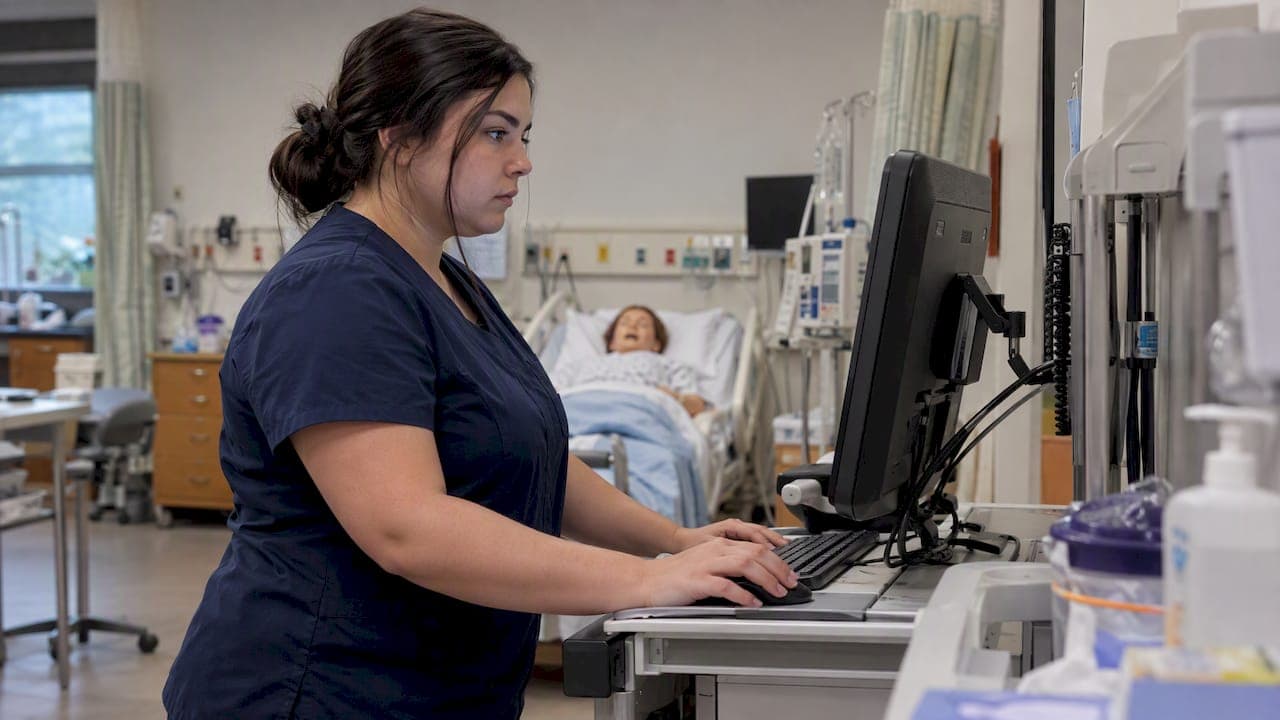
EMR experience is valuable but seldom a hard prerequisite for entry-level nursing jobs. Employers typically expect a nursing license and will train you on their facility's system from day one. What counts as EMR experience includes documentation, MAR entries, handoff notes, and order review from clinical rotations. Highlight those tasks on your resume, even without naming a specific platform.
TL;DR:
- Treat EMR experience as a hard cutoff only when a posting says required; preferred usually means the employer expects to train you.
- Prior platform experience matters most in travel assignments with short onboarding, critical care, informatics, and home health roles using structured OASIS assessments.
- Clinical rotations and simulated EHR coursework count; applicants should name charting, medication entries, handoff notes, order review, and care plan updates, not just software.
- Every nurse must follow HIPAA privacy rules, and facilities use access controls and audit trails; onboarding helps prevent wrong chart access and exposed screens.
Table of Contents
- 1. What employers mean by "EMR experience"
- 2. How much EMR experience employers actually expect
- 3. Which EMR systems employers mention and why the name matters less than the skill
- 4. Pathways to gain EMR experience before you're hired
- 5. How to show EMR readiness on your resume and in interviews
- 6. Legal and privacy compliance requirements tied to EMR use
- 7. How EMR proficiency affects workflow and patient care
- 8. How EMR expectations differ across nursing specialties
- 9. Hiring perspective: what recruiters really look for
- 10. Find roles that match your EMR readiness with Flexible
- FAQ
- Sources
1. What employers mean by "EMR experience"
Job postings rarely spell out what "EMR experience" actually covers, so applicants often underestimate what they already have. Most employers mean hands-on comfort with routine digital tasks tied to patient care, not mastery of a particular software brand.
That comfort shows up in a few concrete places:
- Completing patient assessments and charting vital signs in a digital record
- Entering and verifying medication administration (MAR) accurately
- Writing handoff notes that follow SBAR or similar formats
- Reviewing provider orders and lab results within the system
- Updating care plans as a patient's condition changes
Postings also split into "preferred" versus "required" language, and that distinction matters more than applicants usually assume. A listing that says Epic experience is "preferred" still welcomes nurses who learned charting on a different system. One that says it is "required" usually applies to specialty or senior roles where onboarding time is limited. Navigating a system (finding the right screen, pulling up a chart) is a different skill from documenting in it accurately and efficiently, and most clinical placements give you exposure to both.
2. How much EMR experience employers actually expect
Entry-level nursing roles rarely demand years of EMR experience, and that is by design. The Bureau of Labor Statistics notes that employers typically require graduation from an accredited nursing program and an active state license, treating EMR fluency as a skill sharpened on the job rather than a strict prerequisite. A related BLS factsheet backs this up: a notable share of registered nurse positions rely on on-the-job training rather than prior experience to build competency.
Prior EMR exposure tends to carry more weight in specific situations:
- ICU and critical care roles, where documentation speed affects patient safety
- Nursing informatics positions, which require deeper system-level knowledge
- Travel nursing assignments with short onboarding windows
- Home health roles using OASIS, where assessment documentation is highly structured
When you read a posting, look for the difference between a skill listed as a "requirement" and one listed as a "plus" or "preferred." The first usually reflects a hard cutoff; the second signals that onboarding will cover the gap. Reading that distinction correctly saves you from skipping roles you are actually qualified for.
3. Which EMR systems employers mention and why the name matters less than the skill
Epic Systems shows up often in U.S. nurse job postings, and O*NET's Hot Technologies data confirms it as one of the most frequently cited platforms for registered nurses. That frequency makes Epic a useful reference point, but it does not mean every employer uses it or that lacking Epic experience disqualifies you.
Vendor names vary widely by hospital system, region, and specialty. Cerner, Meditech, and smaller specialty platforms remain common, and the underlying skills (accurate charting, order review, secure messaging) transfer across all of them. A few guidelines for how to frame this:
- Name the system you trained on, but describe the skill, not just the brand
- Avoid claiming "proficiency" in a system you only briefly observed
- Emphasize adaptability: mention how quickly you picked up a new system before
- Treat vendor exposure as a bonus detail, not your main qualification
Employers generally care more about whether you can learn their system quickly than whether you have already used it.
4. Pathways to gain EMR experience before you're hired
Most nurses build EMR competence well before their first paycheck, often without realizing it counts. Clinical rotations are the most common source: log the specific tasks you performed (charting, MAR entries, care plan updates) rather than just the unit you worked on.
Simulated EHR platforms used in nursing programs, such as DocuCare, are another proven route. A practice-oriented education study found that simulated EHR training significantly improved informatics competency among new nurses compared with non-simulated coursework. A related scoping review found that newly graduated nurses often start with gaps in EHR skills, and that simulation and targeted education are effective ways to close them.
Once hired, unit-based onboarding and shadowing remain the main production line for real EMR fluency; most facilities budget real time for this before expecting independent charting.
Pro Tip: Ask your current or most recent clinical instructor for 15 minutes of unsupervised practice time in a simulated EHR before your next shift. Repetition, not length of exposure, builds speed.
A few habits that speed up the learning curve:
- Practice charting a full patient encounter start to finish, not isolated fields
- Review a few real (de-identified) charts for formatting patterns
- Ask a preceptor to show shortcuts for order review and results lookup
5. How to show EMR readiness on your resume and in interviews
A resume bullet works best when it names a task, not just a system. Try a structure like: "Documented patient assessments, medication administration, and care plan updates in [system] during clinical rotations," swapping in whatever platform you actually used.
In interviews, give a specific example rather than a general claim:
- Describe a time you charted under time pressure and what you prioritized
- Mention any simulated EHR coursework and what it taught you about accuracy
- Note how quickly you adapted when switching between systems or units
- Ask what onboarding looks like for their specific EMR platform
If you are hunting for roles that match the EMR exposure you already have, or that offer strong onboarding instead of assuming prior proficiency, skills-based matching can connect you with postings suited to your actual experience level rather than generic requirements.
6. Legal and privacy compliance requirements tied to EMR use
Every nurse who touches an electronic record works under HIPAA, regardless of how new they are to the system. That means understanding who can access a chart, when it is appropriate to look something up, and how to avoid leaving sensitive information visible on a shared screen. These are not optional courtesies: they are legal obligations tied to your license.
The Nursing Informatics Entry-to-Practice Competencies framework places digital professionalism, data integrity, and privacy awareness alongside clinical skills as core competencies for nurses entering practice, not as an afterthought to technical training. Most facilities reinforce this during onboarding with mandatory HIPAA training and system-specific access controls, since audit trails track every chart you open.
New nurses sometimes assume privacy rules are a background concern handled by IT. In practice, the people most likely to trigger a compliance issue are those unfamiliar with a new system, clicking into the wrong record or leaving a workstation logged in. Facilities build in extra oversight during the first weeks for exactly this reason, which is part of why structured onboarding matters as much as prior EMR exposure.

7. How EMR proficiency affects workflow and patient care
Charting speed and accuracy are not just administrative details. When documentation lags behind the bedside, care teams work from outdated information, and small errors (a missed vital sign trend, a delayed order acknowledgment) can compound quickly. Fluency with a system's shortcuts and layout directly affects how much attention a nurse can keep on the patient instead of the screen.
Research on EMR education points to this translation gap as the real challenge. One analysis found that new nurses often struggle to convert fast-moving clinical workflows, like verbal handoffs or rapid assessments, into accurate digital entries without breaking communication with the care team. Simulation and focused onboarding reduce that friction, which is one reason facilities invest in it rather than expecting instant fluency.
The upside compounds over time. Once charting becomes automatic, nurses spend more of their cognitive effort on clinical judgment and less on data entry, and that shift shows up in fewer documentation gaps and faster response to changing patient status.
8. How EMR expectations differ across nursing specialties
EMR expectations shift depending on where you work, and the differences are practical rather than arbitrary. Telehealth roles lean heavily on virtual charting and secure messaging, since the entire patient interaction happens through the screen; comfort navigating a system quickly is close to a baseline requirement there. Readers considering that path can look at telehealth nursing requirements for more detail on the digital competencies those roles expect.
Case management and utilization review roles often involve less bedside charting but heavier use of structured data fields, since much of the job involves reviewing and coordinating care across multiple providers. Home health, by contrast, relies on standardized assessment tools like OASIS, which demand precise, consistent documentation because the data feeds directly into care planning and reimbursement.
Bedside roles in acute care still prioritize speed and accuracy under pressure above all else. None of these specialties require a different EMR system so much as a different emphasis: some reward fast navigation, others reward careful structured entry.

9. Hiring perspective: what recruiters really look for
Hiring managers weigh clinical judgment and trainability more heavily than exact vendor exposure, and that priority rarely changes across specialties. A nurse who can describe a specific documentation example, point to simulation experience, and show they adapt quickly to new systems tends to stand out more than one who simply lists a platform name. Confidence in the details matters more than the brand on the screen.
— Flexible
10. Find roles that match your EMR readiness with Flexible
We built our matching service around real skills and availability, not rigid years-of-experience cutoffs, so nurses with simulated EHR training or rotation-based charting experience can find roles that fit where they actually are. Our free matching service connects you with travel nursing jobs and other flexible roles based on your skills and preferences, and you can set up job alerts to hear about openings as they post.

| What you want | Where to look |
|---|---|
| Digitally-forward remote roles | Telehealth Nursing Jobs |
| Flexible scheduling with fast matching | Travel Nursing Jobs |
| Specialty paths like case management or informatics | Specialty Jobs |
Create a profile today and let our real-time matching connect you with employers who value what you already bring to the chart.
FAQ
What is considered EMR experience?
EMR experience generally means hands-on work with digital documentation tasks like charting assessments, entering medication administration, reviewing orders, and writing handoff notes. It does not require mastery of a specific vendor's platform. Clinical rotations, simulated EHR coursework, and on-the-job onboarding all count.
How many years does it take to become an ER nurse?
Becoming a registered nurse typically requires completing an accredited nursing program and passing the licensing exam, a path the Bureau of Labor Statistics outlines as the standard entry route. Moving into emergency nursing specifically usually follows initial RN experience plus unit-based training, though exact timelines vary by employer.
What EMR do nursing homes use?
Nursing homes and long-term care facilities use a range of systems, and no single platform dominates the sector the way some hospital networks rely on Epic. The specific system matters less than your ability to learn structured documentation tools quickly, since most facilities provide onboarding regardless of your prior exposure.
Is it hard to learn EMR systems?
Most nurses find the initial learning curve manageable, especially with structured onboarding or prior simulated practice. A scoping review found that targeted EHR education and simulation are effective ways to close early skill gaps, and comfort with the shortcuts and layout typically comes within the first few weeks.
Sources
- Registered Nurses : Occupational Outlook Handbook: : U.S. Bureau of Labor Statistics
- Effect of a practice-oriented electronic medical record education program for new nurses (MDPI/PMC)
- Electronic Health Record knowledge, skills, and attitudes among newly graduated nurses: A scoping review
- Nursing Informatics Entry-to-Practice Competencies for Registered Nurses (CASN)