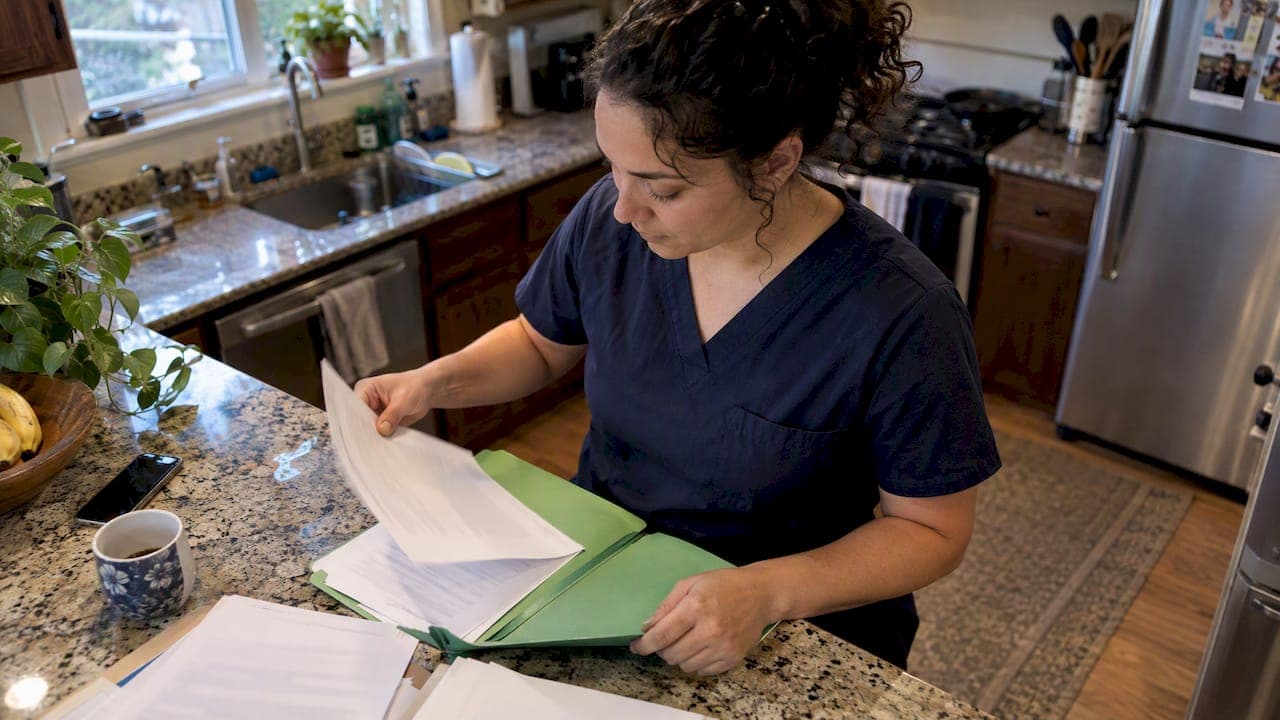
Temporary nurse compliance comes down to one packet: a government ID, work eligibility papers, an active license, BLS or ACLS and specialty certificates, a background check and drug screen, vaccination records, a baseline TB screening, a recent physical, a skills checklist, and references. Your agency and the receiving facility may verify these, and credentialing responsibilities can vary by facility and assignment. Nursys, CDC, and OSHA set the main rules.
TL;DR:
- Employers verify licenses through the nursing board or Nursys; check your status and expiration early, and confirm whether you need state endorsement.
- CDC recommends baseline TB screening at hire, but not routine annual testing without a known exposure; bring prior results, including documentation of positive tests.
- Employers must offer exposed employees the vaccine series at no cost within 10 working days of assignment, unless prior vaccination, immunity, or contraindication applies.
- Facilities may require competency checks, unit and EHR orientation, equipment training, and a preceptor; ask your recruiter what the unit will validate on day one.
Table of Contents
- Which documents belong in your compliance checklist?
- How do employers verify your nursing license?
- What health screenings and immunizations will facilities ask for?
- What do background checks and exclusion screenings cover?
- How do facilities credential agency nurses?
- How do you get start-ready faster?
- What compliance readiness means for your placement
- How we help you find compliant travel assignments
- FAQ
- Sources
Which documents belong in your compliance checklist?
Build this packet before a recruiter calls. Agencies and facilities ask for the same core items again and again.
- Identity and payroll eligibility: a government-issued photo ID and your Social Security card, or the documents your employer accepts for the I-9.
- Licenses and certifications: your active RN or LPN license with its expiration date, plus BLS, ACLS, and any specialty certificates.
- Health screenings: vaccination records, a baseline TB result (IGRA or TST), and a physical exam, as facility requirements may require.
- Background and safety: criminal background or fingerprint results, a drug screen, a concise resume, and references with contact details.
- Extras employers may request: a skills checklist, proof of professional liability insurance, and signed facility policy acknowledgments.
How do employers verify your nursing license?
Primary-source verification is the standard. That means the board of nursing or Nursys, the national database for licensure, discipline, and practice privileges. Employers use QuickConfirm, a free service, to pull your license status. Endorsement verification to a new board typically costs about $30 per license type per board, according to NCSBN.
State boards also expect employers to check licenses at hire and record the expiration date, so an expired license ends an assignment fast. Our Nursys verification guide walks through the process step by step.
- Confirm that your name and license status display correctly.
- Note every expiration date in one place.
- Request verification or run QuickConfirm early, where your state supports it.
- Know whether you hold a compact license or need endorsement for the new state.
What health screenings and immunizations will facilities ask for?
Facilities start with a baseline TB screening. CDC guidance calls for a risk assessment, a symptom evaluation, and a TB test, either a blood test (IGRA) or a skin test (TST), when you are hired as health care personnel. Annual TB testing is a common myth. CDC does not recommend routine serial testing after baseline unless there is a known exposure, so bring your prior result instead of agreeing to a repeat.
OSHA's Bloodborne Pathogens standard requires employers to offer the hepatitis B vaccine series at no cost within 10 working days of initial assignment to employees with occupational exposure. Training is required at assignment and at least annually.
The exception: you may already have the series, proven immunity by antibody test, or a medical contraindication. Our OSHA requirements article covers the timing in more detail.
- Carry records for MMR, Tdap, influenza, and COVID where a facility requires it.
- Keep a dated physical, since facility requirements vary.
- Save documentation of any prior positive TB result or proven immunity.
What do background checks and exclusion screenings cover?
Background items cause many delayed starts, so have the paperwork ready.
- Criminal background checks and fingerprinting apply where state law or facility policy requires them.
- Exclusion screening checks federal sanction lists such as the OIG LEIE, alongside work eligibility verification. Risk advisories from MedPro recommend this step for temporary nursing staff.
- Reference and employment history checks may require original documents or notarized copies, so keep your records clear and consistent.
How do facilities credential agency nurses?
The facility and agency can have different professional and administrative responsibilities for patient care. That is why facilities ask agencies for primary-source verification of education, licensure, certifications, and history. A temporary staffing checklist from Medical Mutual adds clinical competence checks, background and exclusion screening, and documented oversight.
- A written credential file for every nurse.
- Orientation to the unit and the EHR, plus equipment training.
- Competency validation and an assigned preceptor or mentor.
- Contract terms between facility and agency, such as insurance, indemnity, and replacement guarantees. These may affect whether an agency's nurse is accepted.
Pro Tip: Ask your recruiter which competencies the unit will validate on day one, then bring evidence of that specific experience.
Facilities also differ in their own staffing rules. If you are new to the model, our guide to temporary clinical staffing explains who handles what. A structured onboarding checklist can also help you organize your own paperwork.

How do you get start-ready faster?
Build one credentials folder, paper and secure digital, with dated PDFs of everything above. Advisories from Chubb recommend carrying originals and copies and uploading credentials early to avoid onboarding delays. Tell your recruiter about any item nearing its expiration date.
The morning before you start:
- Pack your originals and a printed copy of your packet.
- Confirm your EHR access and login details.
- Confirm the orientation time, location, and contact person.
- Check that no license or certificate expires during the assignment.
Pro Tip: Rename every file with the document type and date, such as "BLS_date.pdf", so a recruiter can find it in seconds.
What compliance readiness means for your placement
We see the same pattern: nurses with current, organized credentials get matched and start sooner. Our platform is built around technology-driven matching and rapid onboarding, so a complete profile does real work for you. Keep your credentials current and update them before they expire.
— Flexible
How we help you find compliant travel assignments
Our free matching service connects you with travel and temporary roles based on your skills, availability, and preferences. Explore opportunities on our travel nursing jobs page. Then subscribe for job alerts so new openings reach you as they appear.

This article is general information, not a substitute for advice from a qualified doctor. Consult a qualified healthcare professional about your own circumstances before acting on anything here.
FAQ
What does a compliance nurse do?
A compliance nurse helps a facility follow regulations and internal policies. That includes reviewing credentials, tracking licensure and training, and checking that documentation meets standards.
What is a temporary nurse?
A temporary nurse works short-term assignments, often through an agency, to fill gaps in staffing. You may need many of the same core credentials as permanent staff, and the facility may verify them before you start.
Do I need a TB test every year?
CDC guidance calls for baseline TB screening at hire. Routine serial testing is not recommended without exposure, though annual TB education is.
How often does OSHA require bloodborne pathogen training?
OSHA's Bloodborne Pathogens standard requires training at initial assignment and at least annually. Employers must also keep training records.
Sources
- Baseline Tuberculosis Screening and Testing for Health Care Personnel | TB Prevention in Health Care Settings | CDC
- Osha
- License Verification (Nursys.com) | NCSBN
- Hiring Temporary Nursing Staff
- Temporary Professional Staffing