
The main nursing practice environments are the emergency department, ICU, med-surg, OR, labor and delivery, pediatrics, ambulatory clinics, home health, long-term care, hospice, school and occupational health, telehealth, and community or public health. If you want maximum schedule control, start with per-diem or agency work in med-surg, home health, or ambulatory clinics. If you want higher pay and don't mind less predictability, ICU, ER, and OR carry acuity premiums.
- Acute, high-stimulation: ER, ICU, OR, L&D
- Continuity-focused: home health, long-term care, hospice, school health
- Predictable weekday hours: clinics, occupational health, telehealth
Scheduling conflict remains one of the most contentious issues in nursing, and it directly shapes turnover. Platforms like NurseFlex Jobs now match nurses to open shifts across all these settings in real time.
Key Takeaways
The right nursing practice environment depends on matching your acuity tolerance and schedule needs to a setting's actual pace, not its reputation.
| Point | Details |
|---|---|
| Acuity drives pace and pay | ER, ICU, and OR pay premiums but demand faster clinical judgment and less predictable hours. |
| Continuity settings reward patience | Home health, long-term care, and hospice favor relationship-building over rapid intervention. |
| Scheduling transparency matters most | Predictable, communicated schedules improve acceptance more than the shift pattern itself. |
| Per-diem trades training for autonomy | Temporary roles offer more schedule control but typically less onboarding investment. |
| NurseFlex Jobs speeds the match | Real-time matching connects nurses to PRN, travel, and per-diem shifts across all these settings. |
Table of Contents
- Types of Nursing Practice Environments at a Glance
- How Responsibilities and Acuity Shift From Unit to Unit
- Shift Patterns and What "Flexible" Actually Means
- Certifications and Skills Employers Actually Check
- Matching Yourself to the Right Setting
- A Checklist Before You Say Yes to a Job Posting
- What Drives Pay Differences Between Settings
- Moving Into a New Practice Setting
- Choosing a Setting Is a Moving Target, Not a One-Time Decision
- Find Flexible Shifts Across Every Practice Setting
- Sources
Types of Nursing Practice Environments at a Glance
Every setting has its own rhythm, and knowing that rhythm before you apply saves you from a mismatch six weeks in.
- Emergency department: Unpredictable patient flow, rapid triage, trauma exposure. Mostly 12-hour shifts, heavy on nights and weekends, with strong PRN and travel demand.
- ICU: Ventilators, titrated drips, one-to-two patient ratios. 12-hour rotating shifts; per-diem ICU roles pay well because coverage gaps are constant.
- Med-surg: Broad patient mix, moderate acuity, high patient loads. 12-hour shifts dominate; this is where most new float and PRN pools start.
- Operating room: Scheduled procedures, on-call for emergencies, precision-driven pace. 8 or 10-hour shifts plus call rotations; specialty training often required before per-diem eligibility.
- Labor and delivery: Long stretches of monitoring punctuated by sudden acuity spikes. 12-hour shifts, frequent on-call, limited PRN openings due to specialized skill needs.
- Pediatrics: Family-centered care, dosing precision, emotional intensity. Mix of 12-hour inpatient shifts and 8-hour clinic days.
- Ambulatory clinics: Steady weekday pace, low overnight demand. 8-hour day shifts, the most family-friendly schedule in nursing.
- Home health: One patient at a time, travel between visits, high autonomy. Flexible daytime hours, often self-scheduled.
- Long-term care: Chronic condition management, close relationships over months or years. 8 or 12-hour shifts, consistent PRN availability.
- Hospice: End-of-life comfort care, heavy emotional labor, family communication. Flexible visit-based scheduling, frequent per-diem roles.
- School and occupational health: Injury response and prevention, minimal acute care. Weekday daytime hours, seasonal predictability.
- Telehealth: Remote triage and chronic disease follow-up. Highly flexible, often part-time or evening blocks.
- Community and public health: Population-level education and outreach. Weekday hours with occasional field flexibility.
Pro Tip: If you're testing a new environment, look for per-diem or short-term platform placements first. You get a real feel for the pace before committing to a permanent schedule.
How Responsibilities and Acuity Shift From Unit to Unit
Hospital-based nursing centers on stabilization. Home health and long-term care emphasize continuity instead, with education and relationship-building replacing rapid intervention as the core skill.
In the ER or ICU, a shift might include:
- Rapid triage and airway management under time pressure
- Titrating vasoactive drips and interpreting arrhythmias in real time
- Coordinating with a full care team during a code
In home health or long-term care, the same hours look like:
- Teaching a patient's family how to manage a new diabetes diagnosis
- Coordinating with physical therapy and social work over weeks or months
- Documenting subtle changes in condition across repeat visits
Acute settings demand faster clinical judgment and shorter documentation windows. Continuity settings demand patience, communication skill, and tolerance for slower, cumulative progress.
Shift Patterns and What "Flexible" Actually Means
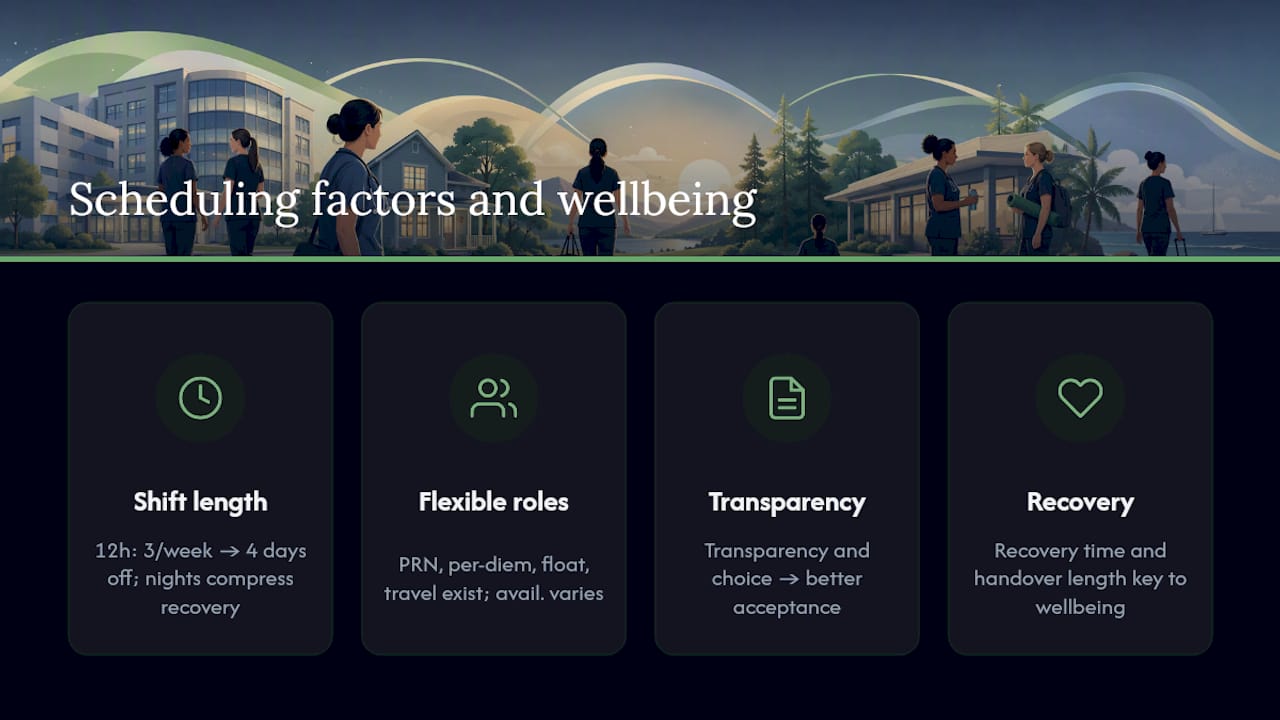
Most acute care runs on 12-hour shifts, rotating between days and nights. Clinics and school health stick to 8-hour weekday blocks. PRN, per-diem, float pool, and travel positions exist in nearly every setting, but availability varies. ICU and ER units lean on per-diem staff constantly because base staffing rarely covers surge demand.
The trade-off is real. Three 12-hour shifts a week means four days off, but back-to-back nights compress recovery time. Day-shift clinic roles offer predictability but rarely pay the night or weekend differentials that acute units do.
Scheduling research shows that fully satisfying every nurse's preference is rarely possible because organizations face real operational constraints. What actually works is transparency: units that communicate scheduling logic and offer some choice see better acceptance than units that dictate schedules top-down. Recovery time between shifts and handover length also came up repeatedly in nurse interviews as core to wellbeing, not a minor detail.
Pro Tip: Ask about typical shift-swap turnaround before accepting a role. A unit that takes two weeks to approve a swap isn't actually flexible, no matter what the job posting says.
Certifications and Skills Employers Actually Check
BLS is close to universal. ACLS and PALS get requested constantly in ER, ICU, and pediatric units. Beyond those baselines, specialty credentials signal readiness for higher-acuity work:
- CCRN for critical care, often expected within one to two years in the ICU
- CNOR for operating room nurses, usually earned after direct OR experience
- OCN for oncology roles, frequently employer-supported through continuing education
Per-diem and travel postings tend to ask for recent, demonstrable competency rather than years of tenure. Expect a skills checklist or a short competency exam before your first shift in a new specialty, even if you're already certified elsewhere.
Matching Yourself to the Right Setting
No environment is universally "better." It depends on what you're optimizing for right now.
- ER/ICU: Pro: highest pay differentials. Pro: constant clinical variety. Con: unpredictable stress load. Con: heavy night rotation. Best for nurses chasing acuity and pay before family obligations tighten schedules.
- Clinics/school health: Pro: predictable weekday hours. Pro: low overnight demand. Con: lower pay ceiling. Con: less clinical variety. Best for parents and nurses prioritizing routine.
- Home health/hospice: Pro: high autonomy. Pro: deep patient relationships. Con: isolation from a care team. Con: travel time between visits. Best for experienced nurses who prefer one-on-one care over team-based acute work.
- Long-term care: Pro: steady per-diem availability. Pro: relationship continuity. Con: emotional weight of chronic decline. Con: staffing ratios can run high. Best for nurses who value patience over pace.
A Checklist Before You Say Yes to a Job Posting
Run through this before accepting any offer, whether it's a permanent role or a one-off shift.
- Check schedule predictability. Ask how far in advance the schedule posts and how often it changes last minute.
- Confirm onboarding length. A same-day orientation for a high-acuity unit is a red flag.
- Match acuity to your comfort. Ask about typical patient ratios on your specific shift, not the unit average.
- Ask about shift-swap policy. Flexibility on paper means nothing if swaps require manager sign-off every time.
- Verify pay differentials. Get the night, weekend, and holiday rate in writing before you start.
- Ask about benefits eligibility. Per-diem roles often skip health coverage; know that trade-off going in.
- Consider commute and float requirements. A "home unit" that floats you three units away isn't the job you applied for.
Pro Tip: Use short-term or trial placements through a matching platform to test a unit's real culture before committing. A two-week trial tells you more than any interview question.
What Drives Pay Differences Between Settings
Acuity is the biggest lever. ICU and OR roles carry premiums because the skill bar and stress load are higher. Night and weekend differentials add 10 to 20 percent in many hospital systems. Per-diem and agency rates run higher per hour, but temporary staff typically receive less training investment than permanent employees, and often lose out on health coverage and retirement matching.
Travel contracts add stipends on top of hourly pay, which can make total compensation attractive even when the hourly rate looks similar to a staff position. Clinic and day-shift roles offer lower hourly pay but steadier benefits. When comparing two offers, calculate total compensation, not just the posted rate.
Moving Into a New Practice Setting
Changing environments doesn't have to mean starting over.
- Run a gap analysis. Compare your current certifications against the new setting's typical requirements.
- Pick up PRN shifts first. A few per-diem shifts in the target setting build real experience without a full commitment.
- Ask for cross-training. Many units will train an interested internal nurse before hiring externally.
- Use short-term placements as a bridge. A travel or per-diem role can turn into a permanent offer once the unit sees your work firsthand.
Pro Tip: Treat your first few shifts in a new setting as an extended interview. Units remember nurses who show up prepared.
Choosing a Setting Is a Moving Target, Not a One-Time Decision
Early in a nursing career, chasing acuity and pay makes sense. Later, when family schedules or burnout enter the picture, continuity-based settings start looking a lot more appealing. The mistake I see nurses make most often is treating their first specialty choice as permanent.

Try a PRN shift in a setting you're curious about before assuming you know how it feels day to day. The Institute for Functional Nurses offers useful frameworks for evaluating fit across autonomy, team structure, and patient relationships if you want a deeper self-assessment before switching lanes.
Find Flexible Shifts Across Every Practice Setting
NurseFlex Jobs is the direct route to flexible shifts without spending weeks on applications that go nowhere. Instead of chasing separate job boards for ER, home health, and clinic openings, the platform's real-time matching connects you to open shifts based on your actual skills, certifications, and availability.

Three things matter most here: you control your calendar instead of building your life around a fixed roster, placements move fast because matching happens automatically rather than through a multi-week hiring pipeline, and you get access to varied environments that let you build acuity experience or step back toward continuity work whenever your priorities shift. The platform's nursing availability matching system does the comparison work that used to take hours of scrolling job boards.
If you're weighing a move between settings or just want more control over your week, browse open roles on the NurseFlex Jobs nursing jobs page and set your availability today.
Sources
- What kind of nurses are there? Exploring the most common nursing roles and specialties | Nevada State College
- I don’t think there’s necessarily a one size fits all” negotiating competing priorities in nurse shift scheduling: a qualitative study | BMC Nursing
- Preprint qualitative study on nurse shift scheduling and flexibility (medRxiv)