
Vendor neutral staffing is a model where an MSP distributes job requisitions equally across all approved staffing agencies, with no financial stake in any one supplier's success. The primary payoff for procurement and HR is unbiased competition among vendors, which typically drives better rates, wider candidate reach, and cleaner spend reporting. The catch: neutrality has to be verified, not assumed. Use the checklist further down to test whether your current program actually delivers it.
TL;DR:
- Vendor-neutral staffing programs can save organizations between 7.5% and 15% in early costs through increased competition and rate transparency.
- With proper oversight, they provide broader candidate reach, consolidated spend visibility, standardized compliance processes, and measurable supplier performance.
- Verifying true neutrality requires transparency about ownership ties, regular audit logs, and vendor-specific reporting, not just reliance on contractual language.
- Smaller programs with fewer than a few dozen requisitions may benefit more from a master-vendor setup due to lower administrative overhead.
- Technology tools like candidate relationship management, analytics dashboards, and compliance software support the integrity and efficiency of neutral panels.
Table of Contents
- What Vendor Neutral Staffing and Vendor-Neutral MSPs Actually Do
- Vendor-Neutral vs. Master-Vendor vs. Agency-Owned MSP Models
- The Real Benefits Procurement and HR Should Expect
- Where Vendor Neutral Staffing Can Go Wrong
- How to Implement a Vendor Neutral Staffing Program: A Working Checklist
- How Real-Time Matching Technology Supports Neutral Outcomes
- What Successful Vendor-Neutral Programs Look Like in Practice
- Does Vendor Neutral Staffing Work the Same Way Across Industries?
- Technology Beyond the VMS That Keeps Neutral Programs Honest
- Three Moves Procurement Should Make This Quarter
- Post Flexible Nursing Roles Faster With NurseFlex Jobs
- Primary Sources and Further Reading
- Sources
- FAQ
What Vendor Neutral Staffing and Vendor-Neutral MSPs Actually Do
A vendor-neutral MSP sits between your organization and a panel of staffing agencies, routing every requisition through the same set of rules regardless of which supplier ends up filling it. The MSP itself owns no staffing agency and holds no financial stake in any vendor on the panel. That structural independence is the entire point.
Here's how it works in practice. A hiring manager submits a requisition into a vendor management system, the VMS broadcasts it to qualified suppliers on the panel simultaneously, and agencies submit candidates within a set window. No supplier gets early access or exclusive visibility into the role.
Three distribution patterns show up most often:
- Round-robin: requisitions rotate evenly across suppliers regardless of past performance, which favors simplicity over merit.
- Performance-ranking: agencies with stronger fill rates and lower time-to-submit get first crack at new roles.
- Tiered models: a top tier of preferred suppliers sees requisitions first, with lower tiers activated only if the top tier fails to deliver qualified candidates within a set window.
Automation and audit logging are what separate a genuinely neutral program from one that just claims to be. A VMS that timestamps every distribution event and every submission creates a record procurement can pull and check against supplier invoices. Without that log, "neutral" is just a word on a contract.
Vendor-Neutral vs. Master-Vendor vs. Agency-Owned MSP Models
The structural difference between these three models comes down to who profits when a role gets filled, and that incentive shapes everything downstream. A master-vendor model routes requisitions through one primary agency first, which only opens the role to other suppliers if that agency can't fill it. An agency-owned MSP goes further: the MSP managing your program is itself a staffing agency, or shares ownership with one, so it has a direct incentive to fill roles with its own recruiters before anyone else's.
Vendor-neutral MSPs are structurally different because the MSP has no ownership stake or financial interest in any staffing agency on the panel. That single fact changes three operational outcomes procurement should watch closely:
- Rate transparency: neutral programs typically publish rate cards visible to all suppliers, while master-vendor setups often negotiate preferential rates behind closed doors.
- Supplier access: every qualified agency on a neutral panel sees requisitions at the same time; agency-owned models frequently give the house agency a head start of hours or days.
- Time-to-fill and diversity: opening competition to more suppliers usually widens the candidate pool, though it can also mean more duplicate submissions to manage.
The tradeoff is real. Master-vendor and agency-owned setups can move faster for a single high-volume account because there's less coordination overhead. Neutral models trade some of that speed for broader reach and lower conflict-of-interest risk, which tends to matter more once a program scales past one or two specialties.
The Real Benefits Procurement and HR Should Expect
Vendor-neutral programs commonly report initial cost savings in the range of roughly 7.5% to 15% in the first several months of operation, driven mainly by increased supplier competition and tighter rate control. That's not a guaranteed number for every program, but it's a reasonable early benchmark to build a business case around.
Beyond the savings, four benefits show up consistently in well-run neutral programs:
- Wider candidate reach: more agencies competing for the same requisition means more submissions per role, which tends to improve fill rates in specialties where talent is scarce.
- Consolidated spend visibility: a single VMS dashboard shows total contingent spend across every supplier instead of scattered invoices from a dozen agency relationships.
- Compliance consistency: onboarding, credentialing, and background checks run through one standardized workflow instead of varying by agency, which matters enormously in healthcare where credential verification has real regulatory stakes.
- Vendor performance accountability: because every supplier is measured against the same metrics, underperforming agencies become visible fast instead of quietly absorbing blame for slow fills.
The compliance piece deserves a second look. When credentialing runs through one system instead of ten separate agency processes, audit prep gets dramatically simpler. That matters most in regulated fields like healthcare, where a missed license renewal or an expired certification can shut down a placement entirely. Neutral vendor structures also make it easier to require vendor-level reporting as a contract term rather than a favor, which is the single biggest lever for holding suppliers accountable over time.
Where Vendor Neutral Staffing Can Go Wrong
The biggest risk isn't the model itself. It's assuming neutrality exists just because a contract uses the word. Insiders in the staffing industry warn that "vendor neutral" is a claim, not proof, and that buyers need to verify whether the MSP has an internal staffing agency or financial ties to any panel vendor, because those ties typically bias order allocation even when nobody admits it out loud.
A few operational headaches show up often enough to plan for:
- Duplicate submissions: when multiple agencies pull from overlapping candidate pools, the same person can land on your desk three times under three different agency banners.
- Administrative overhead: managing a panel of ten or more suppliers requires more contract administration than a single master-vendor relationship.
- Underperformance in niche specialties: highly specialized roles (rare clinical certifications, for instance) sometimes fill faster through one deeply networked agency than through broad panel competition.
Program size matters too. A contingent workforce program running fewer than a few dozen requisitions a year may not generate enough volume to justify the administrative cost of a full neutral panel. Smaller programs sometimes get more value from a tightly managed master-vendor relationship instead.
Before signing with any MSP claiming neutrality, ask directly: Does the MSP or its parent company own equity in any agency on the panel? Can they produce vendor-by-vendor distribution reports going back at least six months? Who audits the distribution algorithm, and how often?
Pro Tip: Ask for a sample audit log before you sign anything. If the MSP can't produce one showing timestamped requisition distribution across suppliers, that's a bigger red flag than any answer they give you verbally.
How to Implement a Vendor Neutral Staffing Program: A Working Checklist
Building a neutral program from scratch, or converting an existing one, comes down to five sequential steps.
- Design the governance model first. Decide who owns supplier qualification, how many agencies belong on the panel, and what disqualifies a vendor from continued participation.
- Set rate cards before onboarding suppliers. Publishing bill rates upfront removes the negotiation advantage that undermines neutrality in practice.
- Write SLAs with teeth. Time-to-submit, minimum submission quality, and response windows should carry consequences, not just aspirational language.
- Pilot in one high-volume department. Rolling out across an entire organization at once makes it nearly impossible to isolate what's working.
- Formalize vendor-level reporting as a contract term. Reporting shouldn't be a favor the MSP grants when asked; it should be a deliverable specified in writing.
Your VMS needs to support this operationally, not just theoretically. At minimum, require:
- Automated requisition distribution matching your chosen rule set (round-robin, performance-based, or tiered).
- Immutable audit logs timestamping every distribution and submission event.
- Vendor-level dashboards showing fill rate, time-to-submit, and time-to-fill by supplier.
- Integration with your existing HRIS or payroll systems to avoid duplicate data entry.
Once live, track a compact KPI set on a monthly cadence: fill rate by vendor, average time-to-submit, average time-to-fill, compliance exception rate, and a rolling vendor quality score based on hiring manager feedback. Review these quarterly with your MSP, not just annually.
Change management is the part most programs underestimate. Hiring managers accustomed to calling their favorite agency directly will resist a system that removes that discretion. Frame the shift around outcomes they care about: faster fills and fewer compliance headaches, not process for its own sake. ROI shows up fastest in the rate card and reduced administrative time; candidate quality improvements tend to show up over two or three quarters as the supplier pool sorts itself by performance.
How Real-Time Matching Technology Supports Neutral Outcomes
Vendor neutrality solves for fairness among suppliers. It doesn't automatically solve for speed. That's where a technology-driven matching layer complements a neutral program rather than competing with it.
A technology-driven job matching platform can use candidate skills, availability, and preferences to reduce the lag between requisition and qualified submission. In a neutral panel structure, faster individual submissions from any single channel strengthen the overall competition rather than undermining it, since every source still competes on the same terms.
This complements neutral programs in a few specific scenarios:
- Telehealth roles, where geographic restrictions don't apply and the candidate pool is effectively national.
- Travel nursing assignments, where speed-to-offer often determines whether a candidate accepts or takes a competing assignment.
- Specialty coverage gaps in areas like case management or utilization review, where the qualified candidate pool is naturally thinner and every additional sourcing channel adds real value.
None of that replaces the governance work a neutral MSP does. It adds one more well-lit sourcing channel to a panel that's already competing on equal terms.
What Successful Vendor-Neutral Programs Look Like in Practice
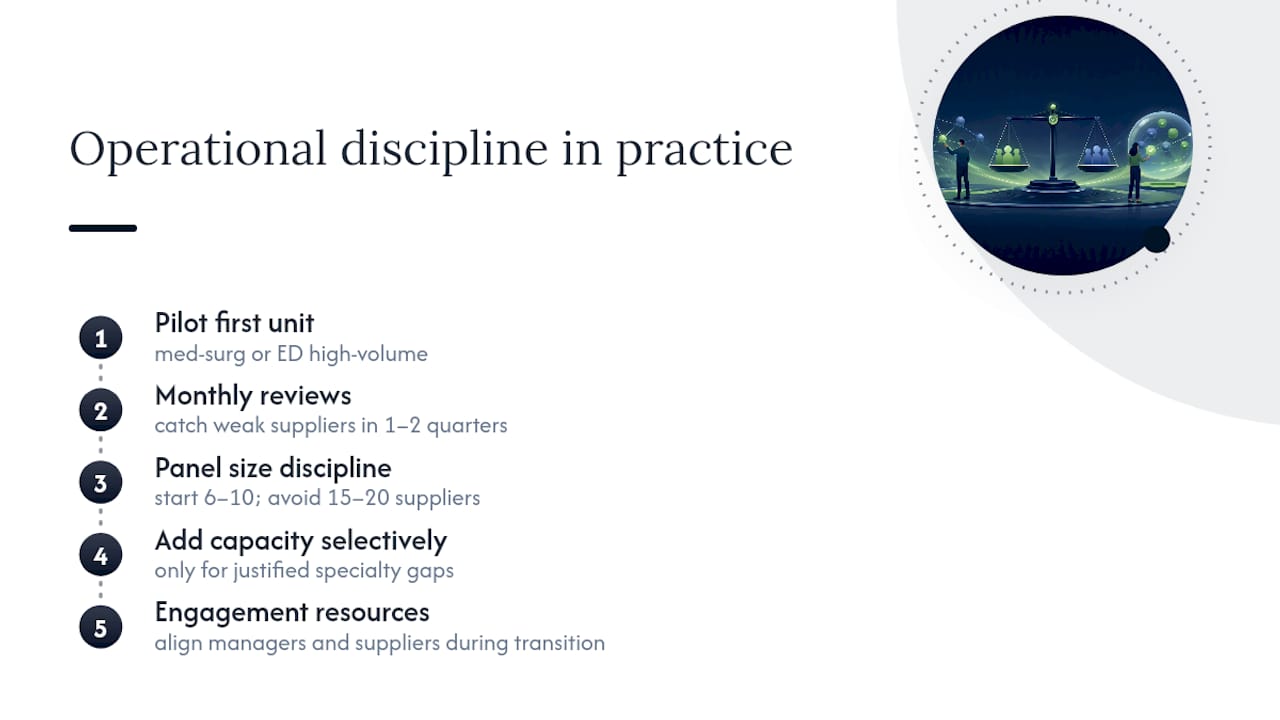
The programs that hold up over time-share a common trait: they treat neutrality as an ongoing operational discipline, not a one-time contract clause. A hospital system running a multi-year contingent workforce program, for example, typically starts with a pilot in its highest-volume unit, usually med-surg or emergency nursing, before expanding the panel structure to specialty units where candidate pools are thinner.
The pattern that separates a working implementation from a struggling one is reporting cadence. Programs that review vendor-level performance data monthly catch underperforming suppliers within one or two quarters and can rebalance requisition flow accordingly. Programs that only look at the numbers annually tend to let a weak supplier sit on the panel for a full year before anyone notices the fill rate gap.
Panel size discipline matters just as much. Organizations that start with too many suppliers, fifteen or twenty agencies for a mid-size program, often find the administrative burden of coordinating that many relationships outweighs the benefit of broader competition. The more sustainable pattern is starting with six to ten qualified suppliers, then adding capacity only where a specific specialty gap justifies it.
External communication and engagement resources, like those offered through partners such as True Colors' healthcare staffing solutions, can also support the softer side of implementation: keeping hiring managers and suppliers aligned on expectations during a transition. That alignment work is often the difference between a pilot that scales and one that stalls after the first quarter.
Does Vendor Neutral Staffing Work the Same Way Across Industries?
Vendor neutral staffing performs differently depending on how deep the candidate pool is and how regulated the placement process happens to be. Healthcare, where credentialing and licensure verification add real complexity, tends to see the strongest returns from neutral models because standardized compliance workflows solve a genuine pain point that agency-by-agency processes handle inconsistently.
IT and technical staffing, by contrast, often see faster results from neutral panels simply because the candidate pool is large and geographically flexible, which means broad competition among suppliers produces submissions quickly with fewer compliance hurdles to standardize.
Light industrial and administrative staffing sit somewhere in between. Volume tends to be high enough to justify a panel structure, but the roles are usually simple enough that a master-vendor relationship can move nearly as fast without the coordination overhead of a full neutral program.
The common thread: neutral models earn their keep fastest wherever compliance complexity or candidate scarcity makes broad supplier competition genuinely valuable, not just theoretically fairer. In simpler, high-volume, low-regulation categories, the administrative cost of managing a full panel sometimes outweighs the marginal benefit over a well-run master-vendor setup.
Technology Beyond the VMS That Keeps Neutral Programs Honest
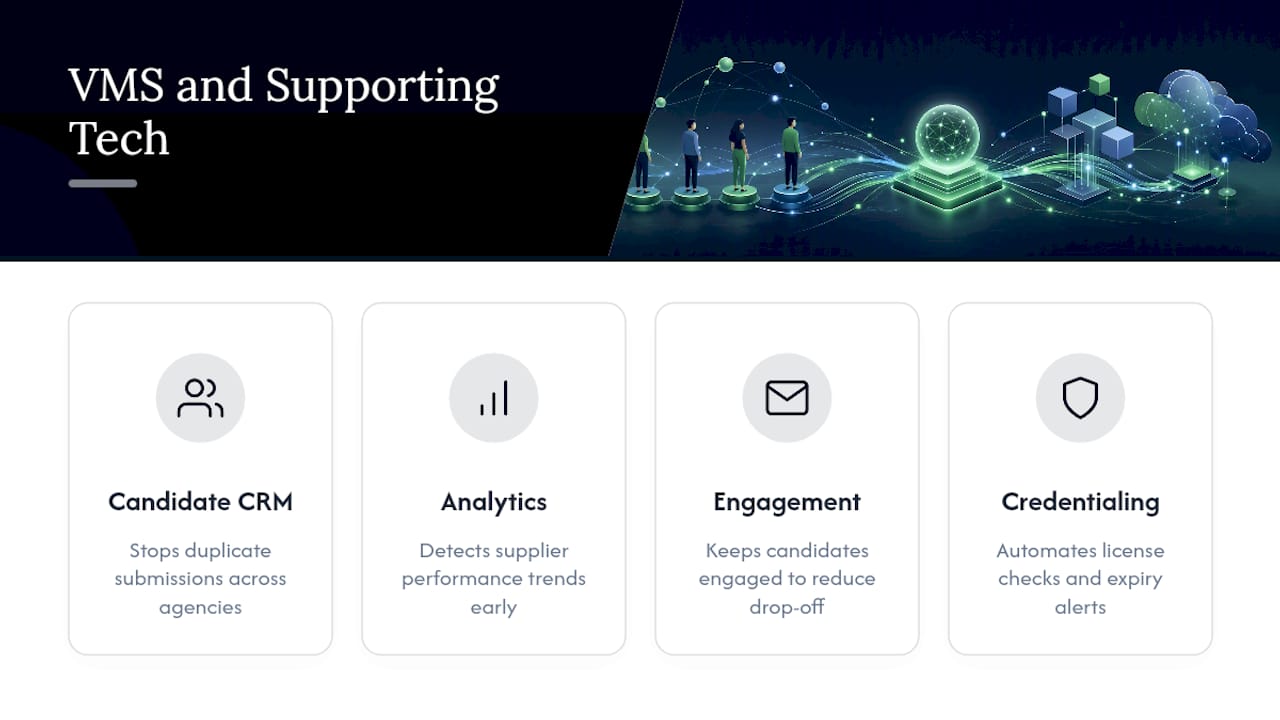
A VMS handles distribution and reporting, but it isn't the only technology layer a well-run neutral program needs. Candidate relationship management tools help suppliers avoid resubmitting the same person across multiple agency channels, which cuts down on the duplicate-submission headache that plagues larger panels.
Analytics platforms that sit on top of VMS data give procurement teams a way to spot supplier performance trends before they show up as a formal quarterly review problem. If one agency's time-to-submit creeps up steadily over eight weeks, a standalone reporting dashboard often catches that drift faster than the VMS's native reports do.
Communication and engagement platforms, the kind referenced in case studies from healthcare technology partners, also play a quieter but real role: keeping candidates engaged between initial submission and final offer reduces the drop-off rate that inflates time-to-fill numbers even when the sourcing side of the program is working well.
Credentialing and compliance software, separate from the VMS, is worth calling out specifically for regulated industries. Automated license verification and expiration alerts catch compliance gaps that a general-purpose VMS often isn't built to track in detail. None of these tools replace the core VMS. They fill the operational gaps a VMS alone tends to leave open.
Three Moves Procurement Should Make This Quarter
Start by verifying your current MSP's ownership structure and distribution rules in writing, not by taking their word for it. Pilot any new neutral model in your highest-volume specialty first, where the data will surface problems fastest. Then make vendor-level reporting a contract requirement, not a courtesy.
If your program runs under a few dozen requisitions a year, a full neutral panel probably isn't worth the administrative lift. Above that volume, the implementation checklist earlier in this article is your starting point.
— Flexible
Post Flexible Nursing Roles Faster With NurseFlex Jobs
If your contingent workforce program needs a faster, lower-friction way to source flexible clinical talent alongside your neutral supplier panel, NurseFlex Jobs gives employers a direct channel built specifically for nursing and healthcare roles.

A free matching service can pair open roles with candidates based on skills, availability, and preferences, cutting down the manual screening work that typically slows time-to-submit. Employers can also access specialty pools covering telehealth, travel nursing, case management, utilization review, and other niche coverage areas that thinner agency panels sometimes struggle to fill quickly. None of this requires restructuring your existing vendor panel. It simply adds another well-lit, technology-driven sourcing channel that competes on the same terms as the rest of your suppliers.
Ready to see how it fits your current staffing mix? Post your remote nursing jobs and get matched with qualified candidates directly.
Primary Sources and Further Reading
- CXC Global's glossary entry on vendor neutrality and ownership disclosure
- Staffing Industry commentary on vendor-neutral MSP claims and client risk
- Goringo's analysis of cost savings and conflicts of interest in healthcare staffing
- Comensura's explainer on vendor-neutral MSP operations
Sources
- Vendor Neutral - CXC Global
- Are Vendor-Neutral MSPs Making it Easier or Harder for Clients? - Staffing Industry
- How vendor neutral staffing eliminates conflicts of interest in healthcare - Goringo
FAQ
What Does "Vendor Neutral" Mean in Staffing?
"Vendor neutral" means the MSP managing your staffing program has no ownership stake or financial interest in any of the staffing agencies competing for your requisitions. That structural independence is what prevents biased order allocation toward a favored supplier.
Who Is the Biggest Staffing Agency in the United States?
Staffing agency size varies widely by specialty and region, and no single agency dominates every category of contingent labor. For healthcare-specific placements, platforms like NurseFlex Jobs focus specifically on flexible and specialty nursing roles rather than competing as a general staffing agency.
Is Cai a Temp Agency?
This question likely refers to a specific staffing or MSP provider, and details on that organization's exact structure aren't publicly listed here. When evaluating any provider, ask directly whether it operates as a staffing agency, an MSP, or both, since that distinction determines whether it can act as a truly neutral panel manager.
What Is the Biggest Healthcare Staffing Agency?
The healthcare staffing market includes several large national agencies alongside more specialized platforms focused on flexible or travel nursing roles. Rather than one dominant agency, procurement teams typically build panels combining a few large generalist agencies with specialty platforms like NurseFlex Jobs for niche coverage such as telehealth or utilization review.
How Do I Verify That an MSP Is Actually Vendor Neutral?
Ask for written disclosure of ownership ties between the MSP and any agency on its panel, and request vendor-by-vendor distribution reports covering at least six months. Auditability of the distribution logic is the clearest proof of neutrality, not the word itself in a contract.