
A healthcare VMS is enterprise software that centralizes requisitions, agency submissions, credentialing, time capture, and invoicing for contract and per-diem clinical staff. It gives a hospital or health system one place to see every supplier, every shift, and every dollar of contingent labor spend. You need one once you're managing multiple staffing agencies and can no longer track compliance, rates, or fill rates by spreadsheet.
TL;DR:
- A healthcare VMS is essential when managing multiple staffing agencies to centralize requisitions, track compliance, and unify spend reporting.
- Credentialing automation, real-time expiration alerts, and integrated scheduling features are critical for healthcare-specific compliance and shift management.
- Combining VMS with a marketplace like NurseFlex Jobs can fill urgent staffing gaps during lengthy onboarding and credentialing processes.
- Vendor selection should depend on volume, agency count, and integration needs, with enterprise systems favored for large networks and healthcare-native platforms for mid-sized facilities.
- Strong program governance and dedicated ownership are crucial to prevent operational chaos and ensure the VMS delivers reliable, audit-ready data.
Table of Contents
- What a Healthcare VMS Actually Controls
- Which Healthcare-Specific Features Actually Matter
- VMS vs MSP vs Talent Marketplace: Which One Solves Your Problem
- How to Evaluate a Healthcare VMS: Checklist and Scorecard
- Implementation Timeline, Costs, and Rollout Steps
- Top Healthcare VMS Providers Worth Knowing
- Integration Patterns: HRIS, Payroll, and Credentialing Data
- Why VMS Programs Fail Without Governance
- Where a Healthcare VMS Fits Your Staffing Strategy
- How NurseFlex Jobs Fills Gaps While Your VMS Program Stands Up
- Sources
What a Healthcare VMS Actually Controls
A VMS centralizes requisitions, supplier submissions, timesheets, approvals, and invoices for every contingent worker touching your facility. The lifecycle runs in a predictable loop: a unit manager opens a requisition for a night-shift ICU nurse, the system broadcasts it to approved agencies, agencies submit candidates against your rate card and credential requirements, and the hiring manager reviews and approves inside the same portal. Once someone starts a shift, the platform captures time, routes it for approval, and consolidates supplier invoices into one bill instead of forty.
That consolidation is the real value, supporting better employee engagement in healthcare. Without it, a mid-size hospital juggling a dozen staffing agencies has no single view of total spend, no consistent rate enforcement, and no clean audit trail when compliance asks who worked where and under whose credentials.
What a VMS delivers operationally:
- A single requisition-to-invoice pipeline instead of scattered agency emails and spreadsheets
- Rate-card enforcement so no supplier quietly bills above the negotiated ceiling
- An audit trail tying every shift back to a credentialed, approved worker
- Consolidated reporting across agencies for spend, fill rate, and time-to-fill
Which Healthcare-Specific Features Actually Matter
Generic vendor management software wasn't built for clinical staffing. A healthcare VMS needs credential and document storage, time capture, rate-card enforcement, and supplier scorecards built into its core, not bolted on as an afterthought.

Credentialing is the feature that separates a real healthcare VMS from a repurposed generic platform. Look for automatic expiration tracking on licenses, certifications, and background checks, with reminders firing well before a document lapses. The system should store documents centrally so a nurse doesn't re-upload the same BLS card to five different agencies. Credential checklists vary by program, so the platform needs to standardize and automate validation rather than leaving it to manual review.
Scheduling logic matters just as much. Float pool management, overtime and union rule enforcement, and per-diem workflows all need to live inside the same system that handles agency staff, or you end up reconciling two separate records of the same shift.
Beyond credentialing and scheduling, expect:
- Integrated time and attendance tied directly to invoicing, so hours worked match hours billed
- Supplier scorecards ranking agencies on fill rate, time-to-fill, and candidate quality
- Reporting built for audit readiness, not just spend summaries
- Role-based access controls that protect PHI touching the platform
Pro Tip: Ask any vendor to demo credential expiration handling with a real 90-day lookback. If the system can't show you who was working on an expired certification last quarter, it can't protect you in an audit this quarter.
VMS vs MSP vs Talent Marketplace: Which One Solves Your Problem
These three models solve different jobs, and confusing them is the most expensive mistake a staffing manager can make.
- VMS is software. It gives you visibility and control, but you or your team still run the program, manage supplier relationships, and enforce the rules.
- MSP is a managed service. A third party operates the VMS on your behalf and takes on supplier governance, rate negotiation, and compliance enforcement. An MSP is the managed program layered on top of the tool, useful when internal HR and procurement don't have the bandwidth to police dozens of agency relationships.
- Talent marketplace sources workers directly rather than managing agency relationships. A VMS doesn't source talent itself; marketplaces fill that gap and should be folded into your governance so direct-sourced shifts don't create a blind spot in total spend.
Choose VMS-only when you already own program governance and just need the visibility layer. Choose an MSP when nobody internally has time to run supplier scorecards and rate audits. Layer a marketplace on top of either when you need a faster, complementary channel for hard-to-fill shifts.
How to Evaluate a Healthcare VMS: Checklist and Scorecard
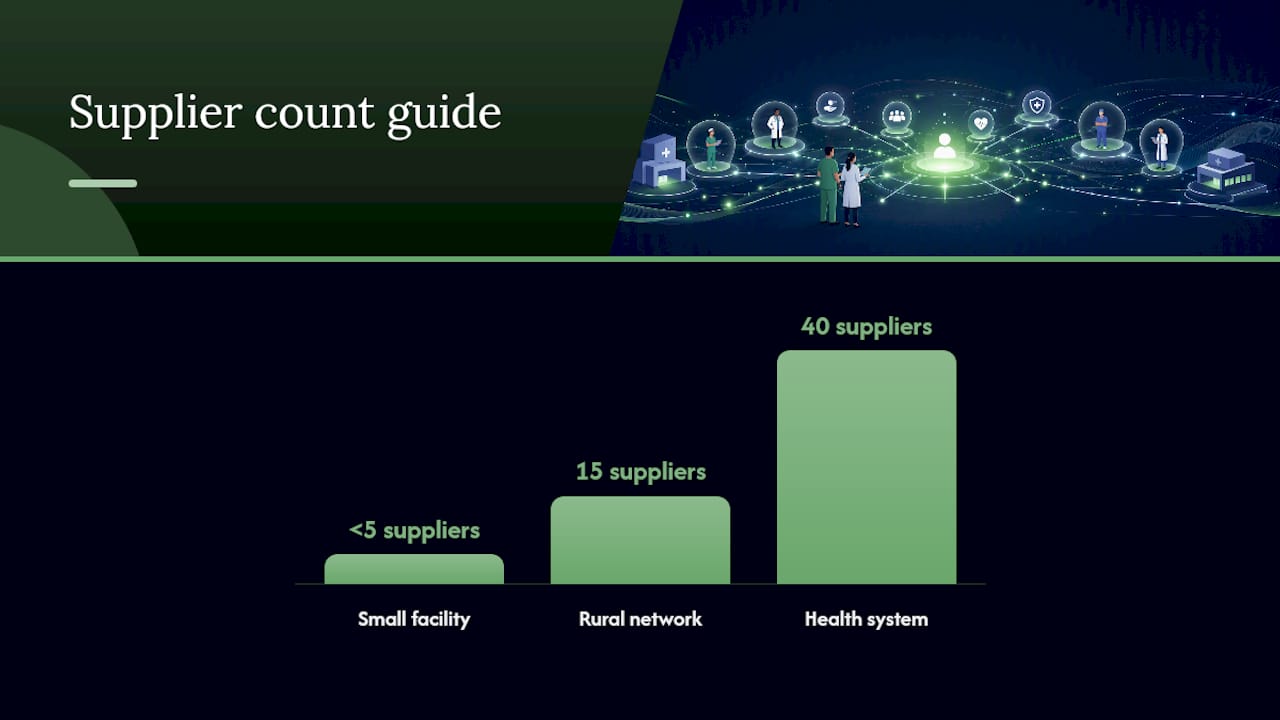
Start with program fit before you look at a single demo. A facility running fewer than five active agencies rarely needs the same platform as a health system managing forty suppliers across a dozen sites. Volume and supplier count should drive your shortlist, not brand recognition.
Separate must-haves from nice-to-haves before you talk to a single vendor:
- Credentialing automation with expiration alerts and centralized document storage
- Native integrations with your HRIS, payroll, and existing credentialing databases
- Mobile access for hiring managers approving timesheets from the unit floor
- Exportable audit logs that satisfy your compliance team without custom reports
Pricing structure deserves real scrutiny. Some programs run supplier-funded, where agencies absorb the cost, while others bill the buyer directly — and the funding model shapes how suppliers behave over time. A supplier-funded model can look free on your ledger but often squeezes agency margins enough to dull recruiter effort on your hardest requisitions.
Before shortlisting, get straight answers on data ownership (can you export your full history if you switch platforms?), service-level guarantees on system uptime, and who internally will own the program day to day.
Pro Tip: Ask every finalist vendor for a reference client running roughly your supplier count and specialty mix. A platform that shines for a 500-bed system with three specialties can struggle with a rural network running fifteen.
Implementation Timeline, Costs, and Rollout Steps
Set expectations early, because supplier onboarding, not software configuration, is usually what stretches the timeline. A medium-sized program typically implements in four to twelve weeks, while enterprise or multi-site rollouts often run eight to twelve months or longer, largely because every agency has to be onboarded and credential formats reconciled.
- Contract and configuration. Negotiate pricing model, set up rate cards, and configure requisition workflows for your specialties.
- Supplier onboarding. Migrate active agencies into the portal, align their credentialing formats with your requirements, and run parallel processes until submissions flow cleanly.
- Integration build. Connect the VMS to HRIS, payroll, and credentialing systems, then validate data sync before go-live.
- Phased go-live. Start with one unit or specialty, confirm acceptance criteria like accurate invoicing and clean audit trails, then expand.
Budget across four cost categories: software licensing, integration and configuration fees, MSP management fees if you're layering one on top, and supplier enablement time, which is often underestimated and rarely quoted upfront.
Top Healthcare VMS Providers Worth Knowing
Every RFP for healthcare staffing technology tends to draw from the same short list of established platforms, each with a distinct center of gravity.
- AMN Healthcare built its VMS heritage directly from managing large-scale clinical staffing programs, making it a natural fit for systems that want a vendor deeply familiar with nursing and allied health compliance.
- ComplyScore (Atlas Systems) focuses heavily on credentialing and compliance workflows, a strong pick when audit readiness is the top priority.
- Medefis targets healthcare-specific staffing with strong scheduling and per-diem logic built for clinical float pools.
- Aya Healthcare pairs its VMS capability with its own staffing supply, appealing to systems that want technology and sourcing from one vendor.
- SAP Fieldglass anchors many enterprise procurement stacks, especially where contingent labor spend sits alongside broader vendor management.
- Beeline and VNDLY round out the enterprise tier. Both emphasize deep integrations with HRIS and payroll systems, making them common choices for large, multi-site health networks running complex integration stacks.
Enterprise systems with dozens of suppliers gravitate toward Fieldglass, Beeline, or VNDLY. Mid-market hospitals often do better with a healthcare-native platform like Medefis or ComplyScore, where credentialing depth outweighs enterprise integration breadth. If you're leaning toward an MSP-backed program, ask which VMS the MSP operates on your behalf; the underlying software still matters even when someone else runs it.
Integration Patterns: HRIS, Payroll, and Credentialing Data
Your VMS is only as reliable as the systems feeding it. Plan integrations with Workday, Oracle or SAP HCM, ADP for payroll, and your credentialing database well before go-live, and read how technology integrations reshape hospital hiring for the broader integration landscape.
Watch these details:
- Sync cadence between the VMS and payroll determines whether hours billed match hours paid without manual reconciliation.
- Duplicate worker records are the most common integration failure. Match on a unique identifier, not name and department alone.
- Credentialing databases need bidirectional sync so expirations flagged in one system show up in the other immediately.
- Every integration point should generate its own audit log, since compliance reviews often trace a single shift back through three or four connected systems.
Why VMS Programs Fail Without Governance
Software alone rarely fixes fractured vendor practices. Buying a VMS without the governance and supplier enablement to back it often turns an expensive platform into a dashboard nobody trusts. Someone internally has to own rate enforcement, supplier rationalization, and credential hygiene, or the system just reports the same chaos it was meant to fix.
Supplier rationalization matters more than most managers expect. Ten disciplined agencies consistently outperform thirty loosely managed ones. While you're standing up governance and trimming your supplier list, a marketplace can serve as a complementary sourcing channel for the shifts that can't wait for the program to mature.
Pro Tip: Assign one named program owner before your VMS goes live, not after. A platform with no accountable owner drifts back into agency chaos within two quarters.
Where a Healthcare VMS Fits Your Staffing Strategy
Pick a VMS when you own governance and need visibility. Pick an MSP when you need someone else to run it. Layer a marketplace on top of either for speed on hard-to-fill shifts. Your next move: run a pilot on one unit, draft your RFP around the checklist above, and name a program owner before you sign anything.
— Flexible
How NurseFlex Jobs Fills Gaps While Your VMS Program Stands Up
A VMS or MSP program can take months to fully onboard suppliers and align credentialing, and that gap is exactly where shifts go unfilled. NurseFlex Jobs gives hospitals a direct channel to credentialed nurses and healthcare professionals for fast, flexible fills, without waiting on a supplier onboarding queue. It works alongside your VMS rather than against it: route standard contract volume through your governed channels, and use NurseFlex Jobs for the urgent per-diem and short-notice shifts that need a fill this week, not next quarter.

Real-time matching means a hiring manager can post a shift and see qualified, credentialed candidates without the multi-day submission cycle a traditional agency requires. If you're evaluating VMS platforms right now and need coverage while implementation runs its course, visit the employer page to post your first shift and see how quickly candidates respond.