
A healthcare candidate profile is a short, internal benchmark document that defines the ideal person for a specific clinical role across four dimensions: required credentials and licensure, clinical capability and acuity experience, behavioral operating style, and schedule or sustainability fit. It is not a job description and it is not a resume. It is the internal standard your team uses to screen, score, and compare candidates before a single interview is scheduled.
Here is what a complete profile captures at a glance:
- Credentials and licensure: Active state license, required certifications (BLS, ACLS, CCRN), and any specialty-specific requirements
- Clinical capability: Patient acuity level, specific equipment or protocols, care setting, and hands-on experience type
- Behavioral operating style: Communication style, adaptability, coachability, and team-fit indicators
- Schedule and sustainability fit: Shift type, weekend or on-call requirements, and realistic tenure expectations
- Dealbreakers and green flags: 3–5 automatic screen-outs and 3–5 positive signals that accelerate a hire
The profile is internal. Candidates never see it. It lives with your recruiting team and hiring panel, and it complements the job description rather than replacing it.
Table of Contents
- Why candidate profiles matter in healthcare hiring
- What to include in a healthcare candidate profile
- How to build a healthcare candidate profile step by step
- One-page template and a filled example you can copy
- How to use the profile across screening, interviewing, scoring, and onboarding
- Red flags in candidate profiles and interviews that matter in healthcare
- How a candidate profile differs from a job description and a resume
- NurseFlex hiring framework: skills-based matching and why adaptability matters
- Key Takeaways
- The case for keeping profiles tight and outcome-focused
- Flexiblenursingcareers connects your profiles to verified candidates
- Useful sources and further reading
Why candidate profiles matter in healthcare hiring
Profiles improve three things that matter most in clinical hiring: speed, consistency, and quality of hire. Without one, every recruiter on your team is screening against a different mental model of what "good" looks like. That inconsistency costs time and produces rework.
The practical benefits for your team are direct:
- Faster screening: A clear dealbreaker list lets a recruiter triage a stack of applications in minutes rather than hours.
- Consistent panel scoring: Every interviewer uses the same criteria, so post-interview calibration takes less time.
- Fewer reworks: When the profile is agreed on before sourcing starts, you avoid the common scenario where a finalist is rejected because the hiring manager's expectations shifted mid-search.
- Better retention: Profiles that include sustainability fit (shift tolerance, commute, tenure expectations) surface candidates who are more likely to stay past 90 days.
Two use cases show this clearly. First, a rapid fill for a high-acuity ICU shift: without a profile, a recruiter might submit a candidate with ICU experience but no recent ventilator management. With a profile that specifies the exact acuity and equipment required, that candidate is screened out in round one. Second, a multi-facility health system standardizing panel scoring: a shared profile and scorecard mean a candidate evaluated at one facility is scored the same way at another, so the system can compare finalists across sites.
Stat to know: According to AAPA research, hiring managers increasingly select candidates based on adaptability and coachability because clinical protocols and technology change quickly. Technical credentials are the baseline; behavioral fit is the differentiator.
What to include in a healthcare candidate profile
A well-built profile captures four layers, each one narrowing the field further. Every layer should be short enough to fit on one page. If it runs longer, the profile is too broad.
The four layers:
- Role context and 90-day outcome: What does success look like at 90 days? One sentence. Example: "Independently managing a 5-patient med-surg load with no more than one escalation per shift by day 60."
- Required credentials and licensure: Active RN license (state-specific), BLS, any specialty cert. List only what is legally or operationally required.
- Clinical and functional capability: Acuity level, specific equipment (ventilators, IV pumps, EHR platform), patient population, and whether experience must be hands-on or supervisory.
- Behavioral operating style: Coachability, communication style, stress response, and team-fit indicators. Employers consistently prioritize empathy, active listening, and adaptability alongside clinical knowledge.
- Schedule and shift fit: Day/night/rotating, weekend requirements, on-call expectations, and travel or multi-site flexibility.
- Motivation and retention drivers: Why does a strong candidate want this role? What keeps them? This shapes your sourcing message and your offer.
Must-haves vs. nice-to-haves:
| Criterion | Must-Have (dealbreaker if absent) | Nice-to-Have (green flag if present) |
|---|---|---|
| Licensure | Active RN license in hiring state | Multi-state compact license |
| Certification | BLS current | ACLS, CCRN, or specialty cert |
| Acuity | ICU or step-down experience | Charge nurse or preceptor experience |
| EHR | Epic or Cerner proficiency | Super-user or trainer status |
| Behavioral | Demonstrates adaptability under pressure | Peer-recognized for communication |
| Schedule | Available for rotating nights | Willing to float to a second unit |
Competency scoring table (copy to your scorecard):
| Dimension | Score 1 (Does Not Meet) | Score 3 (Meets) | Score 5 (Exceeds) |
|---|---|---|---|
| Clinical acuity match | No relevant acuity experience | Meets minimum acuity requirement | Exceeds acuity; charge or preceptor background |
| Credential currency | Expired or missing cert | All required certs current | Additional specialty certs held |
| Adaptability | Rigid; resists protocol changes | Adjusts with guidance | Proactively adapts; leads change |
| Communication | Unclear or passive | Clear and professional | Concise, assertive, patient-centered |
| Schedule fit | Cannot meet shift requirements | Meets core schedule | Flexible; willing to float or cover |
One legal note: keep every screening criterion directly tied to job-related requirements. Criteria must be non-discriminatory and applied consistently across all candidates. Candidate data should be handled in compliance with applicable privacy standards, including HIPAA where candidate health information is involved.
How to build a healthcare candidate profile step by step
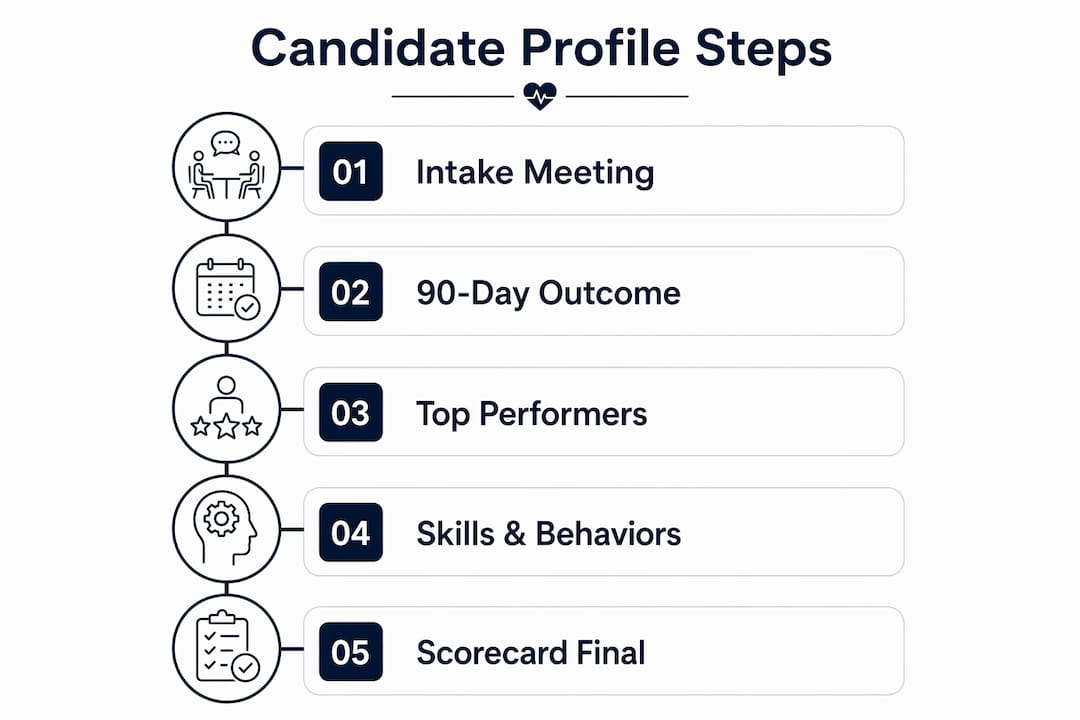
Build the profile before sourcing starts. The steps are: run an intake meeting, define the 90-day outcome, compare your top performers, translate observations into skills and behaviors, then finalize the scorecard and dealbreakers.

Step 1: Run a structured intake meeting
Bring together the hiring manager or clinical lead, an HR or recruiter representative, and, when possible, a current top performer in the role. Each stakeholder contributes something different. The clinical lead defines the acuity, protocols, and patient population. HR brings market context and compensation benchmarks. The top performer shows you what "good" actually looks like day to day.
Sample intake question for the clinical lead: "Walk me through the three most demanding situations a new hire will face in the first 60 days. What skills or behaviors separate the people who handle those well from the ones who struggle?"
Step 2: Define the 90-day success outcome
Write one sentence describing what a successful hire looks like at 90 days. Keep it measurable. Avoid vague language like "fits in well." This outcome becomes the anchor for every other profile decision.
Step 3: Compare your top performers

List two or three people currently in the role who you would rehire without hesitation. What credentials, experiences, and behaviors do they share? What do they have that average performers lack? Those shared traits become your green flags.
Step 4: Translate into skills, behaviors, and dealbreakers
Convert the intake observations into specific, screenable criteria. Rather than "3+ years of experience," specify the type: ICU-level, med-surg, outpatient, hands-on, or supervisory. Define 3–5 dealbreakers (automatic screen-outs) and 3–5 green flags (accelerators).
Sample screening question mapped to adaptability: "Tell me about a time a protocol changed mid-shift. What did you do, and what was the outcome?"
Sample screening question mapped to acuity fit: "Describe the highest-acuity patient you managed independently in the last 12 months. What interventions did you perform?"
Step 5: Finalize the scorecard and attach to the requisition
Build the scoring rubric from the competency table above. Attach the profile and scorecard to the requisition or ATS record before the first candidate is sourced. Version the file with a date so updates are traceable.
Pro Tip: If your team cannot agree on the top three dealbreakers in under 15 minutes, the profile is too broad. Force the trade-off: ask "If a candidate has everything else but not this, do we still move forward?" If the answer is yes, it is a nice-to-have, not a dealbreaker.
One-page template and a filled example you can copy
Use this layout as your standard intake output. Fill one page. If it spills to two, cut the nice-to-haves until it fits.
Template: Healthcare Candidate Profile (one page)
| Field | Your Input |
|---|---|
| Must-have qualifications (dealbreakers) | 1. / 2. / 3. |
| Nice-to-have qualifications (green flags) | 1. / 2. / 3. |
Filled example: Registered Nurse, Med-Surg
| Field | Details |
|---|---|
| Role title | RN, Medical-Surgical — Night Shift |
| Hiring manager / clinical lead | Nurse Manager, 4 North |
| Target start date | Within 30 days |
| 90-day success outcome | Independently managing a 5-patient load with documentation completed before shift end by day 60 |
| Required credentials / licensure | Active RN license (state), BLS current |
| Clinical setting and acuity | Med-surg, 4 patient load; post-op and telemetry experience required |
| Required equipment / EHR | Epic proficiency; IV pump and telemetry monitor experience |
| Must-have qualifications | 1. Active state RN license 2. Minimum 1 year med-surg or acute care 3. BLS current |
| Nice-to-have qualifications | 1. ACLS certified 2. Charge nurse experience 3. Epic super-user |
| Behavioral operating style | Calm under pressure; clear communicator; takes initiative on documentation |
| Schedule / shift requirements | Rotating nights, every other weekend, holiday rotation |
| Motivation and retention drivers | Career growth to charge; stable unit culture; consistent scheduling |
| Automatic screen-out criteria | Expired license; no acute care experience; unavailable for nights |
Save this file as a PDF or Word document. Name it with the role title and date (e.g., "RN-MedSurg-Profile-2026-06"). Attach it to the requisition in your ATS so every recruiter and panel member works from the same version. When the role requirements change, update the file, increment the date, and notify the panel.
How to use the profile across screening, interviewing, scoring, and onboarding
The profile does its job at four stages: it filters applications at screening, structures your interview questions, anchors your scoring rubric, and sets the performance baseline for onboarding.
Screening (CV triage):
- Use dealbreakers as hard filters in your ATS or screening checklist. Any application missing a dealbreaker criterion is screened out before a recruiter reads the full resume.
- Use green flags to rank the remaining pool. Candidates with two or more green flags move to the phone screen queue first.
Structured interviews:
Map one or two behavioral questions to each profile dimension. The competency scoring table from the key elements section becomes your interview rubric. Every panelist scores the same dimensions using the same 1–3–5 scale.
Sample question bank:
- Credentials: "Walk me through your current certifications and when each expires."
- Acuity: "Describe the most complex patient situation you managed without direct supervision."
- Adaptability: "Tell me about a time your unit changed a core protocol. How did you respond?"
- Communication: "Give me an example of a handoff that went wrong. What did you do differently afterward?"
- Schedule fit: "Our schedule includes rotating nights and every other weekend. Walk me through how that works with your current commitments."
Scoring and ranking:
After each interview, each panelist submits scores independently before the debrief. Average the scores per dimension. Any candidate who scores a 1 on a dealbreaker dimension is automatically removed from consideration, regardless of other scores. Rank the remaining candidates by total score.
Onboarding checkpoint:
At 30 and 90 days, compare the new hire's actual performance against the 90-day success outcome in the profile. If there is a gap, flag it for the preceptor or manager. If the gap is consistent across multiple hires, update the profile. That feedback loop keeps the profile accurate over time.
Red flags in candidate profiles and interviews that matter in healthcare
Some red flags should trigger immediate escalation or automatic disqualification. Others require a closer look before you decide. Knowing the difference saves time and prevents bad hires.
Clinical red flags that warrant escalation:
- Credential gaps: Expired license, lapsed BLS, or missing specialty cert required by the role. Escalate to primary-source verification before any offer.
- Inconsistent acuity experience: A candidate who lists ICU experience but whose references describe only step-down or med-surg work. Escalate to a clinical simulation or skills check.
- Repeated short tenures in similar settings: Three or more positions in the same care setting, each lasting under six months, without a clear explanation. Escalate to a structured reference check focused on performance and attendance.
- Poor simulation performance: Candidate passes the interview but fails a basic clinical skills check. This is an automatic screen-out for high-acuity roles.
- Documentation gaps: Missing employment dates, unexplained gaps longer than 90 days, or credentials listed without verifiable institutions. Escalate to primary-source verification.
When to escalate and how:
- Reference check: Use for repeated short tenures and behavioral concerns. Ask references specifically about the candidate's response to protocol changes and peer feedback.
- Primary-source verification: Use for any credential gap or documentation inconsistency. Do not wait until after an offer.
- Clinical simulation: Use when acuity experience is inconsistent or when the role carries high patient-safety risk.
A single red flag does not automatically disqualify a strong candidate. If a candidate has one concerning signal but scores 4 or 5 on every other profile dimension, document the flag, escalate appropriately, and let the verification or simulation result drive the decision. The profile's dealbreaker list tells you which flags are automatic screen-outs and which are simply items to investigate. That distinction is what makes the profile useful rather than rigid.
Pro Tip: When a candidate has one red flag and many green flags, run the simulation or reference check before the panel debrief. That way the panel makes its decision with complete information rather than speculating.
How a candidate profile differs from a job description and a resume
The three documents serve different purposes and different audiences. Mixing them up wastes time and attracts the wrong applicants.
- Candidate profile: Internal evaluation benchmark. Written for recruiters and hiring panels. Defines what "good" looks like. Never shared with candidates.
- Job description: External attraction tool. Written for candidates. Describes responsibilities, qualifications, and application details. Published on job boards and career pages.
- Resume: Candidate self-report. Written by the applicant. Describes their history, credentials, and skills from their own perspective.
Four key differences between a profile and a job description:
- The profile specifies the type of experience required (ICU-level, hands-on, supervisory); the JD lists years of experience.
- The profile includes dealbreakers and green flags; the JD lists required and preferred qualifications.
- The profile includes behavioral operating style and team-fit indicators; the JD describes responsibilities.
- The profile is a living document updated after each hire; the JD is published once per requisition cycle.
Converting a profile into a job description (four steps):
- Translate the 90-day success outcome into two or three responsibility statements.
- Convert must-have qualifications into the "Required Qualifications" section of the JD.
- Remove internal-only language (dealbreaker lists, behavioral scoring notes, panel instructions).
- Add application instructions, compensation range, schedule details, and EEO statement.
Surface the profile's top green flags in the JD's "Preferred Qualifications" section. Do not publish your dealbreaker list. That information stays internal.
NurseFlex hiring framework: skills-based matching and why adaptability matters
Skills-based matching combined with tight candidate profiles reduces time-to-fill and improves early performance signals. When a profile encodes verifiable skills and schedule availability, matching logic can surface credentialed candidates faster than a manual review process.
The Flexiblenursingcareers approach weights clinical credentials and behavioral adaptability differently depending on the role. For high-acuity positions, credential verification and acuity-specific experience carry the most weight. For roles where protocols change frequently or where the unit culture requires close team coordination, behavioral adaptability and coachability move up in the scoring hierarchy.
Verification is built into the matching workflow rather than added after an offer. License status, certification currency, and EHR experience are confirmed at the profile stage, so hiring managers see verified candidates from the start. This approach reduces the risk of offers being rescinded for missing documentation, which is one of the most common and costly rework scenarios in clinical hiring.
The profiles that produce the fastest, cleanest matches are the ones that specify what "good" looks like in concrete, verifiable terms: the acuity level, the equipment, the shift pattern, and the three behaviors that separate a strong performer from an average one. Vague profiles produce vague matches. Tight profiles produce fast ones.
For skills-based job matching to work at scale, the profile must encode skills in terms the matching system can verify: certification names, EHR platforms, acuity descriptors, and shift types. Generic language like "strong clinical background" cannot be matched. Specific language like "CCRN-certified, Epic-proficient, ICU experience with ventilator management" can.
Key Takeaways
A tight, one-page healthcare candidate profile built before sourcing starts is the single most effective way to reduce screening time, align your panel, and improve clinical hire quality.
| Point | Details |
|---|---|
| Define the 90-day outcome first | One measurable sentence anchors every other profile decision and keeps the panel aligned. |
| Use 3–5 dealbreakers and green flags | Binary screening criteria let recruiters triage applications in minutes rather than hours. |
| Map interview questions to profile dimensions | Structured questions scored on a 1–3–5 rubric remove subjectivity from panel decisions. |
| Attach the profile to your ATS record | Versioned profiles reduce rework and keep hiring decisions tied to the original intake. |
| Flexiblenursingcareers operationalizes profiles | Skills-based matching on Flexiblenursingcareers encodes verifiable credentials and shift availability for faster, cleaner matches. |
The case for keeping profiles tight and outcome-focused
The most common mistake in clinical profile design is trying to describe the perfect candidate rather than the minimum viable one. A profile that lists 12 must-haves and 8 nice-to-haves is not a profile. It is a wish list, and it will produce a slow, frustrating search.
The profiles that work are the ones that force a trade-off. Three dealbreakers. Three green flags. One 90-day outcome. Everything else is negotiable. When your team agrees on those seven items before sourcing starts, the search moves faster, the panel scores more consistently, and the hire is more likely to stick past 90 days.
Behavioral criteria deserve more weight than most clinical hiring teams give them. Characteristics like adaptability, coachability, and communication are not soft extras. They are the traits that determine whether a technically qualified nurse thrives in your specific unit or burns out in four months. A profile that scores only credentials and acuity is missing half the picture.
Update the profile after every hire. If a candidate who scored well on the profile underperforms at 90 days, that is a signal that one of your criteria needs adjustment. If a candidate who barely cleared the dealbreakers turns out to be a top performer, look at which green flags they had. The profile gets sharper with every cycle.
Flexiblenursingcareers connects your profiles to verified candidates
You have built the profile. Now you need candidates who actually match it. Flexiblenursingcareers gives hospital HR teams and staffing coordinators a faster path from profile to placement. The platform matches verified nurses and allied health professionals to open roles based on credentials, acuity experience, EHR proficiency, and shift availability — the exact fields your profile already defines.

No manual sorting through unvetted applications. No credential checks after the offer. Verification runs alongside matching, so your team sees compliant, credentialed candidates from the first shortlist. For flexible nursing roles and direct-hire positions alike, the matching logic is built around the same profile dimensions this guide covers.
Ready to put your candidate profile to work? Visit the employer hiring page to see how Flexiblenursingcareers matches your open roles to verified candidates.
Useful sources and further reading
- Healthcare Recruiting Intake Guide | RC Talent — The most practical intake framework available for clinical roles; covers the four-layer profile structure, dealbreaker/green-flag methodology, and one-page template guidance.
- 8 Traits Employers Look For | AAPA — Authoritative source on behavioral differentiators in clinical hiring; useful for weighting adaptability and coachability in your profile's behavioral section.
- Must-Have Characteristics for Health Care Professionals | UMN CCAPS — University of Minnesota overview of the core characteristics that define strong clinical candidates; good reference for building behavioral criteria.
- What Employers Look for in Healthcare Job Candidates | UMA — Practitioner-sourced list of soft skills and readiness indicators from healthcare hiring leaders; supports the behavioral scoring section.
- How to Build a Candidate Profile | Saply.ai — Practical guide on translating experience statements into specific, screenable criteria; useful for the compare-vs and key elements sections.
- Complete Your Healthcare Profile for Faster Hires | Flexiblenursingcareers Blog — Operational checklist for saving, versioning, and attaching profiles to ATS records; directly applicable to the process steps in this guide.