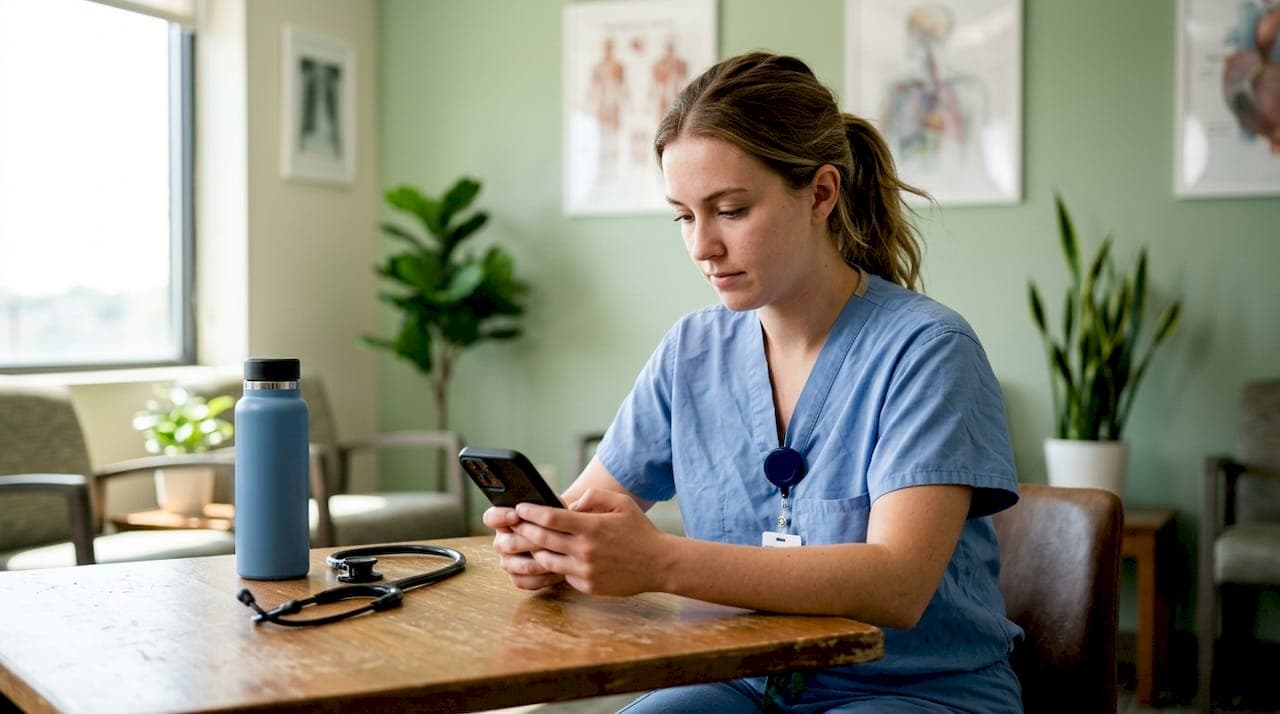
The nursing gig economy is defined as a staffing model where nurses use smartphone apps to select short-term shifts across healthcare facilities instead of holding permanent positions. This model differs sharply from traditional nursing employment, where hospitals hire nurses directly with set schedules, benefits, and long-term contracts. The gig model has grown fast enough that three platforms reached $1 billion valuations by 2026. That growth signals a structural shift in how healthcare facilities fill staffing gaps, and how nurses choose to build their careers. Understanding what the nursing gig economy is, and what it means for your paycheck, your license, and your future, is now a practical necessity for every working nurse.
What is the nursing gig economy and how does it work?
The nursing gig economy operates through digital platforms that connect nurses directly to healthcare facilities for single shifts or short assignments. Nurses sign up, submit credentials for verification, and then browse available shifts at hospitals, clinics, long-term care facilities, and outpatient centers. There is no lengthy interview process and no traditional onboarding. Once approved, you pick a shift, show up, and get paid.

The technology behind these platforms is not neutral. AI-driven algorithmic management controls shift availability and pay rates, which means your income can fluctuate based on demand signals rather than your experience or performance. A hospital facing a weekend shortage may offer higher rates; a slow Tuesday may offer fewer options at lower pay. This is a fundamental difference from a salaried position where your paycheck is predictable.
The types of settings involved span the full healthcare spectrum. Gig nurses work in emergency departments, skilled nursing facilities, surgical centers, and home health agencies. Each facility has its own protocols, electronic health record systems, and team culture. Gig nurses must quickly adjust to facility protocols and team dynamics with little formal orientation. That adaptability requirement is not a minor detail. It is the core skill set the gig model demands.
- Credential verification happens before your first shift, covering license status, certifications, and background checks.
- Shift selection is done entirely through a mobile app, often with same-day or next-day availability.
- Pay is typically deposited quickly, sometimes within 24–48 hours of completing a shift.
- Facilities range from acute care hospitals to outpatient clinics and long-term care communities.
- No employer-employee relationship is established in most gig arrangements.
Pro Tip: Before accepting your first gig shift, confirm that the facility uses an electronic health record system you already know. Familiarity with Epic or Cerner cuts your adjustment time significantly and reduces clinical risk on day one.
What are the differences between gig nurses and locum nurses?
Gig nursing and locum nursing are not the same thing, though nurses and hospital administrators often confuse them. The distinction matters for your taxes, your benefits, and your career trajectory.
Gig nurses act as independent contractors on a shift-by-shift basis, while locum nurses typically work through staffing agencies on contracts lasting multiple months. Locum arrangements often include some form of benefits, housing stipends, or travel reimbursement. Gig arrangements offer none of those by default. You are responsible for your own health insurance, retirement savings, and liability coverage.
The predictability gap between the two models is significant. Locum contracts give you a defined schedule and a known income for the contract period. Gig work gives you maximum flexibility but no guaranteed hours. If the platform's algorithm reduces your shift offers, your income drops with no recourse.
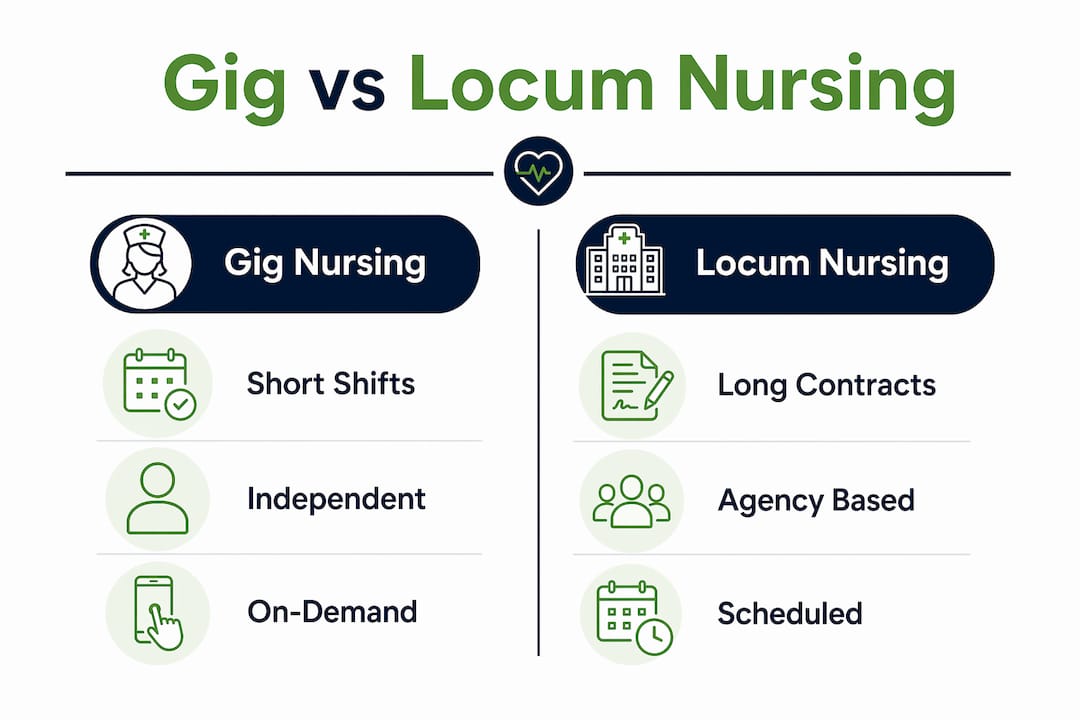
| Feature | Gig nursing | Locum nursing |
|---|---|---|
| Assignment length | Single shifts | Weeks to months |
| Employment status | Independent contractor | Agency contract |
| Benefits provided | None | Partial (varies by agency) |
| Schedule predictability | Low | Moderate to high |
| Onboarding process | Minimal | Structured orientation |
| Income stability | Variable | More predictable |
Career integration also differs. Locum nurses often become embedded in a facility's team over the contract period. Gig nurses rotate through facilities without building those relationships. For nurses who value mentorship, specialty development, or leadership pathways, the gig model offers limited traction. For nurses who prioritize autonomy and schedule control, it delivers exactly what traditional employment cannot.
What are the advantages and challenges of gig nursing?
Nurses choose gig work for three primary reasons: flexibility, pay, and autonomy. Nurses are drawn to gig work for the ability to set their own schedules and, in many cases, earn higher hourly rates than permanent staff. That combination is genuinely attractive, especially for nurses managing family responsibilities, pursuing education, or recovering from burnout in high-pressure permanent roles.
The flexibility benefit is real and measurable. You can work three shifts one week and one shift the next. You can take a month off without requesting leave. You can work across multiple facilities to build clinical breadth. For nurses exploring flexible healthcare roles, the gig model offers a level of schedule control that permanent employment rarely matches.
The challenges are equally real and should not be minimized.
- No employer-provided benefits. Gig nurses do not receive health insurance, workers' compensation, or retirement contributions. You fund all of it yourself.
- Income instability. Algorithmic management means your shift offers and pay rates can change without warning. A slow week on the platform translates directly to a slow week in your bank account.
- Limited career development. Rotating through facilities without continuity makes it difficult to build specialty skills, pursue promotions, or develop mentoring relationships.
- Isolation from teams. Gig nurses rarely integrate into permanent staff culture, which can affect morale and professional support networks.
- Tax complexity. As an independent contractor, you pay self-employment tax and must manage quarterly estimated payments. Many gig nurses underestimate this cost in their first year.
Pro Tip: Set aside 25–30% of every gig paycheck for taxes before you spend anything. Open a separate savings account labeled "tax reserve" and transfer that percentage automatically after each deposit. This one habit prevents the most common financial crisis gig nurses face.
The work-life balance argument for gig nursing is strongest when you have a financial cushion, strong clinical confidence, and a clear sense of your specialty. Without those three factors, the risks outweigh the rewards for most nurses.
How is the nursing gig economy impacting the wider healthcare system?
The gig model is reshaping how hospitals think about staffing, and not always in ways that benefit patients or permanent staff. Healthcare leaders now face a dual pressure: filling immediate gaps with gig nurses while retaining permanent staff who increasingly feel undervalued by comparison.
Healthcare leaders are advised to treat the rise of gig nursing as a signal of deeper staffing dysfunction rather than a solution to it. When a hospital relies heavily on gig nurses to cover chronic shortages, it is masking a workforce retention problem rather than solving it. The fix requires improving conditions for permanent staff, not just filling shifts on an app.
The systemic effects are visible across four areas:
- Staffing flexibility. Gig platforms give facilities the ability to fill last-minute vacancies faster than traditional agency staffing. That speed is a genuine operational advantage, especially in emergency departments and intensive care units where understaffing directly affects patient outcomes.
- Continuity of care. Rotating gig nurses who are unfamiliar with a facility's protocols, patient population, and team communication patterns create real continuity risks. The shift to gig-based nursing may prioritize platform efficiency over established safety and training protocols vital to quality care.
- Permanent staff morale. Permanent nurses who see gig workers earning higher hourly rates for the same work, without contributing to committees, mentoring, or institutional culture, report increased frustration and burnout. That dynamic accelerates the very turnover that creates demand for gig nurses in the first place.
- Institutional adaptation. Forward-thinking health systems are responding by building internal float pools, offering schedule flexibility to permanent staff, and replacing traditional agency staffing with technology-driven platforms that give permanent nurses more control over their own schedules.
The role of AI in this system deserves scrutiny. Algorithmic management affects wages and career growth negatively when platforms prioritize cost efficiency over nurse welfare. Facilities and nurses alike need to understand that the algorithm optimizes for the platform's interests first.
Key Takeaways
The nursing gig economy offers real flexibility and higher hourly pay, but nurses who enter it without financial preparation and strong clinical confidence face significant income instability and career development gaps.
| Point | Details |
|---|---|
| Definition of gig nursing | Nurses select short-term shifts via apps as independent contractors, with no permanent employer relationship. |
| Gig vs. locum nursing | Locum nurses work agency contracts with partial benefits; gig nurses work shift-by-shift with no employer protections. |
| Key benefits | Schedule autonomy and higher hourly rates attract nurses managing burnout, family needs, or education. |
| Key risks | No health insurance, workers' compensation, or retirement benefits; income fluctuates with algorithmic shift availability. |
| System-wide impact | Gig nursing fills short-term gaps but can worsen permanent staff morale and patient care continuity if overused. |
The uncomfortable truth about gig nursing that most articles skip
Gig nursing is not a revolution in healthcare. It is a pressure valve. When hospitals fail to retain nurses through competitive pay, reasonable schedules, and genuine support, gig platforms fill the gap. The nurse wins short-term flexibility. The hospital fills the shift. The platform collects a margin. Nobody fixes the underlying problem.
I have seen nurses enter gig work with genuine excitement, only to realize 18 months later that they have lost clinical mentorship, specialty progression, and the professional community that makes nursing sustainable long-term. The flexibility is real. The isolation is also real.
My recommendation is this: use gig nursing as a deliberate tool, not a default. If you are burned out and need schedule control to recover, gig work can be the right move for six to twelve months. If you are building a specialty or pursuing leadership, stay in a structured environment long enough to develop those skills first. The benefits of working multiple employers are real, but they compound only when you have a strong clinical foundation underneath them.
Healthcare organizations also need to stop treating gig platforms as a staffing strategy. They are a symptom indicator. The data is clear: improving roster flexibility and staff support reduces burnout and retains nurses far more effectively than any app. Build the internal conditions that make permanent employment worth choosing, and you will need fewer gig nurses to cover the gaps.
— Flexible
Flexible nursing jobs available now on Flexiblenursingcareers
Flexiblenursingcareers connects nurses with flexible, on-demand, and short-term positions across hospitals, clinics, and long-term care facilities. The platform uses real-time job matching based on your skills, availability, and location, so you see relevant shifts without sorting through irrelevant listings.

Sign up, verify your credentials, and start browsing flexible nursing jobs that fit your schedule. Whether you want to supplement your current income, transition to full gig work, or simply gain experience across different care settings, Flexiblenursingcareers gives you the tools to do it efficiently. The process is direct: create your profile, confirm your qualifications, and pick the shifts that work for you.
FAQ
What is the nursing gig economy in simple terms?
The nursing gig economy is a staffing model where nurses use apps to choose individual shifts at healthcare facilities instead of holding permanent jobs. Nurses work as independent contractors with no employer-provided benefits.
Are gig nurses paid more than staff nurses?
Gig nurses often earn higher hourly rates than permanent staff, but they receive no benefits, paid time off, or employer tax contributions. The net financial difference depends on how consistently you work and how well you manage self-employment taxes.
Do gig nurses need their own malpractice insurance?
Yes. Gig nurses must independently manage their own liability coverage, including malpractice insurance, since no employer-provided protections apply to independent contractor arrangements.
How is gig nursing different from travel nursing?
Travel nursing involves agency contracts at a single facility for 13 weeks or longer, with housing stipends and some benefits. Gig nursing is shift-by-shift with no agency contract, no stipends, and no guaranteed hours.
Is the nursing gig economy growing?
Yes. Three gig nursing platforms reached $1 billion valuations by 2026, reflecting rapid growth driven by persistent healthcare staffing shortages and increasing nurse demand for schedule flexibility.