
Healthcare placements stall primarily because of fragmented screening infrastructure and middle-funnel execution failures, not candidate shortages. The two biggest drivers are disconnected onboarding systems that force duplicate work and limited interviewer capacity that lets qualified candidates go cold. Three more causes compound those two:
- Platform fragmentation: 99.3% of students navigated more than one system during clinical screening, creating duplicate uploads and manual reconciliation at every handoff.
- Credential and verification backlogs: Primary-source verification and license checks vary by state and site, frequently adding substantial delays to an otherwise ready candidate's start date.
- Interviewer and scheduling bottlenecks: When interviewers are overbooked or feedback cycles run long, candidates accept competing offers before a decision lands.
- Communication breakdowns: Schools, clinical sites, and HR teams operating in silos generate repeated rework and missed deadlines.
Table of Contents
- Why do healthcare placements get delayed? The core operational causes
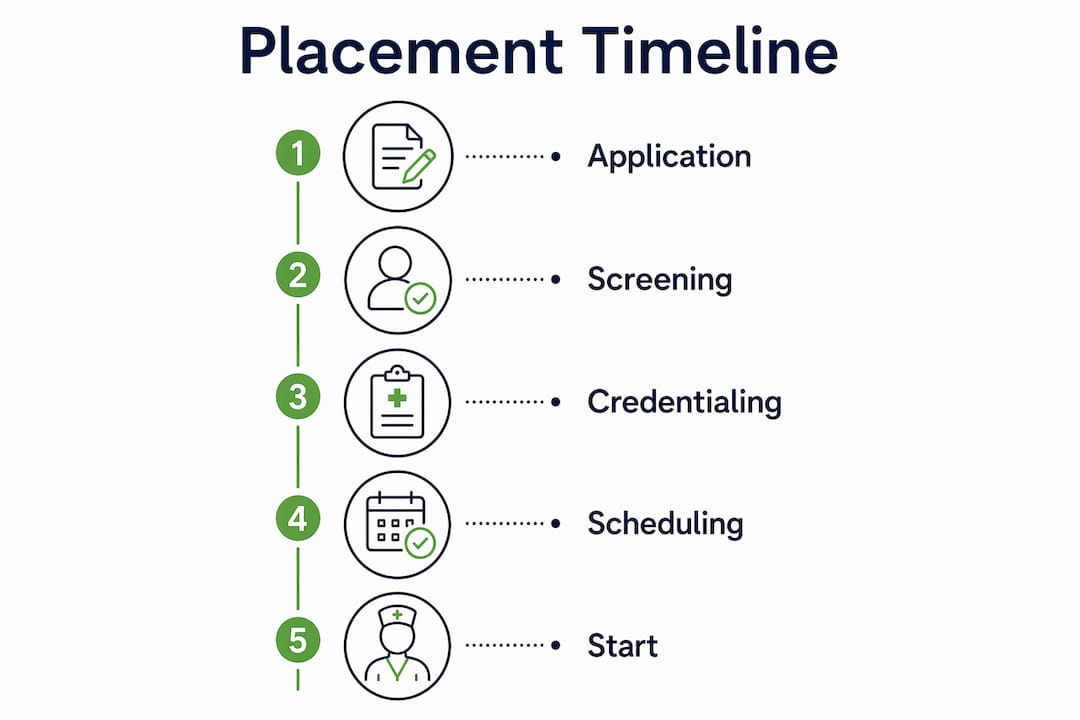
- How the hiring-to-start timeline usually breaks down
- How fragmented screening creates a domino effect
- How interviewer capacity and slow follow-up cost you hires
- Practical steps you can take today to reduce delays
- How NurseFlex Jobs and automation shorten placement timelines
- When is a delay regulatory vs. process-driven?
- Key Takeaways
- The operational reality administrators need to face
- NurseFlex Jobs can help you fill gaps faster
- Useful sources and further reading
Why do healthcare placements get delayed? The core operational causes
The most consistent cause of healthcare placement delays is a fragmented vendor landscape. Most programs rely on separate platforms for background checks, immunization records, and rotation scheduling. Students upload the same document to three portals. Administrators reconcile mismatches by hand. Every manual step is a potential hold.
Credentialing adds another layer; understanding why mental health referrals differ can clarify delays caused by varied screening and verification protocols. Primary-source verification timelines differ by state board and clinical site. A license check that takes five days in one state can take three weeks in another, and that variance is rarely communicated upfront to candidates or programs.
Scheduling failures close the loop. Preceptor availability, site gating rules, and shift-based constraints mean that even a fully credentialed candidate can sit idle waiting for a confirmed rotation slot. Over 90% of administrators said placement difficulty impacted operations, and 30% ranked it as their single biggest inefficiency.
Pro Tip: Map every handoff from application to first shift on a whiteboard. You will find the duplicate uploads and the silent gaps where no one owns the next step.
How the hiring-to-start timeline usually breaks down
Each step in the placement process carries its own delay risk. The table below shows typical duration ranges and the most common cause of overrun at each stage.
| Step | Typical Duration | Common Delay Cause |
|---|---|---|
| Application and initial screening | 1–3 days | Incomplete submissions, wrong document format |
| Background check | 3–10 days | Multi-state checks, criminal-history adjudication |
| Credential and license verification | typically adds days to weeks | State board variability, primary-source backlogs |
| Interview and clinical fit review | 3 days | Interviewer availability, slow scorecard return |
| Site clearance and onboarding | 3–10 days | Portal errors, duplicate resubmission requests |
| First shift confirmation | 1–5 days | Scheduling conflicts, preceptor availability |
The most frequent choke points are credential verification and the interview-to-decision gap. Primary-source verification is cited consistently as a slow, bureaucratic bottleneck that varies by state and site. The interview stage is where candidate momentum dies if feedback is significantly delayed—typically beyond a few days.
- Credential checks alone can add several weeks when state boards are backlogged.
- A notable portion of students are asked to resubmit documents already provided, resetting the clock at the onboarding step.
- Interview scheduling delays are the second most common reason candidates disengage before an offer is made.
How fragmented screening creates a domino effect
One missing immunization record does not just pause one candidate. It forces a rescheduling request, which reduces available rotation slots, which compresses the next cohort's options. When site capacity is already tight, that single document gap ripples forward for weeks.

Cisive's 2026 Clinical Placement Benchmark Report documents the scale of this problem. With 99.3% of students using two to four different platforms during screening, the manual reconciliation burden is not an edge case. It is the standard operating condition.
Pro Tip: Start system consolidation at the document layer. A single-signature clearance checklist shared between your program and clinical partners eliminates the most common resubmission triggers before they start.
How interviewer capacity and slow follow-up cost you hires
Sourcing is rarely the problem. 2026 hiring analysis from Goodtime finds that interviewer availability and delayed feedback cycles are the most consistent brakes on healthcare hiring speed, not the candidate pipeline.
The downstream effects are predictable:
- Candidates receive competing offers during long silences between interview and decision.
- Scheduling delays and cancelled interviews drive dropout before an offer is ever extended.
- Longer time-to-hire increases per-hire cost and leaves shifts uncovered longer.
- Facilities absorb overtime and agency costs while a qualified candidate waits on a scorecard.
Stat to know: Goodtime's analysis finds that scheduling fragility and slow feedback are the most predictable drivers of candidate disengagement in healthcare hiring.
Protecting interviewer time is a structural fix, not a cultural one. Set a 48-hour scorecard SLA. Block interview windows on calendars two weeks out. Assign a backup interviewer for every scheduled slot. These are process decisions, not motivation problems.
Practical steps you can take today to reduce delays
Reducing placement delays does not require a full technology overhaul. Most of the highest-impact fixes are process changes that cost nothing but discipline.
- Centralize requirements documentation. Publish one shared checklist that both your program and your clinical partners accept. Eliminate format disputes before they start.
- Eliminate duplicate uploads. Identify which platforms require the same document and negotiate a single-submission agreement or API connection between them.
- Set feedback SLAs. Require scorecards within 48 hours of an interview. Assign a backup decision-maker when the primary interviewer is unavailable.
- Standardize acceptable document formats. Specify file type, expiration date requirements, and issuing authority upfront so candidates do not resubmit.
- Integrate screening tools with rotation platforms. Even a simple data export between systems cuts manual reconciliation time significantly.
- Automate reminders. Trigger automated nudges at each step: document due, interview scheduled, clearance pending. Silence is where momentum dies.
- Protect interviewer capacity. Block dedicated interview windows and treat them as non-negotiable. A cancelled interview slot is a delayed hire.
- Use flexible staffing to cover short gaps. While a permanent placement clears credentialing, a rapid-hire approach can keep shifts covered.
Pro Tip: Track time-per-step for every placement. If credential verification consistently runs longer than 10 days, that is your first escalation target. Build a 30/90/180-day plan around the two slowest steps.
How NurseFlex Jobs and automation shorten placement timelines
Platforms that consolidate the candidate profile and automate matching address the two root causes simultaneously. NurseFlex Jobs, operated by Flexiblenursingcareers, is built around this model. Key features that reduce time-to-start include:
- Real-time job matching based on skills, availability, and location, so candidates see relevant roles immediately rather than waiting for manual review.
- Consolidated candidate profiles that store credentials, licenses, and immunization records in one place, cutting duplicate uploads across sites.
- Automated reminders that keep candidates and administrators moving through each step without manual follow-up.
- Integrated credential checks that reduce the back-and-forth between programs and clinical partners.
The result is reduced time-to-start, fewer resubmission requests, and better candidate momentum through the funnel. For administrators managing technology integration in hospital hiring, a consolidated platform is the most direct path to cutting the domino effect described above.
When is a delay regulatory vs. process-driven?
Not every delay is fixable from the inside. Some holds are genuinely regulatory, and escalating the wrong way can create compliance risk.
Red-flag regulatory delays:
- Primary-source verification flagged by a state licensing board (typical resolution: 1–4 weeks depending on board backlog)
- Criminal-history adjudication requiring manual review (2–6 weeks)
- Visa or work-authorization holds for international medical graduates (timelines vary; contact USCIS or the AMA for current processing guidance)
- License expiration or lapse requiring reinstatement before placement can proceed
How to triage in three steps:
- Verify the source: confirm the hold is from the licensing board or verifying agency, not a portal error.
- Confirm expiration dates and issuing authority directly with the primary source.
- Contact your program compliance officer or clinical partner site operations team before escalating to the state board.
Never shortcut primary-source verification to speed a placement. The corrective cost of a compliance violation far exceeds the delay. When a hold is genuinely regulatory, communicate the expected timeline to the candidate immediately and document every contact attempt.
Key Takeaways
Placement delays are primarily caused by fragmented screening infrastructure and middle-funnel execution gaps, and both are fixable through process discipline and platform consolidation.
| Point | Details |
|---|---|
| Platform fragmentation is the root cause | 99.3% of students used multiple systems during screening, creating duplicate uploads and manual reconciliation. |
| Credential verification adds the most time | Primary-source checks vary by state and can add several days to weeks; this is the most consistent single bottleneck. |
| Interviewer capacity drives candidate dropout | Slow feedback and scheduling fragility cause candidates to disengage before an offer is made. |
| Process fixes outperform sourcing fixes | Setting SLAs, eliminating duplicate uploads, and protecting interviewer time yield faster results than expanding the candidate pipeline. |
| Flexiblenursingcareers reduces friction | NurseFlex Jobs consolidates profiles and automates matching, cutting the duplicate-upload and manual-follow-up steps that stall most placements. |
The operational reality administrators need to face
The placement crisis is not primarily a supply problem. Qualified candidates exist. Clinical sites exist. What breaks down is the infrastructure connecting them. Every week a placement stalls, a shift goes uncovered, a student's graduation moves back, and a facility absorbs the cost in overtime or agency spend.
Administrators who treat onboarding as a workforce-capacity lever, not just an HR function, see the fastest gains. Map the handoffs. Measure time-per-step. Fix the two slowest steps first. The human cost of delay, delayed graduations, strained patient care, burned-out staff, is too direct to treat this as a back-office problem.
NurseFlex Jobs can help you fill gaps faster
When a placement is stalled and a shift needs coverage now, Flexiblenursingcareers gives you a direct path to qualified nurses without the manual back-and-forth that slows traditional recruitment.

NurseFlex Jobs matches nurses to open roles in real time, using skills, availability, and location to surface the right fit quickly. Consolidated profiles mean candidates arrive with credentials already organized, so your team spends less time chasing documents and more time confirming start dates. For facilities managing short-term gaps while a permanent placement clears credentialing, travel nursing jobs through NurseFlex Jobs offer immediate coverage without a lengthy onboarding cycle. Employers can post needs and receive matched candidates through the NurseFlex Jobs employer portal. Sign in or create your account to get started today.
Useful sources and further reading
- Cisive — Clinical Placement Benchmark Report 2026: Primary data source for platform fragmentation statistics (99.3% multi-system usage, 30% of administrators citing placements as top inefficiency) and workflow consolidation recommendations.
- Cisive — News Release, Clinical Placement Benchmark Report 2026: Source for Matt Jaye's expert statement on fragmented screening infrastructure as the preventable root cause of placement delays.
- Goodtime — Healthcare Hiring Trends for 2026: Industry analysis identifying interviewer capacity and slow follow-through as the dominant drivers of hiring slowdowns in healthcare.
- Innovative Human Capital — The Onboarding Gap No One Is Measuring: Survey data showing 88.5% of students encountered at least one administrative challenge during clinical placement approval; one in four were asked to resubmit documents already provided.
- Jobma — The Biggest Healthcare Recruitment Challenges in 2026: Analysis of credential verification variability by state and site, with context on multi-week delays from primary-source backlogs.
- American Medical Association — America Can't Afford to Leave These Doctors Waiting: AMA perspective on visa and regulatory delays affecting international medical graduates entering U.S. residency programs.
- Flexiblenursingcareers — NurseFlex Jobs: Platform resource describing real-time matching, consolidated profiles, and faster clearance as mitigation tools for placement delays.