
Neither schedule wins outright. Eight-hour shifts reduce end-of-shift fatigue and generally suit units needing sharp late-hour vigilance, while 12-hour shifts win on days off, fewer handovers, and staff satisfaction when properly managed. Nurses seeking work-life balance and compressed workweeks often prefer 12s; those prioritizing daily alertness and shorter commutes often prefer 8s. The research is genuinely mixed on both, and implementation, not shift length alone, tends to decide the outcome.
TL;DR:
- Nurses working 12-hour shifts generally report higher satisfaction and have lower vacancy rates than those on 8-hour schedules, especially when staffing is managed well.
- Fewer handovers on 12-hour shifts reduce communication errors but increase fatigue risk in hours 11 and 12, particularly during night shifts.
- 8-hour shifts promote consistent alertness and better recovery but involve more handovers, which can lead to communication breakdowns and require greater staffing complexity.
- The effectiveness of either schedule depends heavily on fatigue controls, unit culture, and rotation management, rather than shift length alone.
- Flexible scheduling options that let nurses choose their preferred shift length improve retention and reduce burnout compared to fixed schedule assignments.
Table of Contents
- 8 vs 12 Hour Shifts: A Quick Comparison of Outcomes
- What the Research Actually Shows (and Where It Falls Short)
- The Case for 8-Hour Shifts
- The Case for 12-Hour Shifts
- How to Reduce Fatigue Risk on Either Schedule
- Impact on Circadian Rhythms and Sleep Quality
- Health Risks Tied to Long Shifts: Cardiovascular and Metabolic Effects
- Economic and Cost Implications for Employers and Employees
- Legal Regulations and Labor Laws Governing Shift Lengths
- Effects on Team Communication and Collaboration Dynamics
- How Flexible Matching Changes the Shift-Length Conversation
- Find Nursing Jobs That Match the Schedule You Actually Want
- Sources
- FAQ
8 vs 12 Hour Shifts: A Quick Comparison of Outcomes
Pick a metric, and the two schedules trade wins. Neither format dominates every category, which is exactly why so many hospitals run both simultaneously.
Here's how the two stack up on the factors that matter most to nurses and the managers who schedule them:
- Fatigue profile: Eight-hour shifts keep alertness relatively flat across the workday; 12-hour shifts show a documented decline, with a recognized fatigue risk window in the 11th and 12th hour of the shift.
- Handovers per day: Three 8-hour shifts require two handovers daily; two 12-hour shifts require just one, cutting transition-related communication errors in half.
- Days off per year: Full-time 12-hour staff usually work fewer shifts per week compared to 8-hour staff, translating into more consecutive days off across a year.
- Absenteeism and recruitment: Multi-hospital data shows nurses on 12-hour schedules report higher schedule satisfaction and lower vacancy rates than comparable 8-hour units.
- Patient outcomes: The same study found no measurable difference in patient care quality between 8- and 12-hour units, a pattern echoed in later ICU research.
Where the evidence gets murky is burnout and stress. Some comparative studies show higher burnout on 12-hour rosters; others show the opposite. Direction depends heavily on unit culture, overtime norms, and how much control nurses have over their own schedules.
What the Research Actually Shows (and Where It Falls Short)
The most cited review on this topic, a 1998 analysis by Smith and colleagues, found largely equivocal results comparing 8- and 12-hour systems. Some included studies favored 12-hour shifts for lower reported stress and better time-off satisfaction. Others flagged fatigue and safety concerns significant enough to offset those gains. Nearly three decades later, that split verdict still holds up reasonably well.
More recent nurse-specific research adds nuance rather than resolution. A multi-hospital comparison found 12-hour nurses reported meaningfully higher schedule satisfaction and hospitals saw lower vacancy rates, with no drop in patient care quality. An ICU trial published in 2018 found that after switching to 12-hour rostering, nurses reported better communication, higher satisfaction, and reduced sick and family leave, again without any rise in adverse patient outcomes. Other comparative work on healthcare worker burnout finds the opposite in some settings, with 12-hour staff reporting higher exhaustion scores.
Three limitations explain the inconsistency. Studies define "12-hour shift" differently (some measure fixed rotations, others voluntary self-select). Selection bias runs deep, since nurses who dislike long shifts often transfer out before researchers survey the unit. Follow-up periods are frequently too short to capture cumulative fatigue effects over months rather than weeks.
The honest takeaway: evidence supports both schedules under the right conditions. What separates a successful 12-hour rollout from a failed one usually isn't the shift length. It's whether management built in real fatigue controls.
The Case for 8-Hour Shifts
Eight-hour shifts hold their ground where sustained precision matters more than compressed time off. Fatigue accumulates more slowly across an 8-hour block, which is why many high-vigilance units still default to it.
- Lower documented risk of end-of-shift errors, since nurses aren't pushing through the fatigue window that appears late in longer shifts.
- Easier recovery between shifts, supporting more consistent sleep patterns across a five-day workweek.
- More predictable daily routines, which some nurses find easier for managing caregiving or side commitments.
The tradeoffs are real too; hospitals that struggle with fatigue and handover risks increasingly rely on teleradiology coverage: nights, weekends and overflow to support clinical teams and improve vigilance. Three shifts a day instead of two means twice the handovers, twice the commute burden, and more scheduling complexity to cover 24/7 units. Comparative studies on burnout also show 8-hour nurses aren't automatically better off. Some report similar or even higher stress than 12-hour peers, particularly on units with chronic understaffing.
Eight-hour rosters tend to work best in intensive, high-acuity settings such as neonatal ICUs or surgical recovery, where consistent alertness across every hour outweighs the appeal of fewer workdays per week.
Pro Tip: If your unit is weighing a switch to 8-hour shifts, pilot it on one high-acuity unit for 90 days before rolling it out hospital-wide. Fatigue and satisfaction trends take longer than a few weeks to show up honestly.
The Case for 12-Hour Shifts
Twelve-hour shifts remain a common choice in American hospitals, partly because many nurses prefer them. The appeal of three-day workweeks and multi-day blocks off is a major driver behind their adoption, and that preference translates directly into retention.
- Compressed workweeks mean fewer commutes and more consecutive recovery days, which nurses consistently rate higher on satisfaction surveys.
- Fewer handovers per day (one instead of two) reduces communication gaps during shift transitions.
- Some hospitals running 12-hour rosters report lower vacancy rates and reduced sick and family leave after switching schedules.
The risks concentrate late in the shift. Fatigue accumulates measurably in hours 11 and 12, exactly when judgment and reaction time matter most. Burnout signals appear inconsistently across studies, with some comparative research showing elevated exhaustion on 12-hour rosters and others showing the reverse. Continuity of care can also suffer if the same nurse handles a deteriorating patient for 12 straight hours without a true break.
Twelve-hour schedules succeed most reliably when staff genuinely choose them rather than have them imposed, and when management caps consecutive runs at two or three shifts before mandating recovery days.
Pro Tip: Track incident reports by shift hour, not just by shift type. If errors cluster in hours 11 and 12, that's a staffing and break problem, not proof that 12-hour shifts are unsafe.
How to Reduce Fatigue Risk on Either Schedule
Shift length matters less than what happens inside the shift. A poorly run 8-hour roster can be riskier than a well-managed 12-hour one, and vice versa.
For units running 12-hour shifts:
- Cap consecutive 12-hour shifts at two or three before requiring a full recovery day.
- Build mandatory micro-breaks into hours 9 through 12, when fatigue risk peaks.
- Reassign high-vigilance tasks, like medication reconciliation, earlier in the shift whenever possible.
For units running 8-hour shifts:
- Stagger start times to smooth handover crowding and reduce commute overlap stress.
- Use predictable block rosters so nurses can plan around a consistent scheduling template rather than a constantly shifting rotation.
- Build a 15-to-30-minute overlap window at shift change to protect handover quality.
Whichever schedule you run, measure the same things: absenteeism trends, incident reports by hour, time-to-fill for open shifts, and direct staff satisfaction surveys. Pilot changes on one unit before hospital-wide rollout, and involve nursing staff in the design. Managers who treat scheduling as a fill-rate problem first tend to see faster buy-in than those who mandate a switch top-down.
Impact on Circadian Rhythms and Sleep Quality
Shift length affects sleep less than shift timing does, but 12-hour shifts compress recovery windows in ways that matter for night rotations especially. A nurse working three consecutive 12-hour night shifts accumulates sleep debt faster than one working five 8-hour nights, simply because there are fewer hours in the 24-hour cycle left for sleep, commute, and basic life tasks.
Circadian misalignment worsens with rotating patterns regardless of shift length. Nurses who flip between day and night 12-hour shifts within the same week face a sharper adjustment curve than those on fixed 8-hour day rotations, since the body's internal clock resets more slowly than a single day off allows.
The upside for 12-hour advocates: three-day workweeks create longer stretches for genuine circadian recovery between rotations. A nurse working three consecutive night shifts followed by four days off has more room to fully reset than one working five shorter nights with only two recovery days.
The practical fix isn't picking one shift length over the other. It's minimizing rotation frequency, protecting the recovery window after night runs, and avoiding rapid day-to-night flips within the same week. Sleep researchers generally agree that consistency in timing matters more than the raw number of hours worked per shift.
Health Risks Tied to Long Shifts: Cardiovascular and Metabolic Effects
Extended shifts carry health costs that build up over years, not weeks. Nurses working long or rotating shifts face documented associations with elevated cardiovascular risk factors, including higher blood pressure trends and disrupted metabolic regulation tied to irregular meal timing and reduced sleep.
Twelve-hour shifts compress eating windows into less predictable patterns. Nurses often report skipping meals or eating quickly during brief breaks, which contributes to poorer glucose regulation over time. Combined with reduced physical activity during long stationary shifts, this creates a cumulative metabolic burden that shows up more in years of exposure than in any single shift.
Eight-hour shifts don't eliminate these risks entirely, particularly for nurses working rotating rather than fixed schedules. The core issue is circadian disruption and meal irregularity, both of which can occur on either schedule if breaks aren't protected and rotation patterns are erratic.
The mitigation that matters most isn't shift length. It's whether nurses get real, uninterrupted breaks for meals and whether rotation patterns allow the body to settle into a rhythm. Units that protect break time and limit rapid rotation direction changes see better long-term health markers among staff, regardless of whether the base shift is 8 or 12 hours.
Economic and Cost Implications for Employers and Employees
For hospitals, the shift-length decision carries real financial weight beyond payroll. Twelve-hour schedules require fewer total shift changes per week, which can reduce overtime triggered by handover overruns and cut recruitment costs tied to filling more frequent shift slots.
The multi-hospital study cited earlier found lower vacancy rates on 12-hour units, a direct cost signal since unfilled shifts drive both overtime spending and reliance on temporary staffing agencies. Fewer handovers also mean less paid overlap time in units that budget for shift-change coverage.
For nurses, the math runs differently. Three 12-hour shifts a week can mean lower commuting costs and less spent on incidental workday expenses like parking and meals, compared to five shorter shifts. But some nurses on 12-hour rosters pick up extra shifts to boost income, which reintroduces the very fatigue risk the compressed schedule was meant to avoid.
Eight-hour schedules cost more in aggregate handover time and staffing complexity for 24/7 coverage, since covering three shifts daily requires more total staff on the roster than covering two. For smaller facilities or specialty units with thin staffing margins, that complexity can outweigh the fatigue advantages 8-hour shifts otherwise offer.
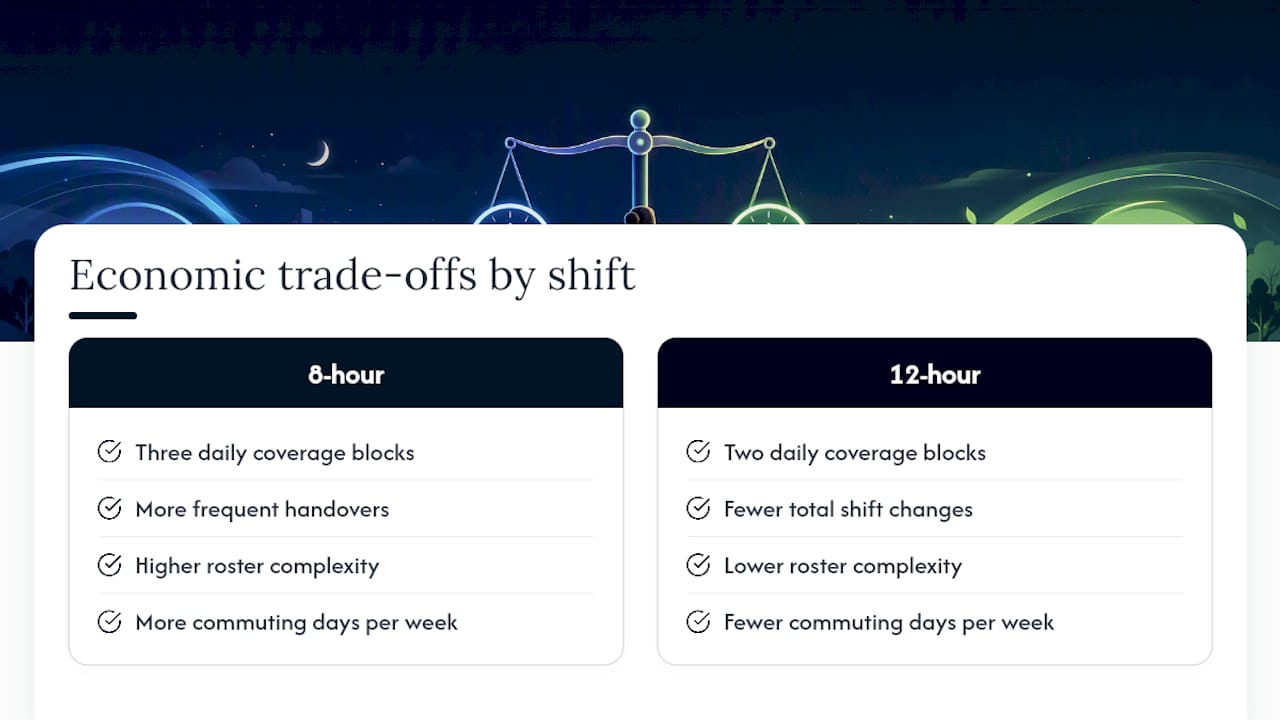
Neither model is categorically cheaper. The real cost driver is turnover. A schedule nurses want to keep working is almost always the cheaper one over a two-year horizon, once recruitment and onboarding costs are factored in.
Legal Regulations and Labor Laws Governing Shift Lengths
Federal labor law in the United States does not cap shift length for adult healthcare workers, nor does it mandate a specific schedule format. The Fair Labor Standards Act governs overtime pay, generally requiring time-and-a-half after 40 hours in a workweek, but it says nothing about whether those 40 hours come in five 8-hour shifts or three-and-a-half 12-hour ones.
Some states impose their own rules. California, for example, restricts mandatory overtime for nurses and sets specific nurse-to-patient ratio requirements that indirectly shape scheduling decisions, though shift length itself generally isn't fixed by statute. Hospitals typically negotiate shift patterns through internal policy or union contracts rather than through blanket state law.
Mandatory overtime is where most legal friction shows up. Several states have passed laws limiting or banning forced overtime for nurses specifically, a response to research linking extended and unplanned hours to elevated error risk. That protection matters more for 12-hour rosters, where an unplanned extension can push a nurse toward 16 or more consecutive hours.
The practical implication for managers: check your state's specific mandatory overtime and rest-period rules before finalizing a schedule, since they vary meaningfully by jurisdiction. What's compliant in one state may violate nurse protection statutes in another.
Effects on Team Communication and Collaboration Dynamics
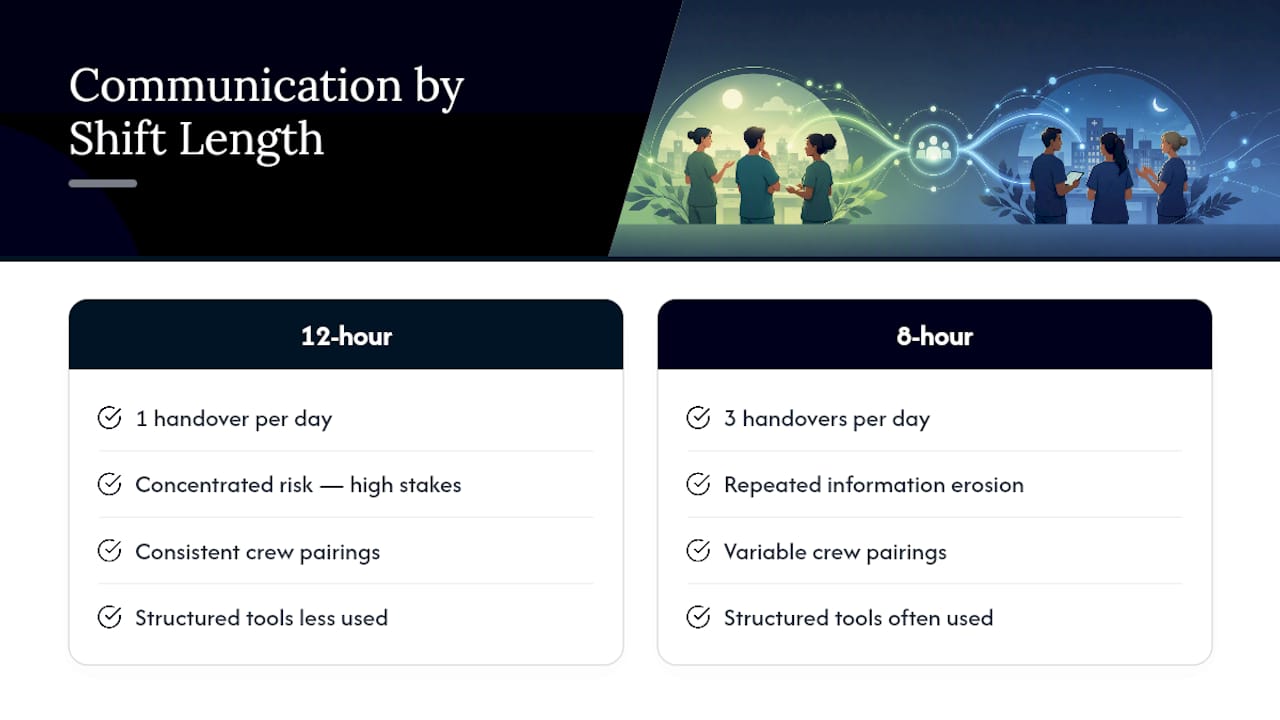
Shift length reshapes how often teams talk to each other, and that has downstream effects on both safety and workplace culture. Twelve-hour schedules mean nurses spend more consecutive hours with the same care team, building familiarity that can improve real-time collaboration during a single shift.
Fewer daily handovers also mean fewer opportunities for information to get lost in translation. A single handover per day, as is typical with two 12-hour shifts, concentrates the risk of miscommunication into one high-stakes transition rather than spreading smaller risks across two.
Eight-hour schedules trade that concentration for redundancy. More frequent handovers mean more chances for a second set of eyes to catch something missed, but also more chances for details to erode across repeated retellings. Units running 8-hour shifts often compensate with structured handover tools like SBAR to keep communication consistent across three daily transitions instead of one.
Longer-term team cohesion tends to favor whichever schedule creates more consistent crew pairings. Nurses who work the same 12-hour rotation together for months build shorthand communication that shortens response time during emergencies. Rotating 8-hour schedules with variable pairings can dilute that familiarity, even though each individual shift carries lower fatigue risk. Neither pattern wins on communication in the abstract. It depends on whether the schedule keeps the same people working together often enough to build trust.
How Flexible Matching Changes the Shift-Length Conversation
Most of this debate assumes nurses are stuck with whatever schedule their unit runs. That's changing. Real-time availability matching lets nurses filter for the shift length that actually fits their life, rather than adapting their life to a roster set years before they were hired. That reduces the mismatch between preferred and assigned schedules that fuels a lot of the burnout data in this article. When nurses choose their shift length, retention tends to follow.
— Flexible
Find Nursing Jobs That Match the Schedule You Actually Want
If this comparison left you wanting shifts on your terms rather than whatever your current unit assigns, that's exactly the gap Flexiblenursingcareers closes. The platform's free matching service connects you with real-time openings filtered by your preferred shift length, availability, and specialty, so you're not stuck choosing between a job you want and hours that wreck your sleep.

Nurses drawn to telehealth roles often find more control over shift structure than traditional bedside rotations allow, while travel and PRN nurses use the matching tool to line up assignments that specifically avoid back-to-back 12-hour runs when that's not what they want. There's no lengthy application gauntlet standing between you and a shift pattern that actually fits.
Ready to see what's open right now? Sign up for job alerts and get notified the moment a role matching your preferred shift length and specialty goes live.
Sources
- Work shift duration: a review comparing eight hour and 12 hour shift systems
- Comparison of nurse, system and quality patient care outcomes in 8-hour and 12-hour shifts
FAQ
Is It Better to Work 8-Hour or 12-Hour Shifts?
Neither is universally better. Eight-hour shifts reduce late-shift fatigue risk, while 12-hour shifts offer more days off and fewer handovers; the right choice depends on unit acuity, staff preference, and how well fatigue controls are implemented.
What Is the Healthiest Shift Work Schedule?
The healthiest schedule minimizes rotation frequency and protects consistent sleep timing, regardless of shift length. Fixed schedules with predictable timing tend to support better circadian health than frequently rotating patterns of either duration.
Why Do Nurses Choose 12-Hour Shifts Instead of 8-Hour Shifts?
Many nurses prefer 12-hour shifts for the compressed workweek and longer blocks of consecutive days off, which studies link to higher schedule satisfaction and lower hospital vacancy rates.
Are Three 12-Hour Shifts Better Than Five 8-Hour Shifts?
It depends on the outcome you're measuring. Three 12-hour shifts mean fewer handovers and more days off, but carry a documented fatigue risk window in hours 11 and 12, while five 8-hour shifts spread fatigue more evenly but require more total handovers and commutes.
Can a Job Platform Help Me Find a Shift Length I Actually Want?
Yes. Real-time matching on some platforms filters open roles by shift length, specialty, and availability, helping healthcare workers find assignments fitting their preferred schedules.