
Hospital locum tenens is defined as a temporary clinical staffing model where licensed healthcare professionals fill short to long-term coverage gaps in hospitals and other care facilities. The Latin phrase means "to hold the place," and that is exactly what locum providers do. Approximately 7% of U.S. physicians participate in locum tenens work annually, drawn by flexibility, higher pay, and relief from burnout. For nurses and allied health professionals, this model has become a serious career path, not just a stopgap. Understanding how hospital locum tenens works gives you a real advantage when planning your next move.
What are the typical types of hospital locum tenens assignments?
Locum tenens assignments fall into three duration categories, each suited to different career goals and lifestyle needs. Knowing which type fits your situation is the first practical step in the locum tenens process.
- Short-term assignments (1 week to 3 months): Best for providers who want maximum variety and freedom. You rotate through different hospitals, regions, and patient populations without long-term commitment.
- Mid-term assignments (3 to 6 months): These offer a balance between flexibility and deeper integration into a facility's culture and workflows.
- Long-term assignments (6 months or more): Suited for providers who want the financial and lifestyle benefits of locum work but prefer a more stable routine.
Assignment durations are categorized this way across the industry, and most staffing agencies use these same brackets when presenting opportunities. That consistency makes it easier to compare offers across agencies.
The types of hospital settings that use locum providers are equally varied. Specialties in demand include internal medicine, emergency medicine, psychiatry, urgent care, and hospitalist roles. Rural and underserved hospitals rely most heavily on locum coverage because permanent recruitment in those markets takes longer.
| Assignment Type | Duration | Best For |
|---|---|---|
| Short-term | 1 week to 3 months | Maximum flexibility and variety |
| Mid-term | 3 to 6 months | Balance of flexibility and immersion |
| Long-term | 6+ months | Stability with locum tenens benefits |
How does compensation for hospital locum tenens compare to permanent roles?
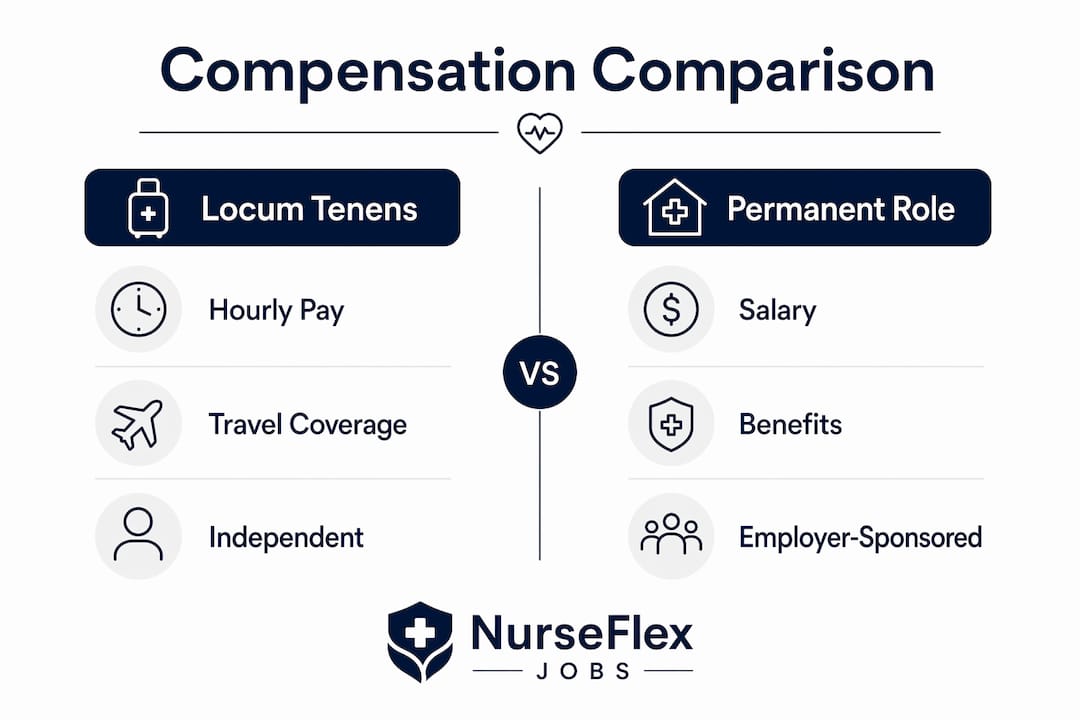
Locum tenens providers are paid hourly rather than on a salary. Hourly rates can reach up to $350/hr depending on specialty, location, and assignment urgency. That figure reflects the premium hospitals pay to fill critical gaps quickly.

Permanent hospital roles offer a predictable annual salary, employer-sponsored health insurance, retirement contributions, and paid time off. Locum providers give up those employer benefits in exchange for higher hourly rates and direct control over their schedule. The trade-off is real, but for many providers, the math works in their favor.
Agencies typically cover travel, housing, and malpractice insurance for locum providers. That coverage removes a significant cost burden that self-employed clinicians would otherwise carry. When you factor in those covered expenses alongside the higher hourly rate, total compensation often exceeds what a comparable permanent role pays.
| Compensation Factor | Locum Tenens | Permanent Role |
|---|---|---|
| Pay structure | Hourly rate (up to $350/hr) | Annual salary |
| Travel and housing | Covered by agency | Self-funded |
| Malpractice insurance | Agency-provided | Employer-provided |
| Health and retirement benefits | Self-funded | Employer-sponsored |
| Schedule control | High | Low to moderate |
Pro Tip: Set aside 25–30% of your locum earnings for taxes from day one. Locum providers work as 1099 independent contractors, so no employer withholds taxes on your behalf. A quarterly estimated tax payment schedule keeps you compliant and avoids penalties.
For a detailed comparison of pay structures between locum and direct hire roles, the differences go beyond the hourly rate and deserve careful review before you commit to either path.
What is the credentialing and licensing process for locum tenens providers?
Credentialing is the formal verification process hospitals use to confirm a provider's qualifications before granting clinical privileges. Every hospital requires it, and it applies to locum providers just as it does to permanent staff. The good news is that reputable staffing agencies handle the bulk of this administrative work on your behalf.
The standard credentialing process includes the following steps:
- Submit your CV and work history. Agencies need a complete employment record covering the past 5–10 years, with no unexplained gaps.
- Provide active state licenses. You need a valid license in the state where the assignment is located. Agencies can help you apply for additional state licenses when needed.
- Gather board certifications and DEA registration. Most hospital assignments require current board certification and, for prescribing roles, an active DEA number.
- Compile immunization records and health clearances. Hospitals require proof of vaccinations including hepatitis B, MMR, varicella, and annual influenza.
- Complete facility-specific paperwork. Each hospital has its own credentialing forms, and agencies coordinate submission directly with the facility.
Credentialing typically takes 2–6 weeks from the time all documents are submitted. Delays almost always trace back to incomplete paperwork or expired licenses. That timeline matters because you cannot start an assignment until credentialing clears.
Pro Tip: Build a digital credentialing folder with current copies of every document before you contact an agency. Providers who arrive with organized, up-to-date records reduce credentialing delays significantly and get placed faster.
Staffing agencies coordinate license applications, DEA registration, and hospital-specific paperwork as part of their standard service. That support is one of the clearest advantages of working through an established agency rather than pursuing assignments independently.
What are the main benefits and challenges of hospital locum tenens work?
The advantages of locum tenens are concrete and well-documented. Flexible scheduling, higher earning potential, travel opportunities, and exposure to diverse clinical environments are the four most cited reasons providers choose this path.
- Flexibility: You choose when and where you work. That control is the single biggest draw for providers managing family commitments, pursuing further education, or recovering from burnout.
- Higher pay: Hourly rates consistently exceed what comparable permanent roles offer, especially in high-demand specialties and rural markets.
- Professional variety: Working across different hospitals and patient populations builds clinical skills faster than staying in one system.
- Travel: Agencies cover your costs, so you experience new regions without the financial burden of self-funded relocation.
The challenges are equally real. Locum providers work as 1099 independent contractors, which means no employer-sponsored health insurance, no retirement matching, and full responsibility for quarterly tax payments. Assignment gaps can occur between placements, creating income variability that requires careful financial planning.
"Locum tenens is increasingly used as a workforce planning tool to ease physician shortages and reduce provider burnout across the U.S. healthcare system. For providers, that demand translates directly into negotiating power and assignment availability."
Locum tenens suits providers at every career stage. New graduates use short-term assignments to explore specialties before committing to a permanent role. Mid-career providers use it to reset after burnout. Near-retirement clinicians use it to reduce hours without fully stepping away. The model is genuinely flexible enough to serve all three groups.
To mitigate the downsides, open a health savings account, work with a tax professional who understands 1099 income, and maintain a cash reserve equal to at least two months of expenses. Those three steps remove most of the financial risk that discourages providers from trying locum work.
How can healthcare professionals get started with hospital locum tenens work?
Getting started with locum tenens is more straightforward than most providers expect. The process has a clear sequence, and following it in order prevents the most common delays.
- Research and select a staffing agency. Look for agencies that specialize in your clinical area and have a track record of transparent contracts. Ask directly about their credentialing support, pay timelines, and how they handle assignment gaps.
- Organize your credentials before your first call. Have your CV, active licenses, board certifications, DEA registration, immunization records, and malpractice history ready. Agencies move faster when you arrive prepared.
- Clarify your availability and preferences. Be specific about assignment length, geographic preferences, and specialty. Vague preferences lead to mismatched placements.
- Review every contract carefully. Pay attention to cancellation clauses, overtime terms, and what happens if an assignment ends early. Ask your agency recruiter to walk you through any language you do not understand.
- Communicate consistently with your recruiter. Recruiters who know your preferences and timeline find better matches. A brief weekly check-in keeps you top of mind when new assignments open.
Healthcare staffing platforms have made the initial search faster by matching providers to assignments based on specialty, availability, and location in real time. That technology reduces the back-and-forth that used to slow down first placements.
Pro Tip: Start your first locum assignment in a state where you already hold an active license. Adding a new state license takes time, and starting in familiar regulatory territory lets you focus on the clinical work rather than paperwork.
Hospitals use locum providers to address urgent staffing vacancies quickly, which means demand is consistent. Providers who are credentialed, organized, and responsive to recruiters get placed first.
Key takeaways
Hospital locum tenens is a proven, structured staffing model that gives healthcare professionals control over their schedule, access to higher pay, and clinical variety, while hospitals get reliable coverage for critical gaps.
| Point | Details |
|---|---|
| Definition and scale | Locum tenens fills temporary hospital gaps; roughly 7% of U.S. physicians use this model annually. |
| Assignment types | Short, mid, and long-term assignments exist to match different career goals and lifestyle needs. |
| Compensation structure | Hourly rates reach up to $350/hr with travel and housing covered by the agency. |
| Credentialing timeline | The process takes 2–6 weeks; organized providers with complete documents get placed faster. |
| Getting started | Choose a specialty-focused agency, prepare credentials in advance, and review contracts carefully. |
Why locum tenens is more than a backup plan
I have watched the conversation around locum tenens shift significantly over the past several years. When I first started paying close attention to healthcare staffing trends, locum work was treated as a fallback option. Providers did it between permanent jobs or when they needed quick income. That perception has changed, and the change is justified.
The providers I see thriving in locum tenens are not running from something. They are running toward a specific kind of career. They want clinical variety without the politics of a single health system. They want to earn more per hour without waiting for an annual review. They want to take a month off without asking permission. Locum tenens delivers all three.
The area I think the industry still needs to improve is transparency around contract terms. Too many first-time locum providers sign agreements without fully understanding cancellation clauses or overtime caps. Agencies that invest in educating their providers on contract literacy will build stronger long-term relationships. Providers who ask hard questions upfront will have better experiences.
Locum tenens is not for everyone. If you need the predictability of a salary and employer benefits, a permanent role is the right fit. But if you have ever thought about what your career could look like with more control, this model deserves a serious look. The workforce shortage is not going away, and that means demand for qualified locum providers will stay strong.
— Flexible
Locum tenens jobs available through Flexiblenursingcareers
Flexiblenursingcareers connects nurses and healthcare professionals with hospital locum tenens opportunities that match their specialty, schedule, and location preferences.

The platform uses real-time job matching to reduce the time between application and placement. Recruiter support covers credentialing coordination, contract review, and assignment logistics so you can focus on patient care. Whether you are exploring your first short-term assignment or looking for a long-term hospital role with locum flexibility, Flexiblenursingcareers has current openings across multiple specialties. Browse available nursing jobs and sign up to get matched with assignments that fit your profile today.
FAQ
What does hospital locum tenens mean?
Hospital locum tenens refers to licensed healthcare professionals who temporarily fill clinical roles in hospitals to cover staffing gaps. The Latin phrase means "to hold the place."
How much do locum tenens providers earn?
Locum tenens providers are paid hourly, with rates reaching up to $350/hr depending on specialty and location. Travel and housing are typically covered by the staffing agency.
How long does credentialing take for locum tenens work?
Credentialing takes 2–6 weeks from the time all required documents are submitted. Providers who prepare CVs, licenses, and certifications in advance move through the process faster.
Do locum tenens providers receive benefits?
Locum providers work as 1099 independent contractors and do not receive employer-sponsored health insurance or retirement benefits. They are responsible for managing their own taxes and benefits.
Is locum tenens suitable for new nursing graduates?
Locum tenens suits providers at any career stage, including new graduates who want to explore different specialties and settings before committing to a permanent role.