
Oregon is the only state with a comprehensive predictive scheduling law, but several cities and counties run their own versions, from San Francisco to New York City. Baseline requirements across these jurisdictions typically include written schedules posted around two weeks ahead, predictability pay when employers change shifts without enough notice, and rest periods between closing and opening shifts. If you operate in any of these jurisdictions, map your locations against these rules now, because the penalties can add up quickly when you guess wrong.
TL;DR:
- Employers must map each location's jurisdiction to ensure compliance with the strictest scheduling rules, including posting schedules 14 days in advance and maintaining rest periods of at least 11 hours where practical.
- Predictability pay is generally one hour at the regular rate for employer-driven schedule changes, but rules and rates vary significantly by city, with New York City using a fixed-dollar matrix for fast food.
- Violations can result in escalating fines, and employers should retain detailed records of schedules, changes, and employee offers for at least three to four years to mitigate penalties.
- Non-federal laws mean employers must align payroll practices with local ordinances, including folding predictability pay into regular overtime rates where applicable.
- Consistent, documented offer-first shift offers and manager training routines are critical for reducing legal risks and building a transparent scheduling culture.
Table of Contents
- What Are Predictive Scheduling Laws and Who Do They Cover?
- Which U.S. Cities and States Have Predictive Scheduling Laws?
- How Do Predictive Scheduling Laws Actually Work?
- Does Federal Law Require Predictive Scheduling?
- Building a Compliance Plan Across Multiple Locations
- What Happens If You Violate a Predictive Scheduling Law?
- What Predictive Scheduling Means for Healthcare Staffing
- Where to Verify These Rules Directly
- Sources
What Are Predictive Scheduling Laws and Who Do They Cover?
Predictive scheduling laws, also called fair workweek laws, require covered employers to give workers advance notice of their schedules and compensate them when last-minute changes disrupt planned hours. No federal predictive scheduling law exists. The Department of Labor's Fact Sheet #56B confirms that all such mandates sit at the state or city level, which means your obligations depend entirely on where your worksites are, not on any single national standard.
Here's what to do first if you run scheduling for more than one location:
- Map every jurisdiction and coverage threshold for each worksite, not just headquarters.
- Adopt a 14-day posting standard and 10 to 11 hour rest window wherever it's practical, even outside covered cities.
- Put every schedule posting and change in writing, and log offers of extra hours along with any refusals.
- Train managers on the specific ordinance in their city, since Chicago's rules differ from Seattle's in coverage and penalties.
- Audit payroll to confirm predictability pay gets calculated correctly and folded into the regular rate when required.
Pro Tip: Build one internal policy that matches your strictest jurisdiction's rules, then apply it everywhere. It costs less to overcomply in a lenient city than to run 11 different scheduling policies across your portfolio.
Which U.S. Cities and States Have Predictive Scheduling Laws?
Eleven jurisdictions enforce predictive scheduling rules as of 2026, according to a compiled map of current ordinances. Three of them, Los Angeles County, Berkeley, and Evanston, joined the list only in the past two years, and that expansion pattern tells you something: this is not a fixed list. More cities are likely to adopt similar ordinances as the fair workweek movement keeps spreading through West Coast and Midwest metros.
New York City is the outlier worth memorizing. Retail employers there face a 72 hour notice rule, far shorter than the modal 14 days everywhere else, while fast food employers operate under a completely separate ordinance with a fixed dollar predictability pay matrix instead of the hourly premium most other cities use.
By the numbers: according to Paycom's 2026 survey of scheduling ordinances, 14 days is the modal advance notice window across nearly every jurisdiction on this list, which makes it the safest default for any multi-state employer trying to standardize policy.
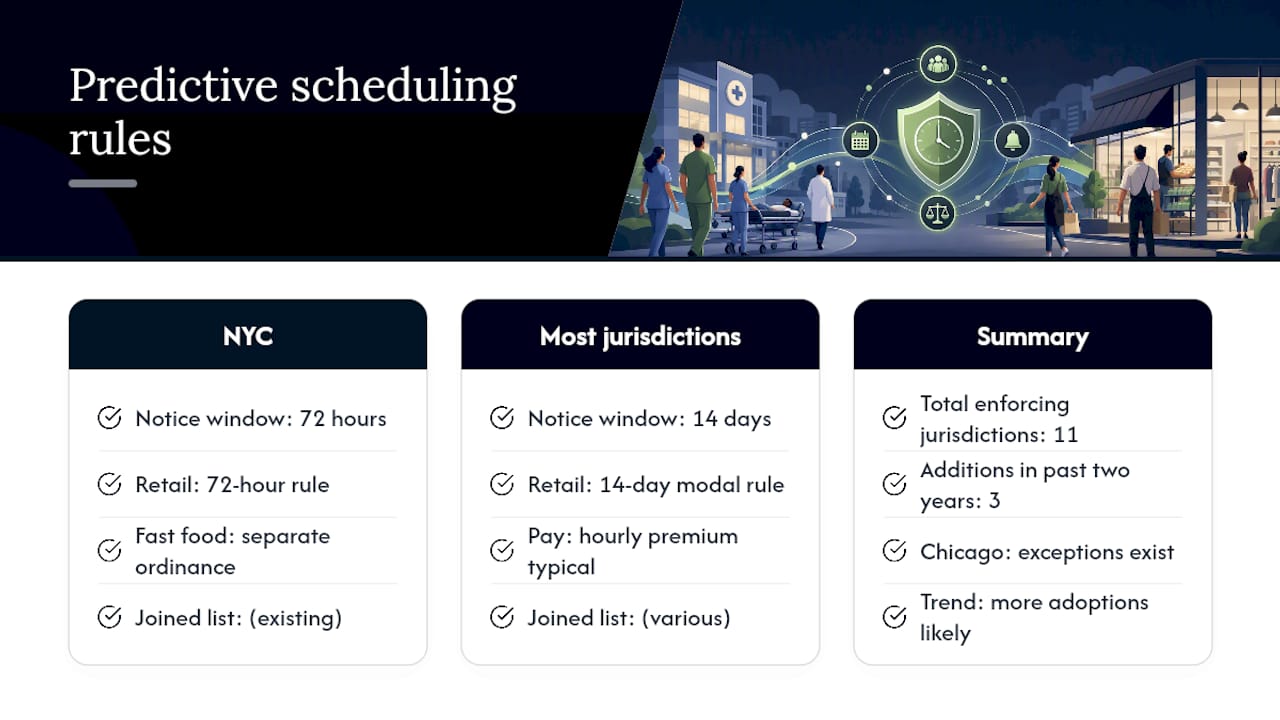
Chicago also carves out exceptions for healthcare and manufacturing employers under certain conditions, so don't assume every hospital-adjacent business in the city falls under the same rules as a retail chain next door.
How Do Predictive Scheduling Laws Actually Work?
Every ordinance on that list shares a common skeleton, even though the numbers shift by city. Here's how the pieces fit together:
- Advance notice. A "posted schedule" is the official written schedule an employer commits to, distinct from an internal draft. Once posted, any employer-initiated change, adding a shift, cutting hours, or reassigning a day, triggers predictability pay in covered jurisdictions.
- Predictability pay. The typical formula pays workers one hour at their regular rate when hours are added with insufficient notice, and half that rate when hours are cut. New York City's fast food ordinance breaks from this pattern entirely, using a fixed-dollar payment matrix tied to how much notice was actually given.
- Clopening and rest rules. Rest windows run from 9 to 11 hours depending on the city, and the clock typically starts from the end of a posted shift, not from when an employee actually clocks out late.
- Good-faith estimate at hire. Oregon and several city ordinances require employers to give new hires a written estimate of expected hours and schedule patterns before their first shift, then update it periodically as business needs shift.
A few carve-outs matter here too. Voluntary shift swaps between employees, schedule changes an employee requests themselves, and shift trades initiated by workers generally don't trigger predictability pay, since the premium exists to penalize employer-driven unpredictability, not worker flexibility.
- Offer-first provisions in several ordinances require employers to offer open hours to existing part-time staff before hiring anyone new for those shifts.
- Emergency exceptions (severe weather, utility failure) typically waive predictability pay obligations, though documentation requirements still apply.
Does Federal Law Require Predictive Scheduling?
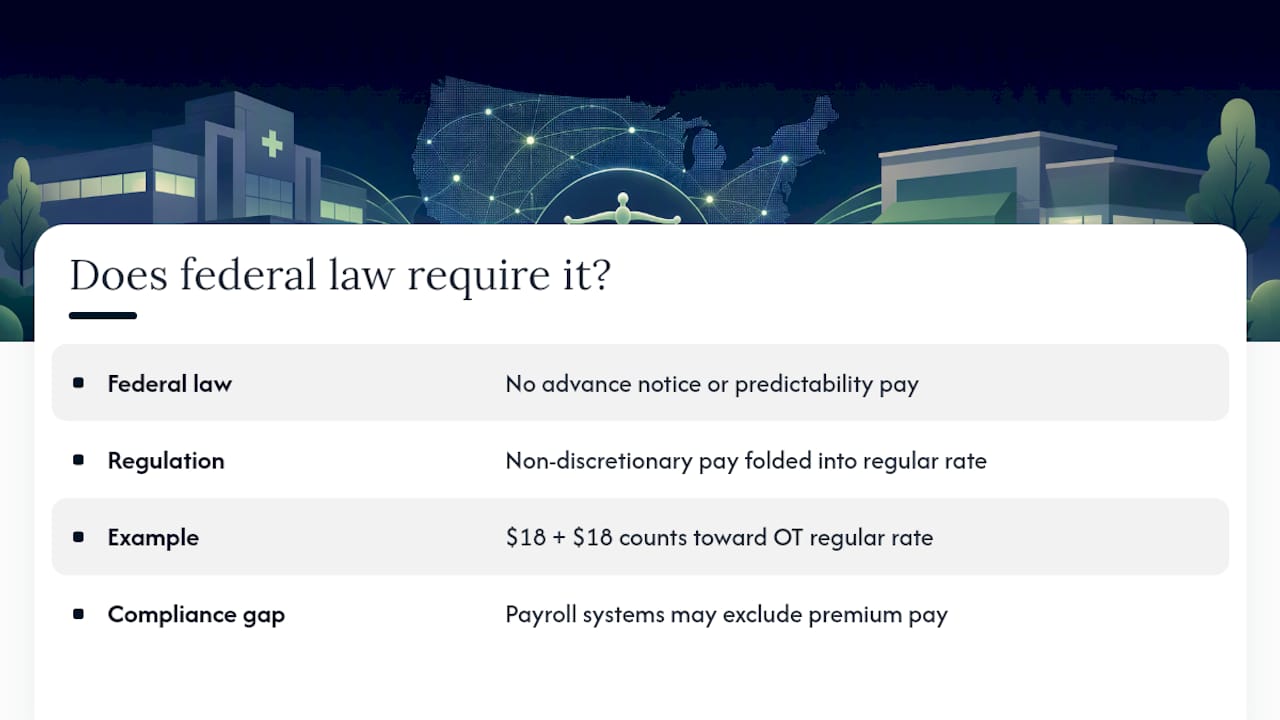
No. The Fair Labor Standards Act doesn't require advance notice or predictability pay anywhere in the country. Every obligation you have comes from state or city statute, not federal law. Where the FLSA does matter is in how it treats predictability pay once a local law requires it.
Key figure: under 29 CFR §778.208, predictability pay that is non-discretionary and owed by statute generally must be folded into an employee's regular rate for overtime purposes, unless a narrow exclusion applies.
That distinction changes your payroll math. If a worker earns $18 an hour and receives $18 in predictability pay for an added shift, that payment typically counts toward the regular rate used to calculate time-and-a-half for any overtime hours worked that same week. Skipping this step is one of the most common compliance gaps auditors find, because payroll systems built before these ordinances existed often exclude premium pay categories by default.
Building a Compliance Plan Across Multiple Locations
Start with a coverage map. List every worksite, its jurisdiction, and the specific threshold that triggers coverage there, because a 40-employee location might dodge Chicago's rule while a 120-employee location down the street doesn't. Once you know where you stand, adopt the strictest standard you can afford everywhere: 14-day posting, 11-hour rest, and a written good-faith estimate at hire. A workaxle analysis of the 2026 map found this strict-everywhere posture meaningfully cuts compliance complexity for operators running locations across several cities.
Manager workflows matter as much as the policy itself. Build a routine where managers post schedules on a fixed day each week, offer open hours to current staff before advertising externally, and record every consent or refusal in writing. Nursing availability matching systems already do something similar in healthcare staffing, matching worker preferences against open shifts before a manager ever has to guess.
Look for scheduling tools with these features before you commit to one:
- Audit logs that timestamp every schedule posting and change.
- Automated alerts when a change falls inside the notice window and predictability pay applies.
- Built-in predictability-pay calculations tied to your payroll system.
- Exportable records formatted for a labor agency audit request.
Pro Tip: Write your offer-first policy in plain language and require a signed or digital acknowledgment for every refusal. Verbal offers with no record are the single most common weakness agencies exploit during an investigation.
If you're aggregating hours across franchise locations, moving staff between states, or unsure whether a threshold applies to your business structure, bring in employment counsel before you finalize policy. The technology guide to hospital hiring covers scheduling tech choices in more depth if you're weighing platforms for a healthcare-specific rollout.
What Happens If You Violate a Predictive Scheduling Law?
Penalties vary sharply by city. San Francisco, Berkeley, and Emeryville all issue escalating fines per violation, while New York City runs a tiered fine structure that increases with repeat offenses. Most investigations start the same way: an employee files a complaint, the local agency requests scheduling records and payroll documentation, and the employer has a limited window to respond.
Recommended safeguards:
- Retain schedule postings, change logs, and predictability pay calculations for at least three to four years, aligned to your strictest jurisdiction's requirement.
- Keep written records of every offer of additional hours and every employee response.
- If a violation surfaces, pay any owed predictability premium immediately and correct the payroll error going forward.
- Retrain the managers involved and document that retraining occurred, since agencies often ask for proof of corrective action, not just payment.
What Predictive Scheduling Means for Healthcare Staffing
Predictable schedules aren't just a compliance checkbox. A University of Chicago study found that stable scheduling improved both productivity and sales in retail settings, and the same logic holds in healthcare, where predictable shifts reduce burnout and turnover among nurses and support staff.
Some healthcare staffing platforms see this play out daily with weekend and holiday radiology coverage without burnout. Facilities that document shift offers to their existing staff before posting externally aren't just avoiding fines, they're building the kind of transparent scheduling culture that keeps nurses from burning out or walking. When you need documented, compliant short-term coverage while you update internal policy, a staffing marketplace can fill the gap without breaking your offer-first obligations, as long as every offer and acceptance gets logged the same way it would for your permanent staff.
— Flexible
Where to Verify These Rules Directly
Confirm current requirements at the source before finalizing policy: DOL Fact Sheet #56B for federal wage interaction, Oregon BOLI for statewide rules, and your city's labor agency page for local ordinance text and enforcement contacts.
If your organization staffs healthcare facilities across multiple cities, browse open nursing shifts or visit our employer resources page to see how documented, on-demand staffing fits into a compliant scheduling policy.
Sources
- Fact Sheet #56B: State and Local Scheduling Law Penalties and the Regular Rate under the Fair Labor Standards Act (FLSA)
- Predictive scheduling : For Workers : State of Oregon (BOLI)
- Predictive Scheduling Laws by State and City (2026)
- Predictive Scheduling Laws in 2026: Full U.S. Map