On-demand nurse staffing delivers measurable operational, financial, and clinical benefits for health systems that deploy it alongside a resilient baseline roster. The advantages of flexible nurse staffing are real, and they show up in metrics administrators track every quarter.
The three highest-impact benefits:
- Improved fill rates and faster coverage. Platform-enabled deployments have reported fill rates as high as 94%, compared to the chronic gaps that manual call-out processes leave open.
- Lower premium labor and agency spend. Controlling overtime and agency costs is a strategic priority for health systems, where labor is the primary driver of cost pressure. On-demand platforms give you a direct lever.
- Better nurse satisfaction and retention. Giving nurses autonomy over when and where they work reduces burnout and voluntary turnover, particularly when paired with fair, predictable pay.
One caveat worth stating plainly: on-demand staffing is not a substitute for adequate core staffing. A modelling study published in PMC found that flexible deployments can be harmful when baseline rosters are set too low. The model works best as a complement to a resilient core roster, not a replacement for one.
Key Takeaways
On-demand nurse staffing delivers the strongest results when it complements a resilient baseline roster, with fill rates, premium labor spend, and nurse retention as the three metrics most likely to move in the first pilot cycle.
| Point | Details |
|---|---|
| Fill rate improvement | Platform deployments have reported fill rates as high as 94%, compared to chronic gaps from manual processes. |
| Premium labor savings | Agency cost reductions of 62% have been reported in system-level deployments; overtime and agency spend are the primary financial levers. |
| Baseline staffing is non-negotiable | The PMC modelling study found low-baseline flexible plans produced worse outcomes when temporary staff were unavailable. |
| Nurse retention benefit | Giving nurses shift autonomy through a platform reduces burnout and voluntary turnover without requiring sign-on bonuses. |
| Flexiblenursingcareers next step | Run a 6–8 week pilot in one unit using Flexiblenursingcareers's real-time matching and employer controls to establish your baseline metrics. |
Table of Contents
- What on-demand nurse staffing means and how it differs from traditional staffing
- Why the operational problems on-demand staffing solves are costly to ignore
- Key operational, financial, and clinical benefits worth tracking
- How on-demand fits among your flexible staffing options
- How to pilot on-demand nurse staffing in your organization
- What the evidence and real-world pilots show
- Risks and safeguards you need to plan for
- How to evaluate on-demand staffing platforms, and where NurseFlex Jobs fits
- Real-world case studies from diverse healthcare settings
- What a nurse manager actually experiences running a pilot
- Flexiblenursingcareers: your direct path to on-demand nurse staffing
- Sources
What on-demand nurse staffing means and how it differs from traditional staffing
On-demand nurse staffing is a shift-by-shift model in which credentialed nurses are matched to open shifts through a digital marketplace, often within hours of a posting. It sits in a different category from per diem arrangements (which still rely on phone trees and manual coordination), travel contracts (which lock in nurses for 13-week assignments), and fixed full-time schedules (which offer no surge flexibility at all).
The operating features that matter most are credential matching, real-time pay signals, and rapid onboarding. On-demand platforms handle credentialing, background checks, and matching automatically, so a facility can post a shift and receive a qualified, verified nurse far faster than any traditional hiring cycle allows. Pay signals, such as rate adjustments for hard-to-fill shifts, let facilities compete for coverage without going through an agency.
Stat to know: A system-level deployment described by AACN achieved a 94% fill rate and a 62% reduction in agency costs after moving to an app-based flexible staffing model.
Flexiblenursingcareers operates as exactly this kind of technology-driven marketplace, using nursing availability matching to connect facilities with nurses based on skills, credentials, and real-time availability, rather than static rosters or agency middlemen.
Why the operational problems on-demand staffing solves are costly to ignore
The triggers that push administrators toward on-demand models are predictable: unexpected call-offs, seasonal emergency department surges, specialty coverage gaps, and elective-surgery scheduling fluctuations. Each one, left unaddressed, creates a cascade of premium costs and safety risks.
Common operational triggers:
- A nurse calls off at 5 a.m. and a manager spends two hours making calls before a shift starts.
- An ED surge during flu season pushes patient-to-nurse ratios past safe thresholds.
- A specialty unit (ICU, OR, L&D) needs a credentialed nurse on short notice and the float pool is already deployed.
- Elective surgery volume spikes after a holiday weekend and the schedule was built for average census.
Each of these scenarios defaults to one of two outcomes: mandatory overtime for existing staff, or an agency call that costs two to three times the standard rate. The AHA's cost-of-caring analysis makes clear that premium labor, overtime, and agency spend are among the most controllable cost levers available to health systems. Leaving them unmanaged is a choice with a dollar figure attached.
Industry analysis from MedCity News adds that overly lean baseline rosters reliant on flexible fill-in staff can leave units critically understaffed if temporary staff are unavailable, compounding both the safety risk and the cost problem.
Key operational, financial, and clinical benefits worth tracking
Operational benefits
Fill rates improve because the matching process is automated. A manager posts a shift, the platform notifies qualified nurses, and coverage is confirmed, often within the same day. That speed reduces the manager time spent on manual outreach, which platform approaches can automate entirely, freeing nurse managers for clinical leadership rather than scheduling logistics.
Metrics to track: fill rate by unit, time-to-fill per shift, and manager hours spent on scheduling per week.
Financial benefits
Premium labor spend drops when on-demand platforms replace agency calls for short-notice coverage. Agency rates typically carry a significant markup over platform rates, and overtime compounds that cost when existing staff are pressed to cover gaps. Better utilization of your existing float pool, combined with on-demand fill for residual gaps, can reduce both line items. The AACN case study reported multi-million-dollar reductions in premium labor spend at a system level.
Metrics to track: agency spend as a percentage of total labor, overtime hours per unit per pay period, and cost per filled shift by source.
Stat to know: The Mercy system deployment reported a 62% reduction in agency costs after adopting platform-based flexible staffing.
Clinical benefits
Adequate nurse-to-patient ratios on critical shifts reduce the risk of missed care, medication errors, and adverse events. When coverage gaps are filled faster, nurses on the floor are less stretched, and patient outcomes tend to follow.
Metrics to track: nursing-sensitive patient outcomes (falls, pressure injuries, HAPI rates), patient satisfaction scores, and length of stay by unit.
Workforce and retention benefits
Nurse autonomy is a retention lever that costs less than a sign-on bonus. When nurses can choose shifts that fit their schedules through an app, forced overtime decreases, burnout slows, and voluntary turnover drops. Platform-based models that support work-life balance give nurses a reason to stay in your system rather than leave for a travel contract.
Metrics to track: RN voluntary turnover rate, nurse satisfaction scores (Press Ganey or internal surveys), and shift abandonment rate.
Pro Tip: *When presenting benefit estimates to executives, use pilot baseline metrics and incremental improvements rather than full-run forecasts.
How on-demand fits among your flexible staffing options
Not every gap calls for the same solution. Here is how the main models compare and where on-demand platforms add the most value.
| Staffing model | Best use case | Key strength | Key limit |
|---|---|---|---|
| Core/baseline staff | Predictable daily census | Continuity, lowest cost per shift | No surge flexibility |
| Float pool | Planned cross-unit coverage | Known staff, lower premium | Limited size, can be depleted |
| Per diem | Scheduled low-census days | Cost control | Slow to fill; manual coordination |
| Travel/contract | Multi-week specialty gaps | Guaranteed coverage period | High cost; 13-week commitment |
| On-demand platform | Short-notice single shifts, specialty fills | Speed, fill rate, credential matching | Continuity lower than core staff |
On-demand platforms are the strongest fit for short-notice single-shift gaps, specialty credential requirements, and fill-rate optimization when the float pool is already deployed. They are not the right tool for multi-week coverage needs, where a travel or contract arrangement is more cost-effective.
The critical caution: on-demand works as a complement to a resilient baseline roster, not a replacement for one. The PMC modelling study is explicit that flexible deployments can produce worse outcomes when baseline staffing is set too low. Set your core roster first, then use on-demand to cover the residual variance.
How to pilot on-demand nurse staffing in your organization
A structured pilot reduces risk and gives you the data to make a confident go/no-go decision. Here is a practical sequence.
Implementation checklist:
- Align stakeholders. Get sign-off from nursing leadership, HR, finance, and legal before selecting a vendor. Define who owns the pilot (labor strategy lead + nurse manager + HR).
- Establish baseline metrics. Measure fill rate, time-to-fill, agency spend, overtime hours, and RN turnover for the target unit over the prior 60 days.
- Select a vendor. Evaluate platforms on credential matching speed, HR/payroll integration, reporting features, and governance controls (see Section 9).
- Design a small-unit pilot. Choose one unit with a clear, measurable gap problem. Set an 8-week timeline with predefined go/no-go criteria.
- Configure credentialing and onboarding. Confirm the platform's credentialing workflow meets your clinical standards before the first shift is posted.
- Integrate with HR and payroll. Map shift data to your payroll system to avoid manual reconciliation errors. Confirm pay parity policy for on-demand nurses versus core staff.
- Train managers. Nurse managers need to know how to post shifts, approve candidates, and read platform reporting dashboards.
- Run the pilot and track KPIs weekly. Fill rate, time-to-fill, premium labor spend, overtime hours, shift abandonment, nurse satisfaction, and patient-safety indicators.
- Review at week 4 and week 8. Apply go/no-go criteria and decide whether to expand, adjust, or stop.
Pro Tip: Keep the pilot unit small enough that a failure is recoverable. One medical-surgical unit with 20–30 beds is a reasonable scope. Avoid starting in a high-acuity specialty unit where credentialing complexity and continuity requirements are highest.
Pro Tip: Communicate the pilot to staff before it starts. Nurses who hear about a new staffing platform from a manager they trust are more likely to sign up and pick up shifts than nurses who hear about it through rumor.
Healthcare platforms built for matching handle much of the credentialing and onboarding workflow automatically, which shortens the time between vendor selection and first posted shift considerably.
What the evidence and real-world pilots show
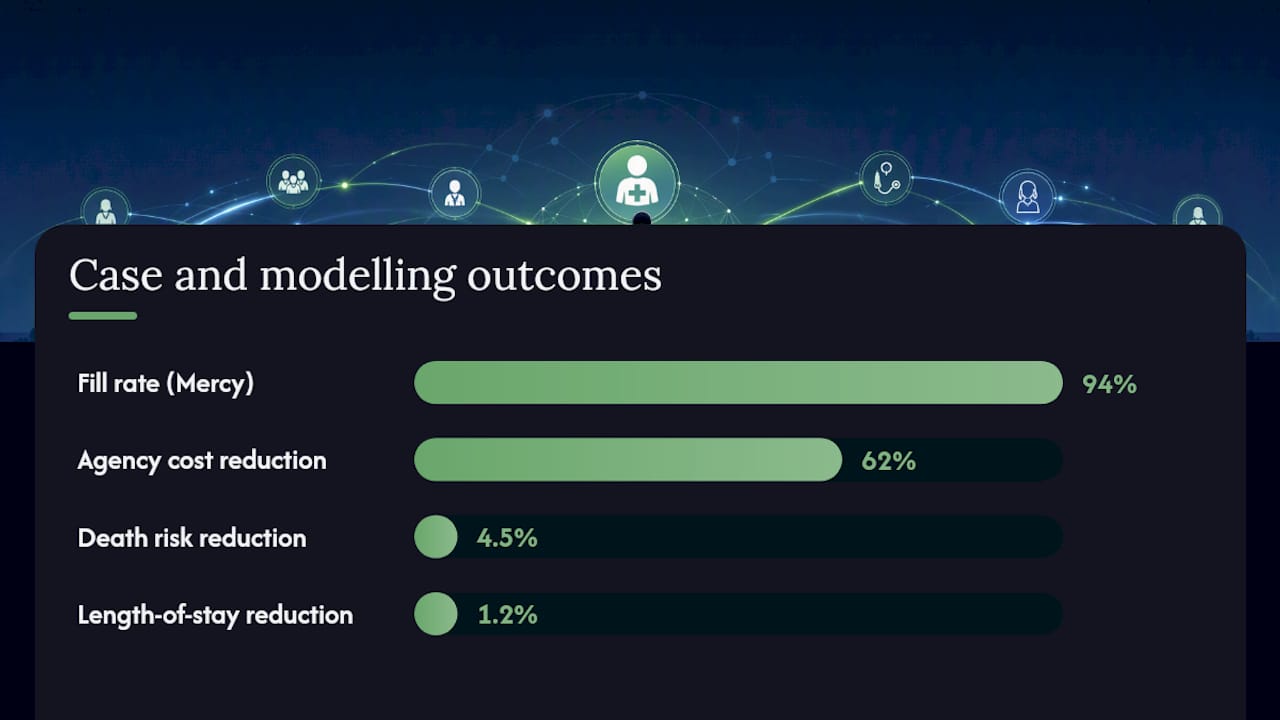
The academic evidence on flexible staffing is nuanced. The PMC simulation and economic modelling study found that higher-baseline "resilient" staffing plans produced better patient outcomes than low-baseline flexible plans, with a 1.2% reduction in average length of stay and a 4.5% reduction in relative risk of death. Flexible deployments helped, but only when baseline staffing was adequate. When temporary staff availability was limited, low-baseline plans produced worse outcomes than higher-baseline ones.
Real-world platform deployments tell a more optimistic story when baseline staffing is maintained. The AACN-reported Mercy case is the most cited example in industry coverage.
| Metric | Reported outcome | Source |
|---|---|---|
| Fill rate | 94% | AACN / Mercy case |
| Agency cost reduction | 62% | AACN / Mercy case |
| Premium labor savings | Multi-million dollar system-level reduction | AACN / Mercy case |
| Length of stay (modelling) | 1.2% reduction vs. low-baseline plans | PMC modelling study |
| Relative risk of death (modelling) | 4.5% reduction vs. low-baseline plans | PMC modelling study |
Note: The Mercy figures are case-study results from a specific system deployment and should be treated as illustrative benchmarks, not guaranteed outcomes. The PMC figures reflect modelling results comparing staffing plan types, not on-demand platforms specifically.
For a deeper look at how replacing agency staffing with a digital platform affects cost structures, the financial framing in that analysis maps closely to what the Mercy case reported.
Risks and safeguards you need to plan for
On-demand staffing carries real risks. Planning for them before the pilot starts is what separates a successful deployment from one that creates new problems.
Key risks:
- Overreliance on flexible labor. If baseline rosters are cut to fund platform spend, units become vulnerable when temporary staff are unavailable. The PMC study found this scenario produces worse outcomes than maintaining a higher baseline.
- Lower continuity of care. Rotating on-demand nurses who are unfamiliar with unit protocols, patient histories, and team dynamics can increase handoff errors.
- Credentialing and competency mismatches. A nurse credentialed for general med-surg may not be clinically ready for a step-down or specialty unit, even if the platform's credential check passes.
- Payroll and invoice reconciliation errors. Shift data that does not flow cleanly into your payroll system creates manual correction work and potential pay disputes.
Safeguards checklist:
- Maintain an adequate baseline roster before expanding on-demand fill.
- Set minimum credential thresholds by unit type, not just license level.
- Require manager approval for all on-demand placements in critical or specialty units.
- Audit clinical outcomes (nursing-sensitive indicators) monthly during the pilot.
- Run quarterly vendor audits on credentialing accuracy and shift data integrity.
- Integrate compliance requirements for state nurse practice acts and Joint Commission standards into your credentialing policy from day one.
Stat to know: The PMC modelling study found that low-baseline flexible plans showed increased understaffing and worse patient outcomes when temporary staff availability was limited, underscoring why baseline roster size is the most important variable to protect.
This cap gives you a clear signal if the platform is being used as a crutch rather than a complement.
How to evaluate on-demand staffing platforms, and where NurseFlex Jobs fits
Not all platforms are built the same. Use this checklist when talking to vendors.
Vendor evaluation checklist:
- Real-time matching. Can the platform match a posted shift to a credentialed nurse within hours, not days?
- Credentialing and onboarding speed. How long does it take a new nurse to complete onboarding and be eligible for shifts? What credential types does the platform verify?
- HR and payroll integration. Does the platform connect to your existing HRIS and payroll system, or does it require manual data export?
- Audit and reporting features. Can you pull fill rate, time-to-fill, and premium spend reports by unit and by time period?
- Pricing model and governance controls. Is pricing transparent? Can you set approval rules, unit-level restrictions, and pay rate caps?
Suggested RFP questions for vendors:
- What is your average time-to-fill for a shift posted with less than 24 hours' notice?
- How do you verify specialty credentials (ICU, L&D, OR) beyond license validation?
- What payroll integrations do you support natively?
- How do you handle a no-show from a placed nurse?
Flexiblenursingcareers meets these criteria through technology-driven matching that connects facilities with nurses based on skills, availability, and credentials in real time. The platform's rapid onboarding process reduces the time between vendor selection and first filled shift, and employer controls let managers set unit-level rules and approval workflows. For facilities evaluating the platform, the employer landing page outlines the specific features and integration options available.
Pro Tip: Ask every vendor for a reference from a facility of similar size and unit mix to yours. Fill rate and cost savings figures from a 500-bed academic medical center may not translate directly to a 120-bed community hospital.
Stat to know: Industry analysis highlights that a platform approach can automate matching and reduce manager time spent filling shifts, while also enabling pay-signal adjustments for hard-to-fill shifts, two capabilities that are worth testing explicitly during a vendor demo.
Real-world case studies from diverse healthcare settings
The Mercy health system case is the most documented example in U.S. healthcare coverage. The AACN case summary attributes the improvement to a demand-supply model that standardized pay and gave nurses genuine choice about which shifts to pick up.
Community hospitals have reported similar directional results, though at smaller scale. Facilities that moved from phone-tree per diem coordination to platform-based posting typically see the largest time-to-fill improvements in the first 30 days, when the novelty of the platform drives high nurse engagement with shift notifications.
Long-term care and post-acute settings face a different version of the same problem: chronic CNA and LPN shortages that create daily coverage gaps. Platform-based on-demand staffing has been applied in these settings with comparable fill-rate improvements, though continuity of care concerns are more acute when residents have complex, relationship-dependent care needs.
Telehealth and virtual nursing units represent a newer application. Facilities using telehealth staffing options can extend on-demand coverage to virtual monitoring roles, which require different credential matching but benefit from the same rapid-fill logic. The role of staffing agencies in hospitals provides useful context on how platform-based models compare to traditional agency relationships across different care settings.
What a nurse manager actually experiences running a pilot
The 4 a.m. call to find coverage is the moment most nurse managers describe first when talking about why they adopted an on-demand platform. Before the pilot, that call could take 90 minutes and still end with a mandatory overtime assignment. During the pilot, the same gap was posted to the platform the night before, and coverage was confirmed before the manager's alarm went off.

Staff reactions were mixed at first. Experienced nurses on the core roster wanted to know whether on-demand nurses would be held to the same clinical standards. Once the credentialing process was visible and managers could see which nurses were approved for which units, that concern settled. Nurses who signed up for the platform themselves reported that picking up an extra shift on their own terms felt different from being called in under pressure.
Platform reporting made the difference in how staffing decisions were communicated upward. Instead of anecdotal reports to administration, the pilot produced weekly fill-rate and premium-spend data that made the case for expanding the model to a second unit. That data also surfaced a pattern: two specific shift windows (Sunday nights and holiday Mondays) accounted for a disproportionate share of the gaps, which let the manager adjust the baseline schedule before relying on on-demand fill.
Flexiblenursingcareers: your direct path to on-demand nurse staffing
Filling a shift at 5 a.m. through an agency call costs you time, money, and manager goodwill. Flexiblenursingcareers gives you a faster route: real-time matching that connects your open shifts to credentialed nurses based on skills, availability, and unit requirements, without the agency markup or the 13-week travel commitment.

The platform is built for exactly the use cases this article covers: short-notice single-shift gaps, specialty credential fills, and fill-rate improvement without cutting your baseline roster. Employer controls let you set unit-level approval rules, credential thresholds, and pay parameters before a single shift goes live. Onboarding is fast, and the reporting dashboard gives you the weekly fill-rate and premium-spend data you need to make the case for expanding the model internally.
If you are ready to run a pilot, the NurseFlex Jobs employer page is the right starting point. You can also browse the available nursing roles to see the depth of the credentialed nurse pool in your market before committing to a full deployment.
Sources
- Beyond ratios - flexible and resilient nurse staffing options to deliver cost-effective hospital care and address staff shortages: A simulation and economic modelling study - PMC
- Flexible Staffing Choices - AACN
- Beating Healthcare Growth Challenges Depends on a New Nurse Staffing Approach - MedCity News
- Works
- Aha