
If you want the fastest hiring and the most open positions right now, prioritize ICU/critical care, emergency, OR/perioperative, and behavioral health. If you want steadier hours and a gentler pace, look at home health, case management, or nurse informatics. Advanced-practice routes like CRNA and NP still pay the most, but every specialty below is backed by real hiring pressure, not hype.
TL;DR:
- ICU and emergency nursing are in the highest demand, with certifications like CCRN and CEN unlocking the best job opportunities and pay premiums.
- Perioperative, labor and delivery, NICU, and behavioral health specialties also face staffing shortages driven by high turnover and specialized training requirements.
- Advanced-practice roles such as CRNA and NP offer the highest median wages, but require years of additional schooling and specific ICU or specialty experience.
- Certification and facility designation levels significantly influence pay prospects, with trauma and NICU levels commanding more negotiation leverage.
- Building a career in high-demand specialties benefits from documented competency, strategic experience, and careful evaluation of workload, schedule, and long-term fit.
Table of Contents
- What Are the Highest Demand Nursing Specialties Right Now?
- Why Is Demand Rising So Fast Across These Fields?
- What Do the Numbers Actually Say About Pay and Growth?
- How Do You Pick the Right Specialty for You?
- What's the Fastest Path Into a High-Demand Specialty?
- Which Certifications Actually Move the Needle on Pay?
- Where Should You Look for These Jobs, and How Do You Negotiate?
- Balancing Demand With a Sustainable Career
- How NurseFlex Jobs Helps You Land Specialty Roles Faster
- Sources
- FAQ
What Are the Highest Demand Nursing Specialties Right Now?
Ten specialties consistently show up on hospital "hard to fill" lists, and each one has its own reason for staying there. Some pay a premium because the work is dangerous or emotionally exhausting. Others pay a premium simply because too few nurses have the training to do the job safely. Here's a breakdown of what's driving each one, and what it takes to get in.
ICU / critical care tops nearly every shortage list because these units require nurses who can manage ventilators, titrate drips, and read a patient crashing before the monitor does. Hospitals typically want some prior med-surg or telemetry experience before hiring into ICU, though some systems run new-grad critical care residencies. The CCRN certification from AACN is the credential that unlocks the best assignments.
- Common settings: Level I trauma centers, cardiac ICUs, neuro ICUs, academic medical centers
- Certification: CCRN (adult, pediatric, or neonatal tracks)
- Pay signal: Among the highest shift differentials and travel rates of any RN-level role
Emergency nursing runs a close second. ER turnover is brutal, and the CEN certification plus TNCC (Trauma Nursing Core Course) tell an employer you can triage a waiting room and run a code at the same time. Nurses who pair CEN with CCRN report far more flexibility moving between ICU and ED assignments.
- Common settings: Level I to IV trauma centers, urgent care, freestanding EDs
- Certification: CEN, TNCC, ACLS/PALS
- Pay signal: Strong travel contract demand, especially in trauma-designated facilities
OR / perioperative nursing demand keeps climbing because surgical volume drives hospital revenue, and few nursing schools teach sterile technique and surgical instrumentation in depth. The CNOR credential from CCI takes two years of perioperative experience to sit for, which keeps the qualified pool small relative to need.
- Common settings: Ambulatory surgery centers, academic surgical programs, cardiac surgery units
- Certification: CNOR (requires two years perioperative RN experience)
- Pay signal: Premium pay tied directly to surgical case volume and specialty (cardiac, neuro, ortho)
Labor & delivery and NICU face a different problem: too few nurses are trained for high-risk obstetric and neonatal complications. RNC-OB and RNC-NIC certifications from the National Certification Corporation signal that competency. Level III and IV NICUs, which handle the most fragile infants, pay noticeably more than Level II units for exactly this reason.
- Common settings: Labor and delivery units, antepartum, Level II through IV NICUs
- Certification: RNC-OB, RNC-NIC
- Pay signal: Facility-level NICU designation is one of the biggest local pay drivers
Behavioral and psychiatric nursing has the highest turnover of any specialty on this list, and that turnover is the demand driver. Staffing shortages here run deep enough that the PMH-BC certification is often optional at hiring, though it helps long-term earning potential and mobility.
- Common settings: Inpatient psychiatric units, crisis stabilization centers, telehealth behavioral platforms
- Certification: PMH-BC (Psychiatric Mental Health Nursing Board Certification)
- Pay signal: High demand, but median pay often trails acute surgical specialties
Oncology nursing demand grows with an aging population that develops more cancer diagnoses every year. The OCN certification from the Oncology Nursing Certification Corporation is the standard credential, and infusion and chemotherapy competency (ONS/ONCC chemo certification) adds another layer of value.
- Common settings: Infusion centers, inpatient oncology units, academic cancer centers
- Certification: OCN, ONS chemotherapy/biotherapy certification
- Pay signal: Steady demand growth tied to cancer incidence trends
Home health and community nursing is where predictability lives. Shifts are more fixed, call is rare, and the work has shifted here specifically because hospitals are pushing recovery and chronic care management out of the building. This is a strong specialty for nurses who want demand without the acuity chaos.
- Common settings: Home health agencies, hospice, community clinics
- Certification: No universal mandatory credential; case management certification (CCM) helps
- Pay signal: Lower shift differentials but more schedule control
Telemetry/PCU and med-surg round out the list as the volume workhorses of hospital staffing. Nearly every hospital has open telemetry and med-surg positions year round, and these units remain the most common entry point into ICU, ER, or OR later. Med-surg experience is the foundation almost every specialty above eventually asks for.
- Common settings: Progressive care units, general medical floors, step-down units
- Certification: PCCN (Progressive Care Certified Nurse) for telemetry/PCU
- Pay signal: Lower premiums than acute specialties, but the highest volume of open roles
CRNA and NP roles sit above all of these on the pay scale and typically require an RN specialty background first. ICU experience, in particular, is close to a prerequisite for CRNA school admission.
Why Is Demand Rising So Fast Across These Fields?
Three forces are colliding at once, and none of them are temporary. The Census Bureau reported in 2025 that older adults now outnumber children in the United States, a first in the nation's history. That shift alone pushes more patients into ICU beds, more diagnoses into oncology infusion chairs, and more chronic conditions into home health caseloads.
Older adults now outnumber children in the U.S. for the first time on record, according to the Census Bureau, a shift that directly increases demand for critical care, oncology, and home health nursing.
Turnover compounds the problem. Peer-reviewed workforce research points to burnout and high attrition, especially in behavioral health and emergency nursing, as a major driver of specialty shortages rather than a lack of interest in the field. Meanwhile, AACN documents a persistent nursing faculty shortage that caps how many new nurses schools can train each year, tightening the supply side just as demand climbs. Facility-level factors matter locally too: a hospital that adds Level I trauma status or a Level IV NICU instantly needs a deeper bench of specialty-certified staff than it did the year before.
What Do the Numbers Actually Say About Pay and Growth?
CRNAs earn the highest median pay of any nursing role. Mid-2026 BLS wage data puts nurse anesthetists in the roughly $223,210 to $236,590 range, reflecting both the graduate-level training required and the anesthesia responsibility involved.
CRNAs post the highest median wages of any nursing specialty, with BLS occupational data placing mid-2026 pay between roughly $223,210 and $236,590 depending on region and setting.
RN specialty pay sits well below that ceiling but still varies widely by unit. ICU, ER, and OR roles typically carry the strongest shift differentials among bedside RN jobs, and travel pay data shows these same units commanding the biggest premiums on contract assignments. The BLS Occupational Outlook Handbook projects continued strong demand for registered nurses overall, with advanced-practice roles growing faster than the RN baseline. Certification adds real dollars, too: industry pay guides estimate specialty credentials add roughly $3,000 to $15,000 annually depending on the specialty and local market conditions. Advanced-practice roles offer the highest ceiling, but they demand years of graduate school most nurses fund by working an RN specialty first.
How Do You Pick the Right Specialty for You?
Demand alone is a bad reason to choose a specialty. The best fit balances five things: personal temperament, how in-demand the field actually is, how long it takes to get credentialed, what it pays, and what it does to your schedule and sleep.
Run through this checklist before committing:
- Rate your stress tolerance honestly. ICU, ER, and behavioral health reward nurses who thrive on unpredictability; med-surg or home health suit those who want structure.
- Check the real time-to-credential. CNOR requires two years of OR experience before you can even test; CRNA school takes years beyond RN licensure.
- Price out the income you actually need now versus later. An RN specialty role can fund graduate school for CRNA or NP down the road.
- Weigh schedule against acuity. Home health and case management trade some pay ceiling for predictable hours.
- Ask what setting fits your life, not just your resume, when comparing nursing practice environments.
A new graduate chasing fast hiring and mentorship might target a telemetry or med-surg residency program first. A mid-career RN with five years of ICU experience and a family to plan around might weigh CRNA school against a lateral move into nursing informatics instead.
Pro Tip: Don't rank specialties by pay alone. Rank them by which stressors you can sustain for a decade, then use pay data to break ties between the ones that pass that test.
What's the Fastest Path Into a High-Demand Specialty?
Moving into a new specialty is rarely about switching jobs overnight. It's a sequence, and skipping steps usually backfires when you hit the certification exam or the interview panel.
- Get baseline experience in an adjacent unit. A year or two of med-surg or telemetry experience is the standard bridge into ICU, ER, or OR.
- Start documenting subspecialty competency early. Case logs, preceptor sign-offs, and internal competency checklists carry real weight with hiring managers, often more than certification alone.
- Sit for the relevant certification once eligible. CCRN, CEN, and CNOR all have minimum experience requirements before you can test.
- Ask about internal fellowship or residency programs. Many hospitals run structured ICU, ER, or OR transition programs for RNs moving from other units.
- Consider a travel or contract assignment as a bridge. Short-term specialty contracts can build documented subspecialty hours faster than waiting for an internal opening, though they demand strong baseline skills going in.
For a longer breakdown of the process, see this guide on switching nursing specialties mid-career.
Which Certifications Actually Move the Needle on Pay?
Not every credential matters equally, but a handful consistently show up in job postings for the specialties above:
- CCRN (critical care) and CEN (emergency) are the two most requested certifications for ICU and ER roles, and holding both significantly widens your travel and contract options.
- CNOR (perioperative) requires two years of OR experience and is close to mandatory for senior surgical roles.
- RNC-OB and RNC-NIC signal obstetric and neonatal competency for labor and delivery and NICU positions.
- OCN (oncology) is the standard for infusion and inpatient cancer care roles.
- PMH-BC (psychiatric) helps behavioral health nurses move into leadership and outpatient roles even though it's often not required at hiring.
Beyond RN certifications, the NP pathway requires a master's or doctoral degree and typically two to four years of additional schooling, while CRNA programs require ICU experience plus a doctoral-level anesthesia program running three to four years. Travel agencies and hospital contract managers consistently rank certified candidates above uncertified ones for the same role, and it's often the deciding factor when two candidates have similar years of experience.
Where Should You Look for These Jobs, and How Do You Negotiate?
Job channels each come with tradeoffs. Hospital career pages are reliable but slow. Specialty boards (like AACN's job board for critical care) reach a narrower, more qualified pool. Travel agencies move fast and pay premiums but come with less job security. Technology-driven matching platforms sit in between other channels in terms of speed and stability.
- Hospital direct postings: Stable, benefits-rich, but slower interview cycles
- Specialty job boards: Reach a targeted pool but list fewer total openings
- Travel and contract agencies: Fast placement and pay premiums, less long-term security
- Matching platforms: Faster time-to-offer through automated skill matching, useful for both staff and travel roles
When an offer lands, negotiate more than base pay. Certifications, shift differentials, travel stipends, assignment length, and signing bonuses are all on the table, especially for ICU, ER, and OR roles where hospitals feel the shortage most acutely. Before accepting, run the offer through a simple checklist: total compensation, benefits, training support, schedule, and professional development funding. For a deeper breakdown, see this guide on evaluating nurse practitioner job offers, which applies just as well to RN specialty contracts.
Pro Tip: Always ask what the facility's designation level is (trauma level, NICU level) before negotiating pay. A Level I trauma center or Level IV NICU almost always has more room to negotiate than a community hospital with a lower designation.
Balancing Demand With a Sustainable Career
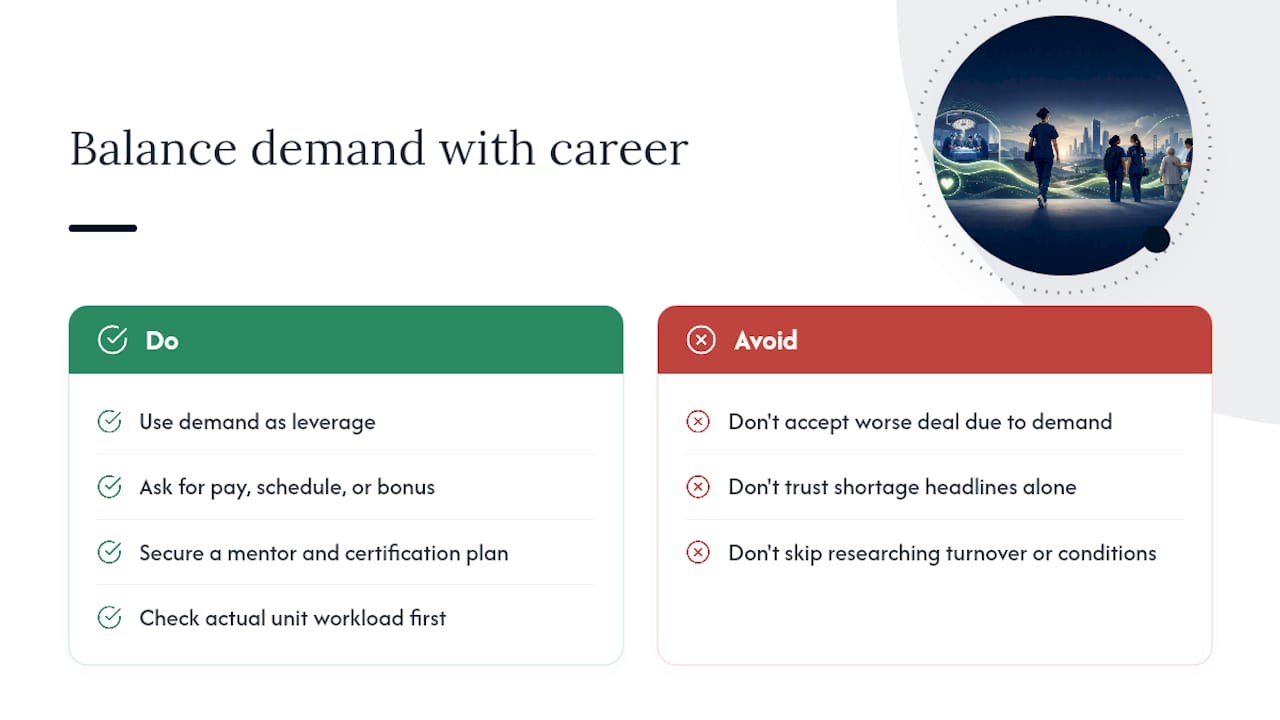
The industry loves to point nurses toward whatever specialty has the loudest shortage headline, but loud shortages usually mean brutal working conditions, not just good pay. Behavioral health is a clear example: demand and turnover both run high, yet pay often lags behind acute surgical specialties facing similar staffing pressure. That gap should factor into your decision as much as the job posting count.
Use demand as leverage, not as a reason to accept a worse deal. A hospital desperate to fill an ICU or ER slot will often negotiate on differentials, schedule, or a signing bonus if you simply ask. Build your transition around a mentor, a real certification timeline, and a clear-eyed view of the actual workload in that unit, not just the salary listed in a job ad. The nurses who last longest in high-demand specialties are the ones who chose them on purpose, not by accident.
— Flexible
How NurseFlex Jobs Helps You Land Specialty Roles Faster
Traditional hiring for high-demand specialties often means weeks of paperwork before you see a single shift. A technology-driven matching platform cuts hiring wait times by matching certifications, availability, and specialty experience directly to open roles in real time, minimizing recruiter back-and-forth.

If you're chasing ICU, ER, OR, or behavioral health openings, browse current specialty listings to see what's hiring now, including telehealth roles if you want flexibility without bedside acuity. Considering a travel contract to build subspecialty hours faster? Check travel nursing opportunities matched to your certifications instead of scrolling generic agency listings. Employers looking to fill urgent specialty gaps can post a remote or specialty role directly. And if you're still weighing your next move, sign up for job alerts so new openings in your specialty land in your inbox the moment they post.
Sources
- BLS — Occupational Employment and Wage Statistics: Nurse Anesthetists, Nurse Midwives, and Nurse Practitioners
- U.S. Census Bureau — Older adults outnumber children (2025 press release)
- PMC — Peer-reviewed article on nursing workforce and shortages
- AACN — Nursing faculty shortage fact sheet
FAQ
What RN specialty is most in demand?
ICU/critical care and emergency nursing consistently top hospital hiring-difficulty lists, largely because of high acuity and staff turnover. Perioperative (OR) and behavioral health nursing follow closely, driven by surgical volume growth and persistent psychiatric staffing shortages.
How to make $200,000 a year as a nurse?
The most realistic path is becoming a CRNA, where median pay runs roughly $223,210 to $236,590 according to BLS data. Reaching that income typically requires ICU experience plus a three to four year doctoral-level anesthesia program.
What is the fastest growing nursing specialty?
Advanced-practice roles like nurse practitioner and CRNA show the strongest projected growth among nursing careers, according to the BLS Occupational Outlook Handbook. At the RN level, ICU, emergency, and behavioral health show the most persistent hiring pressure due to turnover and an aging population.
How to make $300,000 a year as a nurse?
Reaching very high pay typically requires stacking a CRNA credential with senior-level experience, leadership responsibilities, or high-paying travel and locum assignments in markets facing acute shortages. It's an achievable ceiling for experienced CRNAs but sits well above typical RN specialty pay, even with certifications and premiums factored in.
What certifications help the most nursing specialties at once?
Pairing CCRN with CEN gives you the broadest mobility between ICU and emergency roles, since both units share overlapping high-acuity skills. Employers and travel agencies consistently rank dual-certified candidates above single-certified ones for cross-unit assignments.