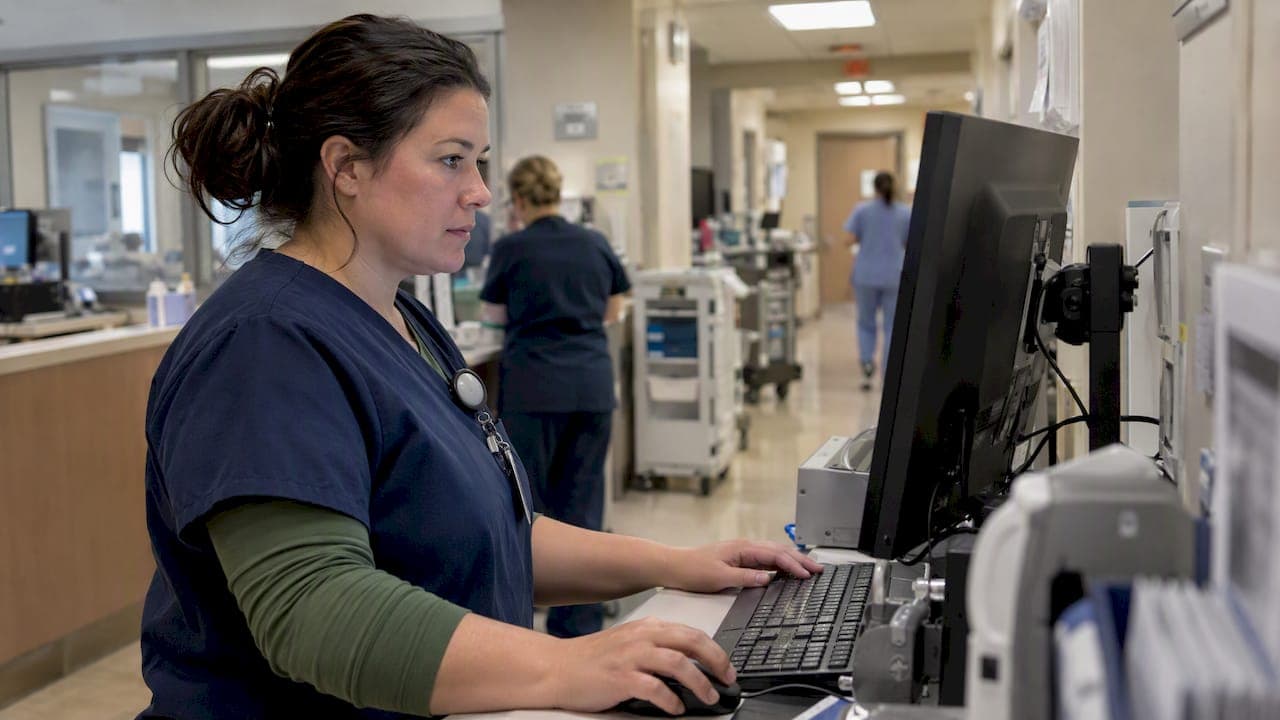
AI now forecasts nurse demand, optimizes rosters, and speeds up hiring by matching candidates to open shifts in real time. None of that guarantees savings on its own. Leaders who pilot the technology and measure results against a queuing-model study and a Columbia Business School pilot get the clearest picture of what to expect.
TL;DR:
- A Columbia pilot cut hourly staffing costs by more than $160, or about $1.4 million annually, in one emergency department while patient flow remained stable.
- AHRQ modeling produced staffing needs of six to nine nurses based on arrival timing and task times from 21.4 to 26.1 minutes, not census alone.
- Demand forecasts need timestamped admissions, transfers, and discharges, plus call light activity and patient acuity scores, because census alone misses shifting workload.
- Pilot results should track labor cost, access, and workforce measures, while managers retain override authority and teams validate performance locally before expansion.
- Evidence on clinical outcomes and nurses’ health over time remains limited, so lower scheduling costs do not prove better care or improved staff experience.
Table of Contents
- How AI forecasts nurse demand
- How AI optimizes scheduling and rostering
- How AI speeds nurse recruitment
- What the research and pilots say
- Practical pilot checklist for AI nurse staffing
- Responsible-use requirements and procurement questions
- Balanced scorecard metrics to track during pilots
- Our take on where AI staffing tools actually help
- Post a shift and match faster with NurseFlex Jobs
- FAQ
- Sources
How AI forecasts nurse demand
Forecasting models predict how many nurses a unit needs, hour by hour, using more than a bed count. Useful inputs include:
- Admissions, discharges, and transfers, each timestamped
- Call-light events and response times
- Historical arrival patterns by day and shift
- EHR-derived acuity scores tied to individual patients
The AHRQ queuing-model study found that arrival timing and nurse service time, measured at 21.4 to 26.1 minutes per task in its scenarios, can shift staffing needs to between six and nine nurses depending on the acceptable delay target. Census alone misses that variation entirely. Common model families for this work include time-series forecasting, LSTM networks, and tree ensembles, chosen based on how much historical data a unit has and how volatile its patient flow is.
How AI optimizes scheduling and rostering
Once a forecast sets the target headcount, an optimization engine builds the actual roster. That engine has to respect constraints a spreadsheet can't track at scale:
- Applicable requirements for consecutive hours and rest periods
- Certification and skills-mix requirements per shift
- Union or contract rules on seniority and shift bidding
- Staff-submitted availability and time-off requests
Solvers typically use mixed-integer programming or heuristic search to find a roster that satisfies those constraints while balancing workload. Some pilots can track fairness, watching whether overtime and weekend shifts land disproportionately on the same nurses.
Pro Tip: Build a manager override button into every AI-generated roster, with a clear escalation path for unsafe or unusual assignments.
How AI speeds nurse recruitment
Matching engines compare structured candidate profiles against open shifts, factoring in skills, licensure, availability, and distance. This is the same logic behind nursing availability matching, where a complete, current profile determines how fast a nurse gets matched to work.
- Credential verification can help check licensure and certifications before a candidate reaches a hiring manager
- Text-based outreach lets candidates apply or confirm interviews without a phone call
- Prioritization logic ranks candidates by fit rather than by submission order
Automation in job placement only works as well as the data behind it. A matching engine fed incomplete or outdated candidate profiles produces the same slow, mismatched results as a manual process, just faster.
What the research and pilots say
The strongest public evidence on AI nurse staffing comes from two very different studies, and both point to the same lesson: measure outcomes locally rather than assume savings.
The Columbia Business School pilot reported hourly staffing cost reductions of more than $160, about $1.4 million a year for one emergency department, while wait times, treatment duration, and patient flow stayed stable and reliance on travel nurses dropped. That result is specific to one emergency department's conditions, not a universal return.
The AHRQ queuing-model study reinforces why census-only staffing rules fall short: modeling arrival rates and service times produced staffing needs ranging from six to nine nurses depending on the delay target a unit was willing to accept. A 2024 scoping review of 10 studies grouped AI's role in nursing into monitoring and prediction, decision support, and communication, which lines up closely with forecasting, rostering, and recruitment automation. The review also noted that evidence on clinical outcomes and long-term staff well-being is still developing, so operational gains in scheduling shouldn't be mistaken for proven clinical benefit yet.

Practical pilot checklist for AI nurse staffing
Running a pilot well matters more than picking the fanciest model. A practical sequence, similar to what a streamlined hiring process requires, looks like this:
- Confirm data readiness. Verify time-stamped admit, transfer, and discharge events, call-light data, and EHR connectivity before testing any model.
- Define pilot scope and metrics. Set a control period, a treatment period, and a balanced scorecard covering cost, access, and workforce outcomes.
- Assign a governance owner. Name who approves manager overrides, handles escalations, and trains staff on the new workflow.
- Run acceptance testing. Validate the model against local test sets, check subgroup performance, and stage rollout unit by unit rather than hospital-wide.
Pro Tip: Keep your control period long enough to capture a representative staffing cycle, including a high-volume weekend if possible, before comparing results.
Responsible-use requirements and procurement questions
The Joint Commission's responsible-use guidance treats AI staffing as an organizational change, not a plug-in tool. It calls for governance structures, staff education, incident reporting, and lifecycle monitoring because staffing outputs can affect patient safety indirectly.
Before signing with any vendor, ask for:
- A description of the datasets used to train the model, including patient population and setting
- Subgroup performance data, broken out by unit type and shift pattern
- Drift monitoring procedures and a plan for model revalidation
- A documented remediation process for when the model underperforms
Retain nurse-manager authority to override any AI-generated assignment that looks unsafe or unusual. Periodic local validation and transparent reporting on tuning steps can help protect patients and build the staffing team's trust in the tool.
Balanced scorecard metrics to track during pilots
A pilot that only tracks labor cost misses half the picture. The Columbia Business School researchers recommend a scorecard covering several dimensions at once.
- Operational: hourly labor cost, agency or travel nurse usage, time-to-fill, overtime hours
- Access and flow: wait times, treatment duration, patients who leave without being seen
- Workforce: turnover, fairness indices, and nurse-reported workload
Burnout research on hypnosis-based interventions has examined how workforce strain affects wellbeing, a reminder that workforce metrics belong in the scorecard alongside cost.
Our take on where AI staffing tools actually help
We built NurseFlex Jobs around matching and we track outcomes the same way the research above recommends, not just fill speed. AI should support a nurse manager's judgment, never replace it. Override authority stays with the people who know the unit.
— Flexible
Post a shift and match faster with NurseFlex Jobs
Running an AI staffing pilot takes time to set up. While you build out your forecasting and rostering models, we help you fill the gaps that show up along the way.

Our platform offers a few ways to move fast:
- Post Your Remote Nursing Jobs and reach nurses who match your open shifts right away
- Use our Free Matching Service to connect with travel and flexible nurses without a lengthy application process
- Get Job Alerts to hear about candidate availability.
Visit our employer page to start a pilot conversation or post your first shift today.
This article is general information, not a substitute for advice from a qualified doctor. Consult a qualified healthcare professional about your own circumstances before acting on anything here.
FAQ
Is there an AI app for nurses?
Some apps use AI for shift matching, scheduling, and credential verification, and NurseFlex Jobs connects nurses with flexible roles. These tools generally support staffing and job search rather than clinical decision-making.
Who are the big 4 AI agents?
There is no single, widely agreed-upon "big four" AI agents specific to nurse staffing. The field includes tools for forecasting, scheduling, recruitment matching, and credential verification, each designed for a different part of the staffing workflow.
What are 5 examples of AI?
In nurse staffing specifically, examples include demand forecasting models, schedule optimization engines, candidate matching algorithms, credential verification tools, and chat-based recruitment communication. Outside staffing, AI also covers image recognition, language models, and robotics, though those aren't the focus here.
What are the 7 main types of AI?
Definitions vary across sources, but a common framework distinguishes AI by capability (reactive machines, limited memory, theory of mind, self-aware) or by function (narrow, general, super). Nurse staffing tools are designed for specific tasks like forecasting or matching, rather than general reasoning.
How does AI reduce reliance on travel nurses?
Better demand forecasting and faster internal matching can help fill open shifts with staff or flexible nurses already in the system, a potential benefit of on-demand staffing. The Columbia Business School pilot found this approach reduced travel nurse reliance while keeping patient flow stable.
Sources
- AI-Driven Nurse Staffing Can Cut Costs and Maintain Patient Access, New Columbia Business School Study Finds | Columbia Business School
- Final Progress Report: Exploratory Study Using Queuing Theory To Improve Nurse Staffing Effectiveness
- Responsible Use of AI in Healthcare | Joint Commission
- Pubmed