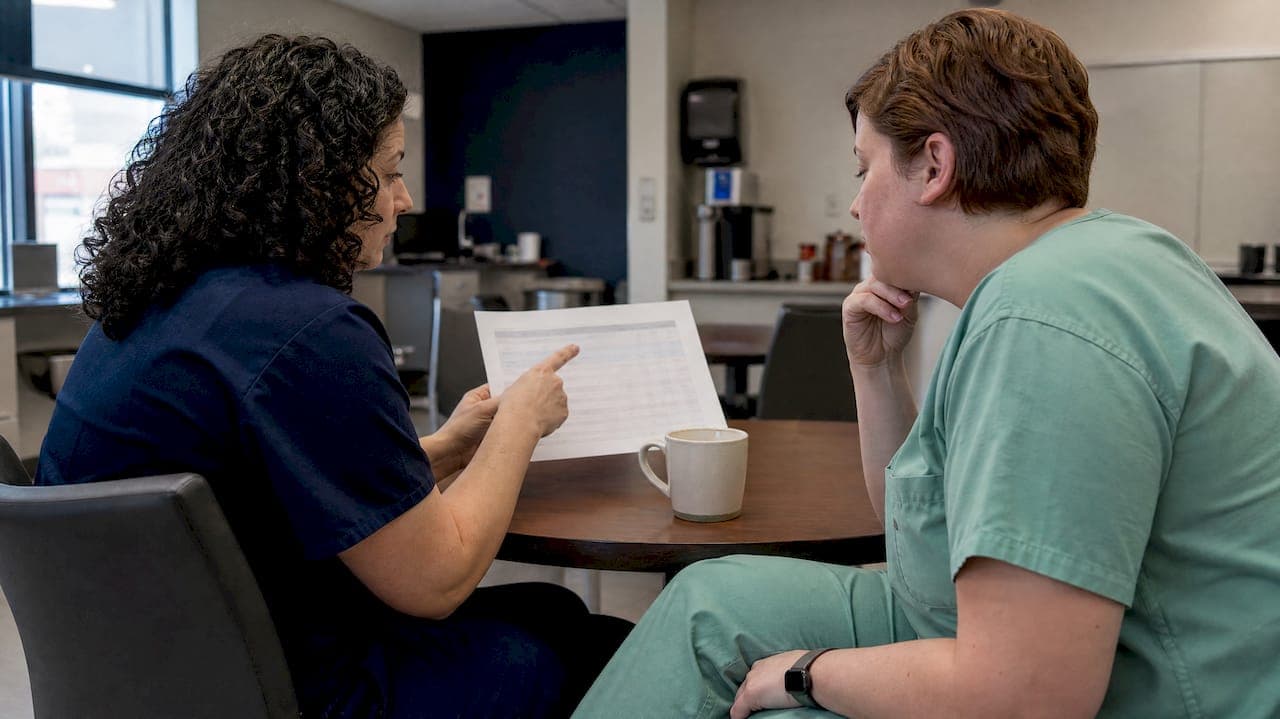
Holiday staffing in nursing comes down to one question: who covers the shifts when most people want to be home? The answer that works is a plan made early. It uses a fair rotation, a flexible pool of per diem and travel nurses, and firm limits on overtime. If you are a nurse, this guide shows how holiday shifts are filled and how to choose your own. If you manage a unit, it shows how to close gaps before the scramble.
TL;DR
- Hospitals run around the clock, so nights, weekends and holidays are a normal part of hospital nursing. Coverage needs a plan, not a last-minute phone tree.
- Off-shift periods carry real risk. A systematic review of the off-shift literature links them to lower staffing and poorer patient outcomes.
- The ANA says mandatory overtime is not an acceptable staffing solution. A flexible pool is the safer fix.
- Nurses can use holidays as leverage. Ask about premiums in writing and pick up per diem or travel shifts on your terms.
Table of Contents
- Why holiday shifts are hard to fill
- How hospitals fill holiday shifts today
- A holiday staffing timeline for nurse managers
- Why a flexible pool beats the scramble
- Our perspective
- For nurses: how to approach holiday shifts
- Find holiday and flexible nursing work with us
- FAQ
- Sources
Why holiday shifts are hard to fill
Patients do not stop arriving on December 25. Emergency departments, ICUs, labor and delivery and med-surg units need full coverage every day of the year. Staff, meanwhile, ask for the same few days off.
The result is a predictable squeeze. Vacation requests stack up around Thanksgiving, Christmas and New Year's. Sick calls rise with the winter illness season. A single late call-out on a short-staffed unit can push a manager into dialing through a list of names.
A 2024 article in Daily Nurse describes the holiday scramble as the product of long-term planning failures plus urgent personal crises. That matches what many managers report: the crisis on the day is usually the result of decisions made weeks earlier.
What the evidence says about off-shift risk
The review of off-shift research looked at nights, weekends and holidays in hospitals. It found evidence that outcomes, including mortality, can be poorer for patients admitted during these periods than on a weekday day shift. It also tied off-shift work to nurse fatigue.
This is why holiday staffing is a patient safety issue and not only a scheduling chore. Thin coverage, unfamiliar staff and tired nurses make a poor combination.
The regulatory climate is moving the same way. The Joint Commission's National Performance Goals for hospitals, effective January 2026, include a new goal on being staffed to meet patient needs with competent staff. Holiday coverage is where that goal gets tested.
Facility readiness is more than headcount
Holidays also change how buildings run. Some units close or run at low census for days, then reopen to a surge. Water systems, equipment and supplies need attention when use drops and then jumps. A UK-based compliance firm explains why Legionella risk management matters for immunocompromised patients. Its rules are British, so U.S. teams should follow their own infection prevention and facilities requirements. The point still holds: a staffing plan works best when it sits next to an environment-of-care plan.
How hospitals fill holiday shifts today
Most facilities use a mix of the following.
| Method | How it works | Main weakness |
|---|---|---|
| Fixed holiday rotation | Staff work a set number of holidays per year, or alternate major holidays | Needs strict fairness rules, or resentment builds |
| Voluntary pickup with a premium | Extra pay for those who sign up | Can be costly and may still leave gaps |
| Mandatory overtime | Staff are held over or called in | Raises fatigue and turnover, and the ANA opposes it as a solution |
| Internal float pool | Cross-trained staff move between units | Limited by pool size and competencies |
| Per diem and PRN nurses | Nurses who pick up shifts as needed | Needs advance onboarding and clear orientation |
| Travel nurses | Contract nurses on 8 to 13 week assignments, typically | Planned months ahead and not suited to last-minute gaps |
Many hospitals still rely on manual phone trees for sudden gaps. The Hartford Hospital work on emergency department scheduling describes how labor-intensive these manual methods are and why better tools matter.
What better scheduling can do
A 2024 study at Hartford Hospital applied optimization models to ED nurse scheduling over six-week cycles. It found automated scheduling could cut workload on weekends and holidays by 17% and 14% while improving nurse satisfaction. That is one hospital's emergency department, so treat the numbers as a signal, not a promise for your unit. The direction is clear: fair, planned schedules beat patched ones.

A holiday staffing timeline for nurse managers
Work backward from the holiday. This timeline fits most acute care units.
- Four to six months out: Publish the holiday rules. State how many holidays each nurse works, how requests are ranked and how swaps are approved. Rules posted early cut disputes.
- Three months out: Collect requests in one window. Close it on a set date. First come, first served rewards the loudest, not the fairest.
- Ten to twelve weeks out: Post the draft schedule and measure the gaps by shift, unit and skill. Count how many RNs with each competency you need.
- Eight weeks out: Open gaps to your per diem and PRN pool first. These nurses already know your unit, which shortens orientation.
- Six weeks out: Add travel or contract nurses for gaps that remain. Credentialing and onboarding take time, so do not wait.
- Two weeks out: Set up a standby list with names, phone numbers and the order to call. Agree on who decides.
- During the holiday: Check census every shift. Release or add staff based on real numbers.
- After: Review what happened. Which gaps were predictable? Which rules caused friction? Fix them before spring.
For winter surges specifically, see our guide on cutting winter surge staffing costs.
Keep fatigue limits in the plan
Holiday pressure tempts managers to stack extra hours. The ANA's staffing principles call for institutions to set policies on shift length, meal breaks and rest periods to protect nurses and prevent fatigue-related errors. They also say mandatory overtime should not be the answer.
If your team debates shift length, read 8 vs 12 hour shifts for nurse leaders. If your state has meal and rest break rules, the guide on break coverage laws covers how to plan for them.
Count the real cost
The cheapest hourly rate is not always the cheapest option. The ANA advises administrators to look beyond base wages to turnover, fatigue-related errors and the cost of adverse outcomes when inadequate or inexperienced staff cover off-shift hours. A nurse who burns out after a forced double on Christmas is a cost that shows up in resignations in February.
Why a flexible pool beats the scramble
The Daily Nurse piece argues that a pre-vetted flexible workforce can supplement core staff and ease the holiday anxiety managers feel. It also reports that well-run flexible programs can reach fill rates as high as 95% without premium holiday bonuses. The reason given is trust: per diem nurses who already work at a facility know the people and the routines. Treat that figure as one source's finding, not a guarantee.
Three things make a flexible pool work:
- Pre-vetting. Credentials, references and competencies are checked before the holiday, not during it.
- Familiarity. Nurses who have worked your unit before need less orientation and make fewer mistakes.
- Speed. When a gap opens, you can reach qualified nurses by real-time alert instead of a phone tree.
To see what per diem roles look like in practice, browse these PRN nursing position examples across settings. If you are setting up the pool, the guide to per diem minimum hours explains the 4 to 12 hour rules that affect pay and booking.
Our perspective
We run a job platform that matches nurses and healthcare professionals with flexible work by skills, availability and preferences. Hospitals and facilities pay for postings or placements. Nurses do not pay to use it.
Here is what that model teaches us about holiday staffing.
Holiday gaps are a matching problem. Most units have nurses nearby who would work a holiday for the right pay, the right shift and the right notice. Managers often cannot find them fast enough. Matching by availability and skill closes that distance.

Early beats expensive. A gap posted eight weeks ahead is easier and cheaper to fill than one posted two days ahead. We encourage facilities to list holiday needs as soon as the schedule shows them.
Nurses should name their terms. A holiday shift is leverage. Say which days you will work, which you will not, and what you need in return. Good facilities respect clear limits.
Flexibility serves both sides. Nurses who control their schedules tend to stay engaged. Facilities that offer flexible roles keep experienced people they would otherwise lose. Our guide to making flexible nursing schedules work lays out how.
We do not claim a platform replaces good scheduling policy. It adds reach to a plan that already has fair rules and safe limits.
— Flexible
For nurses: how to approach holiday shifts
Know the pay before you say yes
Holiday pay varies by employer and contract. Some pay time and a half, some pay a flat premium, and some pay nothing extra. Ask four questions in writing:
- Which days count as holidays?
- Is the premium applied to base pay only, or to shift differentials too?
- Does the premium apply to per diem and travel contracts?
- Is there a minimum number of hours?
For reference, BLS reports that the median annual wage for registered nurses was $97,550 in May 2025. Holiday premiums sit on top of base pay and differ by facility, so compare the offer, not the average.
Choose how you work holidays
- Staff nurse: You usually follow a rotation. Learn it early and trade shifts with a colleague who prefers a different day.
- Per diem or PRN: You pick up the shifts you want. You can work a holiday for the premium, or skip it with no penalty, depending on the agreement.
- Travel nurse: Your contract states holiday expectations. Read it before you sign, because the assignment may require holiday shifts.
- Weekend or alternate-schedule roles: Some nurses choose set patterns that avoid unpredictable calls. See weekend nursing job benefits.
- Remote roles: Telehealth and other remote jobs may still need holiday coverage, but the work comes without a commute. Our guide to controlling nursing work hours remotely shows how.
Not sure which setting suits you? Compare nursing practice environments.
Protect your time off
If holiday work means missing family events, plan around it. Celebrate on a different day. Block recovery time after a run of shifts. The guide to balancing your nursing career and family obligations has practical ideas.
If you feel pressured to work beyond safe limits, say so. The ANA position is that mandatory overtime is an unacceptable staffing solution. Raise it with your manager first, then your nurse staffing committee or HR. A union representative can help if you have one.
Find holiday and flexible nursing work with us
If you want holiday shifts on your terms, or work that avoids them, start with our free matching service for travel nursing jobs. You can also set up job alerts so new openings reach you quickly. If you prefer to work from home, browse telehealth nursing jobs, or look at case management, utilization review and other specialty roles.
Facilities with holiday gaps can post jobs here and reach nurses looking for flexible work.
FAQ
Do nurses have to work holidays?
Not always, but in hospitals it is common. BLS notes that nurses in hospitals and nursing care facilities usually work in shifts and may work nights, weekends and holidays. Outpatient, clinic and some remote roles often have fewer holiday duties. Check the schedule policy before you accept any job.
Can a hospital force a nurse to work a holiday?
That depends on your employer, your contract and your state's law. The ANA states that mandatory overtime is an unacceptable staffing solution, but that is a professional position, not a law everywhere. For your specific situation, ask your HR department, union representative or a state nursing association.
How can a unit fill holiday gaps quickly?
Start with your own per diem and PRN nurses, then widen to contract staff. Have a standby list with a clear calling order. Pre-vetted flexible nurses are the fastest option, because credentials and orientation are already done. Do not rely on overtime as the first move.
Do per diem nurses get holiday pay?
It depends on the facility and agreement. Some pay a premium and some do not. Ask in writing before you accept the shift, including whether the premium covers base pay only.
Sources
- Registered Nurses, Occupational Outlook Handbook, U.S. Bureau of Labor Statistics
- Twenty-four/seven: a mixed-method systematic review of the off-shift literature
- Principles for Nurse Staffing, American Nurses Association
- Optimization Automates Emergency Department Nurse Scheduling at Hartford Hospital
- Data Shows Flexible Nursing Workforce Can Fill Dreaded Summer and Holiday Staffing Gaps, Daily Nurse
- Nurse Staffing Identified as New Joint Commission National Performance Goal, AACN